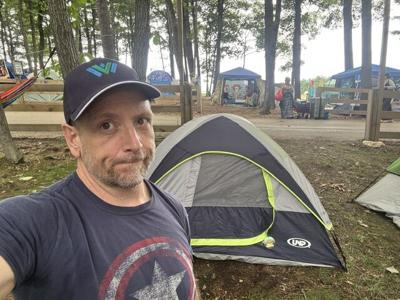
Columnist Bill Lynch tests out some of the things he's practiced over the last couple of months at FloydFest in Floyd, Virginia. Shown here on July 23, 2026, did great with talking to random strangers. He did less great with sleeping in a tent.
Columnist Bill Lynch tests out some of the things he's practiced over the last couple of months at FloydFest in Floyd, Virginia. Shown here on July 23, 2026, did great with talking to random strangers. He did less great with sleeping in a tent.
BILL LYNCH | For HD Media
I place the tent under the trees, near a break in the fence. On the other side, festivalgoers in various shades of groovy regalia (or just T-shirts and shorts) walked past on their way to and from the music somewhere at the bottom of the hill.
The tent looked pretty good to me, even though it took me two tries to position the rainfly correctly.
Inside, my sleeping bag covered an inflatable mattress pad. My favorite pillow rested at the head of the camping mattress. I had a fully charged lantern and a headlamp, in case I needed to go find a porta-john in the middle of the night. My clothes, a jug of water and a freshly opened can of bug spray were piled in a corner, along with my backpack, some recording gear and earplugs.
“Not bad,� I thought. “This will be fine.�
Then, I grabbed my digital recorder and tramped down the hill, past the sea of tents. I went off to talk to more strangers.
Testing out stuff
I don’t always get the chance to apply the things I’ve learned during my One Month projects, but going to FloydFest — an outdoor music festival in Floyd, Virginia — seemed like a great opportunity to see whether I’d made any progress over the summer.
Going to FloydFest to talk to people about Appalachia was a project for “Inside Appalachia,� one of the radio shows I produce for West Virginia Public Broadcasting. It's also available as a podcast.
FloydFest has been around for about 25 years, and it is situated in the mountains of Appalachia, in a place that seemed like it might be friendly toward conversations about place and identity.
But the festival is a three-hour drive from ÂÒÂ×ÄÚÉä, which all but required that I camp if I wanted to get anything done. In preparation for the trip, I’d spent much of June working on getting better acclimated to tent camping. Results had been mixed, but I felt more confident about pitching a tent in a campground, if not the actual wilderness.
July was about learning to more effectively talk to strangers. Specifically, I’d talked to almost random strangers in ÂÒÂ×ÄÚÉä. That seemed like good practice if I hoped to talk to a lot of strangers.
Some of what I learned
I expected talking to strangers would be harder. I thought people would be more reserved, more guarded, and likely to tell me to scram.
They didn’t.
People in ÂÒÂ×ÄÚÉä were uniformly warm and genial. Nobody gave me any grief.
But I also expected I wouldn’t learn much.
I’d thought my conversations would be superficial and awkward, like small talk at a company picnic. I imagined the conversation would be about common things like the weather, or whatever was happening in the area on a given day. If I was lucky, I thought, we’d steer clear of politics and religion, the thorniest of topics to tackle even with friends.
But the subject of God or President Donald Trump never came up. Everyone was generous with their lived experiences and wisdom.
One stranger I spoke with in ÂÒÂ×ÄÚÉä, Keith Beverly, said that maybe we all can go home again.
As a kid, Keith had wanted nothing more than to be rid of ÂÒÂ×ÄÚÉä, and he left the first chance he got. When he came back, he realized there was a lot here for him. He decided he wanted to try to bookend his life by beginning and ending with the people who loved him best.
Patrick Nelson told me about falling in love young and growing — as a person — with his wife.
As a guy who has been divorced a few times and involved in a couple of unpleasant breakups, I couldn’t help but envy that kind of luck.
Elizabeth Miller told me about embracing the new and leaning into your talents. She started a cottage bakery this spring after her husband's friends (and probably others) told her how good her sourdough bread was. She’d only been baking it since around Christmas 2025.
Hector Falcon astounded me. He’d turned himself into a long-distance runner in his mid-20s and within a few years had become one of the fastest men in the city and probably in West Virginia.
Why were people so open?
While I thought finding people to talk with might be like pulling teeth, I hadn’t had any trouble. Not everybody I spoke with was absolutely lucid or sober, but everyone I’d approached had been willing to give me a minute or two of their time.
In ÂÒÂ×ÄÚÉä, I thought I might have some advantage in finding people because my silly face (and comic book T-shirt) has appeared in the local newspaper hundreds of times. I work for a media company and have been part of television and radio projects.
I’m not a big deal. I’m just kind of small-town famous. But nobody knew me from anything I did.
Even Patrick, who said he recognized me, really just knew me as some guy on Facebook.
So I can’t say for sure why anybody talked to me, other than maybe they took me at my word.
I wasn’t there to convince them of anything. I wasn’t trying to sell anything or get anyone to do anything other than just tell me a little about themselves.
And maybe people were just glad that someone was interested.
At FloydFest
At the festival, I wandered around without a map or a particular idea of where I needed to go. At first, I just stopped people who happened to make eye contact with me. Later, I sought out folks who were doing something interesting.
I talked to a woman painting a mural. I interrupted a man who was meditating on a stump. I chatted with inebriated people, a pair of grandparents who were babysitting a toddler and a couple of people who’d turned trash bags into rain ponchos.
I talked to anyone who would talk to me, which turned out to be anyone I approached.
For about six hours, I had small conversations about who people thought they were, where they were from and what they thought that meant.
I had the best time — except for the camping.
The tent had gone up without a hitch, but I chose my campsite poorly. I’d picked out a space that was a short walk to the bathrooms, the showers and someplace that sold hot coffee.
I’d set up next to a fence without thinking too hard about why the fence was there.
The fence separated the campground from a road. I’d watched people hike up and down that road as I came in. What I’d failed to notice were the side-by-side ATVs that also used the road.
FloydFest offered complimentary shuttle services from the campground to different points within the festival grounds. Services started early in the day and continued on until the Monster Energy drinks ran out, apparently.
One day, I’ll get better at this, just not right away.
Moving on
Every now and again with these One Month projects, I hit on something I want to keep doing. That’s how I ended up learning how to roll sushi and make pies. That’s how I wound up becoming a regular at CrossFit WV and an occasional dancer for ÂÒÂ×ÄÚÉä Ballet.
I enjoyed all of the random conversations this month. I liked them so much I thought I’d keep doing them for a while and just post them to a blog, called Small Town Famous.