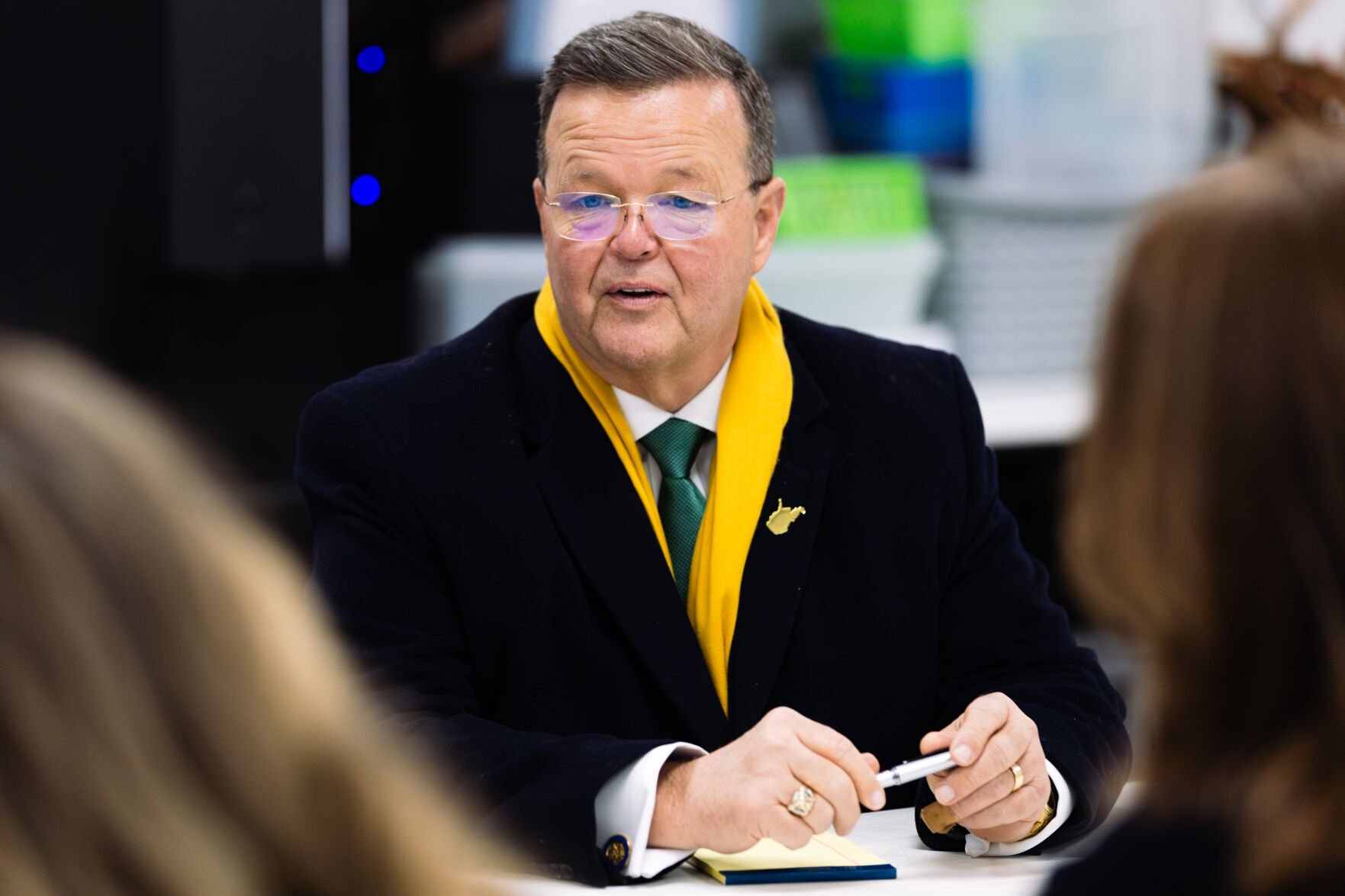
West Virginia Secretary of State Kris Warner speaks to leadership from Ridge Kids Academy in Barboursville during a visit on Jan. 15, 2026, in Barboursville.
West Virginia Secretary of State Kris Warner speaks to leadership from Ridge Kids Academy in Barboursville during a visit on Jan. 15, 2026, in Barboursville.
RYAN FISCHER | HD Media
The West Virginia Secretary of State's Office is at odds with the Trump administration and its Department of Justice over the release of sensitive information belonging to nearly 1.2 million Mountain State voters.
This comes after the DOJ last May demanded that nearly every state and the District of Columbia provide detailed election-related records, but those requests may violate state and federal laws.
Since then, the DOJ has reportedly sued more than 20 states to force them to release the data, which they say is to check compliance with the National Voter Registration Act of 1993.
According to the Brennan Center for Justice, an independent, nonpartisan law and policy organization based at the law school at New York University, the U.S. Constitution details that Congress sets rules for federal elections, but in practice, states manage all aspects of elections in their states.
West Virginia Secretary of State Kris Warner understands that.
“West Virginians entrust me with their sensitive personal information," Warner said in a news release Wednesday. "Turning it over to the federal government, which is contrary to State law, will simply not happen.
“State law is clear: voter lists are available in a redacted format from my office, but I'll not be turning over any West Virginian's protected information," Warner said.
How we got here
According to correspondence provided by the SoS, the DOJ has asked twice since last September for detailed voter information including voter registrants' full names, date of birth, address and either their driver's license number or the last four digits of their social security number.
After the first request, Warner's office directed the DOJ to publicly available information, which does not include driver's license numbers or partial social security numbers.
Publicly available voter information includes name, residence address, party affiliation, voting status (active or inactive) and registration date. The information is not free or online but can be purchased through the SoS office via a form at bit.ly/WV_VoterInfo_RequestForm.
According to the SoS, the DOJ, in a letter dated Feb. 4, asked for the information for the second time, and for confirmation that the SoS position from September had not changed. Warner responded on Feb. 11, saying the justification made by the DOJ for the personally identifying information did not have legal standing.
"Our office performed a thorough review of [the DOJ's] cited statues,� the SoS letter to the DOJ says, in part, "none of which require compliance with such a broad request."
The DOJ said on Friday that the information is critical to check for ineligible voters.
"Congress gave the Justice Department authority under the NVRA, HAVA, the Civil Rights Act, and other statutes to ensure that states have proper voter registration procedures and programs to maintain clean voter rolls containing only eligible voters in federal elections,� a DOJ spokesperson said in a statement Friday. “The recent request by the Civil Rights Division for state voter rolls is pursuant to that statutory authority, and the responsive data is being screened for ineligible voter entries.�
The Secretary of State’s Office said in its Wednesday news release that in the last nine years, more than 408,000 outdated, abandoned, out of state or otherwise ineligible voter registration records have been cleared from the state’s database. At the same time, more than 350,000 new voter registrations have been added to the rolls.
What's next
Different states have handled the DOJ request in different ways. Some have provided the requested information. Some, like West Virginia, have directed the DOJ to publicly available information. So far, The DOJ has sued 22 other states to get the extra information.
A DOJ spokesperson would not comment Friday on potential future litigation against West Virginia. However, federal judges are already ruling against the government on the matter.
On Tuesday, a Trump-appointed federal judge dismissed the DOJ's lawsuit against the Michigan Secretary of State who also refused to turn over voters' personal data. The judge ruled that no federal law, including the Help America Vote Act, National Voter Registration Act, or Civil Rights Act of 1960, give the DOJ authority to demand and receive states' unredacted voter registration files. Judges in Oregon and California have made similar rulings.
"The leadership of the DOJ has been on the national news threatening that they're coming after everyone," Warner said Thursday. "We responded with what we're willing to provide based on West Virginia law. What has changed is it's now the acting chief demanding that info and we've come to an impasse."
Warner said his office's decision was an easy one to make.
"When was the last time you heard of a police officer trying to enforce the law by pulling someone over for driving the speed limit," Warner said. "We're not breaking the law."
Christopher Millette is the Editor of the ÂÒÂ×ÄÚÉä Gazette-Mail. He can be reached at 304-348-5124 or cmillette@hdmediallc.com. Follow him on X: @cmillette.