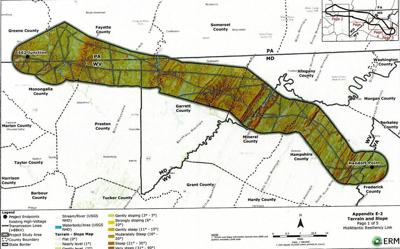
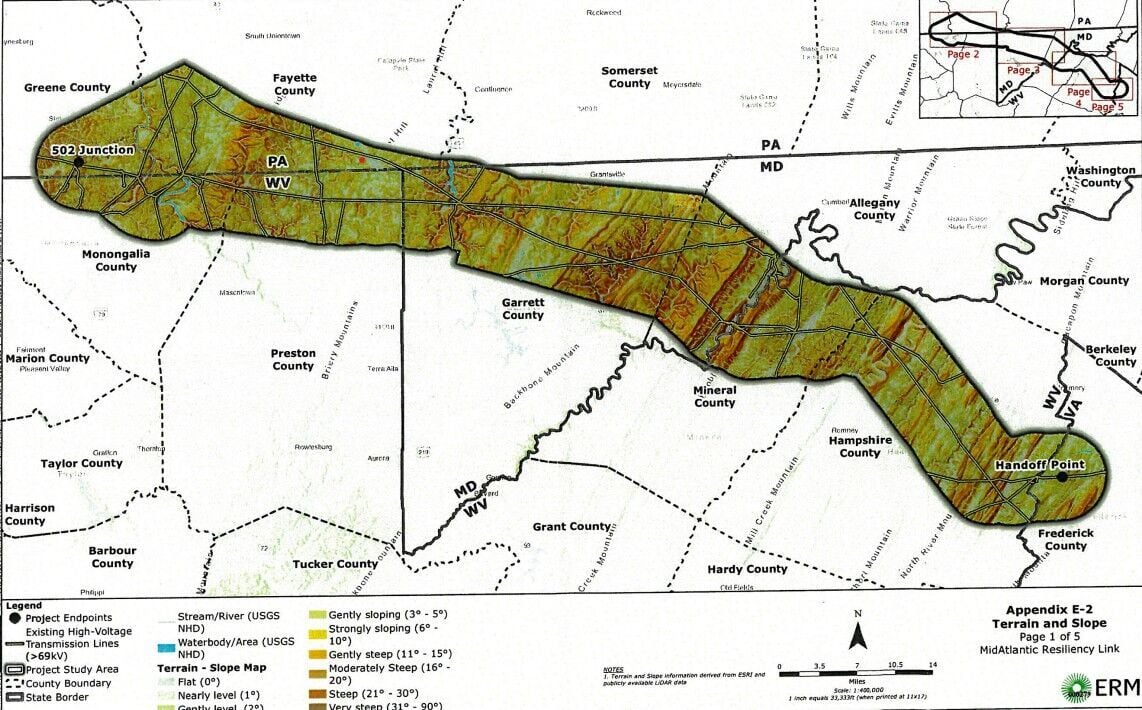
This project map was submitted in an application filed with the West Virginia Public Service Commission by NextEra Energy Transmission MidAtlantic for approval of its MidAtlantic Resiliency Link electric transmission line project.
This project map was submitted in an application filed with the West Virginia Public Service Commission by NextEra Energy Transmission MidAtlantic for approval of its MidAtlantic Resiliency Link electric transmission line project.
West Virginians have spoken out against a regional power transmission line planned to cross the state in overwhelming numbers.
As of Wednesday, 4,470 out of 4,586 written public comments the West Virginia Public Service Commission has received on NextEra Transmission MidAtlantic Inc.’s planned $1.16 billion MidAtlantic Resiliency Link project since August have opposed the venture.
That’s 97% of commenters against the project, which NextEra has projected will result in electricity rate increases for customers not only in Mon Power and Potomac Edison territories that would be crossed by the power line but Appalachian Power and Wheeling Power territories as well.
In just the first two days of June, the PSC received 24 petitions to intervene in a case in which NextEra is seeking regulatory compliance certification from the agency for the planned 107.5-mile, 500-kilovolt transmission line to cross parts of Pennsylvania, Maryland and Virginia in addition to the Mountain State. The West Virginia segments of the project known as MARL are slated to consist of 59 miles of transmission line and related facilities in Monongalia, Preston, Mineral and Hampshire counties.
Jonathan Trueblood was one of Monday’s petitioners, writing the project would “consum[e’]� and “decimat[e]� his 200-year-old barn and apple orchard in the Hampshire County hamlet of Capon Bridge. Trueblood expressed concern about the project’s potential impacts on the land, native animals and farm animals. Chemicals from project weed and foliage management would damage the ground waterways serving the property while utility rates would grow for electric power being delivered elsewhere, Trueblood predicted.
Maya Mier-Thomas and Charles Thomas, landowners in Monongalia and Preston counties, filed a petition to intervene reporting owning pieces of property that would be negatively impacted by the project, fearing transmission line installation would bring environmental health ruin via broadly sprayed herbicides, deforestation and power support for water-guzzling data centers that reduce the area’s water access while pushing utility bills up and property values down.
NextEra proposed “an appallingly low offer on the property,� the pair reported, adding that the company told landowners they need to support its project or their electricity would be “browned/blacked out� and threatened them with eminent domain.
In a protest letter filed Monday, Paul Porter of Morgantown reported the MARL line would cost him both his dwelling and only investment property.
“This will ruin my family,� Porter wrote.
In a phone interview ahead of PSC public comment hearings on the project slated to begin Thursday, Kaitlin McCormick, senior director of development at NextEra affiliate NextEra Energy Transmission LLC attempted to counter the thousands of protest letters in part by citing just three letters: P, J and M.
McCormick noted that PJM Transmission LLC, the regional electric grid operator serving West Virginia, 12 other states and the District of Columbia, had recommended the MARL project to benefit the grid amid what is widely expected to be future strain brought on by power-hungry data centers and other demand sources.
PJM was mentioned 65 times across 84 pages of written testimony from McCormick filed in the case before the PSC in January.
“There are many people [who] understand and realize that we all want to keep the lights on those really brutally hot days, make sure the air conditioning is working,� McCormick told the Gazette-Mail by phone.
But there’s evidence to suggest that grid constraints might not be as severe as PJM and other project proponents have anticipated.
Demand forecasting uncertainty
PJM signed off on the project in December 2023, and NextEra’s filing application includes testimony from PJM transmission planning director Sami Abdulsalam noting a PJM projection that the grid is at risk of voltage violations that could result in system collapse and blackouts due to high energy demand for 2027 and 2028 study years.
But NextEra committed to an in-service date of Dec. 31, 2031, well beyond those study years, adding in a filing that it’s working to accelerate the in-service date to December 2029 or earlier to meet PJM reliability needs.
Abdulsalam testified that the 2022 competitive solicitation process through which PJM designated NextEra to build, own and maintain transmission improvements to address projected reliability violations throughout the region was driven by an increase in expected demand growth. Behind that growth was new data center demand proposed in Maryland and northern Virginia, Abdulsalam testified, naming regional constraints to support high regional power transfer flows as a reliability factor.
But demand forecasting uncertainty has loomed over PJM’s data center growth, and data centers have been increasingly expected to bring their own capacity. In its 2026 Long-Term Load Forecast Report, PJM renewed its prediction of substantial growth in electricity demand over the next 20 years but decreased the expected demand increase for near-term years compared with last year’s report.
PJM projected decreases from its 2025 long-term forecast of 2.8% in 2027, 3.8% in 2028, 3.9% in 2029, 4.3% in 2030 and 2.3% in 2031.
NextEra filed PSC testimony in January that MARL retail rate impacts for Mon Power and Potomac Edison would include projected 5% and 5.2% decreases in megawatt-hours comprising annual system-wide sales from 2023 to 2036, respectively.
NextEra’s application comes amid PSC consideration of another regulatory compliance certification request from Mon Power and Potomac Edison for a $2.47 billion gas-fired power plant project that they warn will push customer rates upward, with potential additional costs looming.
Mon Power and Potomac Edison in February filed an application with the PSC seeking approval of a 1,200-megawatt combined-cycle gas turbine-powered plant at Mon Power’s Fort Martin site in Monongalia County with an expected commercial operation date of Dec. 31, 2031 — the same day as the projected in-service date for the MARL project.
As it is with MARL, projected demand growth from data center development is a key driver of the gas plant project — with fears of cost burdens that could result regardless of whether that development materializes.
Intervening parties in that case have criticized Mon Power and Potomac Edison for what the intervenors say is the companies’ overreliance on expected demand from a single data center to justify the project.
David Dismukes, a Baton Rouge, Louisiana-based consulting economist with the Acadian Consulting Group, a research and consulting firm that focuses on regulated and energy industries, testified in written gas plant case testimony that the degree to which new Mon Power and Potomac Edison generation ultimately meets new demand instead of being dispatched into the wholesale market as excess capacity “hinges almost entirely on the siting and interconnection decisions of a few data centers whose plans remain uncertain and subject to change.�
“While the Companies emphasize the market risks associated with capacity shortfalls and the potential benefits of owning excess generation capacity, they do not sufficiently acknowledge that market risk runs in both directions,� Dismukes testified as a witness for the West Virginia Consumer Advocate Division, an independent arm of the PSC charged with representing residential ratepayers. “Operating with excess capacity introduces its own set of market risks for ratepayers, mainly, exposure to wholesale price volatility.�
The result of revenues falling short of projections, Dismukes testified, is higher costs that “fall entirely onto ratepayers, not shareholders.�
Ratepayer burdens are slated to grow under NextEra’s plan. In a March 4 filing, NextEra indicated the project would result in annual increases of 0.1% for average residential customers of Appalachian Power and Wheeling Power each year from 2032 through 2036, corresponding with bill hikes ranging from $0.17 to $0.18 in that span for use of 1,000 kilowatt-hours per month.
Residential customers of Appalachian Power and Wheeling Power also would see estimated rate increases ranging from 0.01% to 0.07% from 2026 through 2031, per the filing.
Mon Power and Potomac Edison residential customers would take a greater hit, with estimated increases ranging from $1.02 to $1.12 (0.74% to 0.81%) per month for 1,000 kilowatt-hours from 2032 through 2036 after changes ranging from $0.14 (0.1%) to $0.84 (0.61%) annually from 2026 through 2031.
Property seizure threat looms
NextEra submitted testimony in January indicating there were 241 private owners in West Virginia of 279 deeded properties along the proposed route for West Virginia portions of the MARL project. NextEra reported acquiring easement option agreements from the landowners of 40 private owners of the 279 deeded properties.
NextEra testimony in January noted the company would “promptly file to obtain rights of entry and condemnation authority� if it was “forced to seek to obtain� needed rights-of-way via eminent domain after failed voluntary negotiations.
McCormick declined to tell the Gazette-Mail how often NextEra expects to have to try to seize property from nonconsenting owners, instead noting the company has a goal of 100% voluntary participation from individuals and saying it has a “robust land agent team� working with landowners.
Requirements in a NextEra Energy Transmission code of conduct for all internal and external land services staff include getting permission to enter property for surveying, conducting environmental assessments or other activities, respecting the party’s wishes if asked to leave the property, sending written communication when an agreement has been reached to ensure accuracy, and keeping all communications with property owners and occupants confidential.
McCormick said NextEra has conducted market studies for each of the counties along the route and is working at or above fair market value for easement areas. But McCormick declined to specify any such values, saying they depend on individual cases and easement areas.
McCormick also declined to say what chemicals NextEra has been working with for managing vegetation, referring to a project vegetation management fact sheet that did not specify any chemicals.
The fact sheet noted low-growing vegetation and compatible trees, usually under 15 feet, are permitted in the transmission line “wire zone,� with larger compatible trees, typically under 25 feet, allowed to grow within the “border zone.�
Mon Power and Potomac Edison customers would cover $490 million in costs, $170 million of which would fall to residential customers, with Appalachian Power and Wheeling Power customers being on the hook for $82 million, including a $25 million hit for residential customers, according to the firm.
The total acreage for the West Virginia portions of the proposed route would be 1,769 acres based on a 200-foot right-of-way width.
The project’s critics say West Virginia won’t benefit enough from expected transport of electricity through the state to northern Virginia’s cluster of data centers to make the project worth the cost in the Mountain State.
The West Virginia portions of the proposed route would cost about $482.7 million, including siting, engineering, construction, procurement, financing, administration, development, legal costs, escalation contingency and taxes. NextEra warned that its estimate is subject to change through construction and other variable factors.
NextEra has asked the PSC to determine that it is a public utility but contended its rates are subject to exclusive jurisdiction of the Federal Energy Regulatory Commission, given that agency’s purview over interstate wholesale transmission service.
Project costs would be recovered through NextEra and a Virginia affiliate company’s transmission rates and allocated to demand-serving entities under a PJM FERC-approved tariff, per NextEra’s application.
McCormick said West Virginia would “benefit directly� from the project, which a company fact sheet states would generate an annual $1.2 million to Hampshire County, $350,000 to Monongalia County, $725,000 to Preston County, and $300,000 to the state of West Virginia in combined tax revenue.
“The way that this project is done, it reflects the shared regional reliability benefits and the modernization that we need to help make sure that we're continuing to deliver safe, reliable electricity to people for generations to come,� McCormick said. “This project is needed now because the grid is under stress, and we can't wait for the grid to fail to fix it.�
But unlike tax revenue or power cost projections, the fear West Virginians have expressed to the PSC about the project pervading their neighborhoods doesn’t come with a price tag.
In a comment filed with the PSC Monday, Sarah Haynes said her family had donated a conservation easement on property in the Augusta area of Hampshire County to the Cacapon and Lost Rivers Land Trust, a Cacapon and Lost Rivers watershed protection nonprofit.
Haynes lamented that if approved, the MARL right-of-way would sit on the family’s mountainside property line, and that deforestation of the mature hardwood forest and subsequent right-of-way maintenance would pierce an unbroken stretch of forest and “destroy valuable wildlife habitat and beautiful rock outcroppings that are visible and enjoyed for miles around.�
“The visual and environmental blight associated with this project will degrade the value of our forest,� Haynes wrote, “and our enjoyment of our property in every way.�
CLICK HERE to follow the ÂÒÂ×ÄÚÉä Gazette-Mail and receive