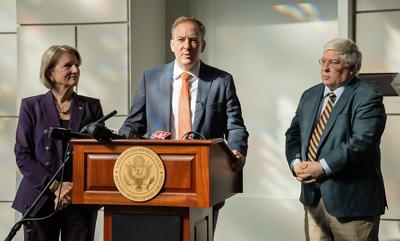
Lee Zeldin, administrator of the U.S. Environmental Protection Agency, is flanked Wednesday, Nov. 12, 2025, by Sen. Shelley Moore Capito, R-W.Va., and Gov. Patrick Morrisey as he talks to reporters at the Robert C. Byrd U.S. Courthouse in ÂÒÂ×ÄÚÉä.
Lee Zeldin, administrator of the U.S. Environmental Protection Agency, is flanked Wednesday, Nov. 12, 2025, by Sen. Shelley Moore Capito, R-W.Va., and Gov. Patrick Morrisey as he talks to reporters at the Robert C. Byrd U.S. Courthouse in ÂÒÂ×ÄÚÉä.
GOVERNOR'S OFFICE | Courtesy photo
Wetlands are as rare as they are resourceful in West Virginia.
The state Department of Environmental Protection has estimated West Virginia has lost 80% to 90% of its wetlands, far more than the national share lost.
Although wetlands make up only 1% of West Virginia’s land surface, they are a critical habitat for nearly a quarter of its species and 44% of its rare plant species, the DEP has reported.
Wetlands purify water and retain floodwater, impacts that come in handy in West Virginia given its disproportionately poor water quality and flood-prone topography.
But protections for wetlands have been placed on a regulatory chopping block by the U.S. Environmental Protection Agency and Department of the Army in a move cheered by West Virginia’s political leaders and manufacturing industry.
The agencies on Monday announced proposed revisions to significantly narrow the federal definition of “waters of the United States,� which defines the scope of jurisdiction over Clean Water Act permitting. The definition has been the subject of protracted legal wrangling before and since a 2023 Supreme Court decision that favored a narrower test to determine whether the Clean Water Act applies to a wetland.
EPA Administrator Lee Zeldin announced in March his agency and the Department of the Army planned to revise the definition of “waters of the United States,� known as WOTUS, in line with the Supreme Court decision.
The agencies already narrowed WOTUS wetland protections that year following the court’s decision, removing what’s been known as the “significant nexus� test from consideration when identifying tributaries and other waters as federally protected.
“Wetlands that may not meet a narrow legal test still filter pollution, slow floodwaters, and protect downstream communities,� West Virginia Rivers Coalition communications manager Maggie Stange said Tuesday in response to the federal agencies’ announced revisions. “Losing federal oversight for these waters leaves real gaps in protection.�
The feds’ proposed rule “brings tremendous uncertainty and risk� to drinking water, flood protections and critical habitats, Will McDow, associate vice president of Environmental Defense Fund, a global environmental nonprofit, said in a statement.
“Requirements in the new rule are not based in science, difficult to implement in practice and will create a dangerous lack of clarity,� McDow said.
But the feds’ move drew fervent praise from West Virginia political leaders, with Gov. Patrick Morrisey and Attorney General John “JB� McCuskey joining Zeldin at EPA headquarters in Washington Monday for the rule proposal announcement.
“The definition of that term [WOTUS] has been often abused, sometimes stretched beyond recognition over time,� Assistant Secretary of the Army Adam Telle said at the announcement event.
“It was [a] textbook example of federal overreach,� Morrisey said of past interpretations of the definition under the Biden and Obama administrations that were more protective than the proposed changes, which proponents say will slash red tape and provide clarity for businesses, farmers and landowners.
Among the feds’ public listening sessions on the rule after Zeldin’s March announcement that the rule was targeted for revisions was a May listening stop at the Kanawha County Courthouse in ÂÒÂ×ÄÚÉä at which industry representatives called for rolling back the rule but were opposed by conservationists and private citizens.
Senate Environment and Public Works Committee Chairman Shelley Moore Capito, R-W.Va., urged rolling back the rule at the ÂÒÂ×ÄÚÉä session and welcomed the proposed changes Monday.
“This action will reduce unnecessary burdens and bring predictability to the landowners, farmers, energy producers, and builders who rely on understandable and workable regulations, while continuing to protect our nation’s water,� Capito predicted in a statement.
McCuskey, in a statement, hailed the EPA and Army rule proposal as “a monumental step toward protecting our farmers and developers.�
Bill Bissett, president of the West Virginia Manufacturers Association, echoed those statements, calling the rule the feds are looking to change “unreasonable and unfair.�
“[WOTUS] hurts states like West Virginia that has significant water resources that can be used to create jobs and economic development here at home,� Bissett said of the definition as amended in 2023 under then-President Joe Biden.
“We are pleased that the new rule protects critical water sources while respecting the efforts of farmers to protect the natural resources they’ve been entrusted with,� Zippy Duvall, president of the American Farm Bureau Federation, a farmer and rancher advocacy group, said in a statement.
How key definition updates would narrow scope of rule Â
But the EPA and Army move, if finalized, would leave many wetland areas newly unprotected.
McDow predicted commercial developers would be permitted to pave over wetlands to construct unsafe housing that floods or increases flooding to neighbors.
“With this new [proposed] rule, the Trump administration is putting polluters’ profits ahead of our basic human right to clean water,� the Natural Resources Defense Council, a global environmental nonprofit, said in an email to supporters Tuesday, predicting that the planned rollbacks would degrade drinking water sources for millions of Americans.
The EPA and Army propose to redefine “relatively permanent,� and to what features the phrase applies, in response to the Supreme Court holding in 2023 that the Clean Water Act’s use of “waters� applies only to “relatively permanent,� standing or continuously flowing waterbodies.
The agencies are proposing “relatively permanent� to mean “standing or continuously flowing bodies of surface water that are standing or continuously flowing year-round or at least during the wet season.�
Bodies of surface water that are “standing� are meant to include lakes, ponds and similar features that have standing water year-round or during “the wet season� and are part of a tributary system. “Continuously flowing� waterbodies under the proposed rule would cover streams, rivers, ditches and certain “similar features.�
The Supreme Court’s 2023 decision, in Sackett v. EPA, held that the Clean Water Act extends to relatively permanent bodies of water connected to traditional navigable waters and wetlands with a continuous surface connection to those waters “so that there is no clear boundary between “waters� and wetlands.
The court sided in Sackett v. EPA with Michael and Chantell Sackett, who sued the EPA after the agency told them their backfilling a lot with dirt to construct a home violated the Clean Water Act.
The proposed rule defines “continuous surface connection� as having surface water at least during “the wet season� and touching a jurisdictional water.
Stange contends that by limiting federal jurisdiction to only “relatively permanent� waters and wetlands with a strict “continuous surface connection,� the proposal overlooks how water moves across West Virginia’s landscape. Stange noted that many West Virginia headwater streams don’t flow year-round but still feed public water systems and trout streams.
Jim Kotcon, chair of the West Virginia Chapter of the Sierra Club, predicted to the Gazette-Mail the proposed definition of “relatively permanent� would allow pollution of streams from upstream “with impunity.�
The EPA and Army note in the rule proposal that the time period marking a wet season differs throughout the country based on climate, hydrology, soils, topography and other conditions. The agencies intend to use web-based modeling outputs reported in a tool developed by the Army Corps to help evaluate precipitation normalcy and other climatic variables in their effort to help identify wet seasons.
But the agencies acknowledge in the rule proposal that outputs reported in the tool “may not have complete functionality in certain territories� and say they are exploring ways to improve functionality.
The Environmental Defense Fund asserted that the information on wetness the rule proposes to use is outdated and inappropriate for evaluating a wetland’s wetness.
Groundwater excluded in proposed rule
The federal agencies have proposed excluding groundwater under the rule, including groundwater drained through subsurface drainage systems.
In their proposal, the agencies “acknowledge the importance of groundwater as a resource and its role in the hydrologic cycle� but hold that “its regulation is most appropriately addressed by other Federal, State, Tribal, and local authorities.�
Although the agencies previously have held that WOTUS don’t include groundwater, the Supreme Court ruled in 2020 that statutory provisions at issue in County of Maui, Hawaii v. Hawaii Wildlife Fund et al. require a permit if the addition of pollutants through groundwater is equivalent to a direct discharge from a pollution source like an industrial facility or livestock operation into navigable waters.
That case stemmed from environmental groups bringing a citizens’ lawsuit under the Clean Water Act that the County of Maui alleging that Maui was discharging a pollutant to navigable waters without a required permit.
The court ruled that where a pipe ends “a few feet from� navigable waters and emits pollutants that travel those few feet through groundwater, a permitting requirement “clearly applies.�
But the EPA and Army say in their new proposal, despite acknowledging that pollutants released to groundwater can reach surface water resources, that the statutory reach of WOTUS is limited.
Stange found the EPA and Army move to codify exclusion for groundwater “especially troubling,� noting the close connection between groundwater and surface water in West Virginia.
“[W]hat seeps into the ground often ends up in our springs, wells and streams,� Stange said.
'Federal baselines' slated for rollbacks
West Virginia is one of 26 states that don’t have its own wetland permitting program, according to the National Agricultural Law Center.
“West Virginians have long relied on strong federal baselines to ensure consistent protection across watersheds that cross counties and state lines,� Stange said.
Many speakers at the EPA and Army WOTUS-focused May session in ÂÒÂ×ÄÚÉä evoked West Virginia’s history of poor drinking water quality to suggest the feds would be making a mistake by weakening water regulations.
Dave Bassage, New River Gorge program coordinator for the New River Conservancy, a regional New River watershed protection group, said drinking water in West Virginia has exceeded standards considered safe “far too often.�
“It defies common sense to only regulate polluters who discharge directly into large waterways when any pollutant on any land will eventually find its way to a larger stream,� Bassage said.
More than half of West Virginia’s critical infrastructure — including fire, police and power stations — was at risk of becoming inoperable due to flooding, according to a 2021 First Street Foundation study.
West Virginia’s share of critical infrastructure at risk of being inoperable due to flooding was higher than any other state.
Of West Virginia’s 831 public water systems, 622 — 74.8% — had violations of the federal Safe Drinking Water Act in 2023, according to Environmental Protection Agency data, dwarfing the national average of 27.6%. West Virginia’s percentage of public water systems with drinking water violations was 18.5 percentage points higher than that of the second-highest state, Oklahoma, at 56.1%.
Agencies to take public comment Â
The proposed rule will be published in the Federal Register, which will start a 45-day public comment period. EPA and the Army will host two hybrid public meetings, with details yet to be announced. The proposed rule and related information is available at bit.ly/WOTUSpage.
Backed by Morrisey and McCuskey at EPA headquarters Monday, Zeldin said he hopes the WOTUS definition that his EPA and the Army settle on sticks through future administrations.
Morrisey agreed.
“I'm hopeful that whatever happens with the body politic over the next 10 years that this could be a durable rule, because it's common sense,� Morrisey said. “And I know West Virginia will be weighing in to be supportive of this rule.�
Conservationists, though, fear the rule won’t support the waters of West Virginia.
“[West Virginia] Rivers supports simple, science-based rules that reflect the reality of our hydrology,� Stange said. “We urge [the] EPA and the Army Corps to make sure the final rule keeps strong protections for the headwaters and wetlands that our communities depend on.�
CLICK HERE to follow the ÂÒÂ×ÄÚÉä Gazette-Mail and receive