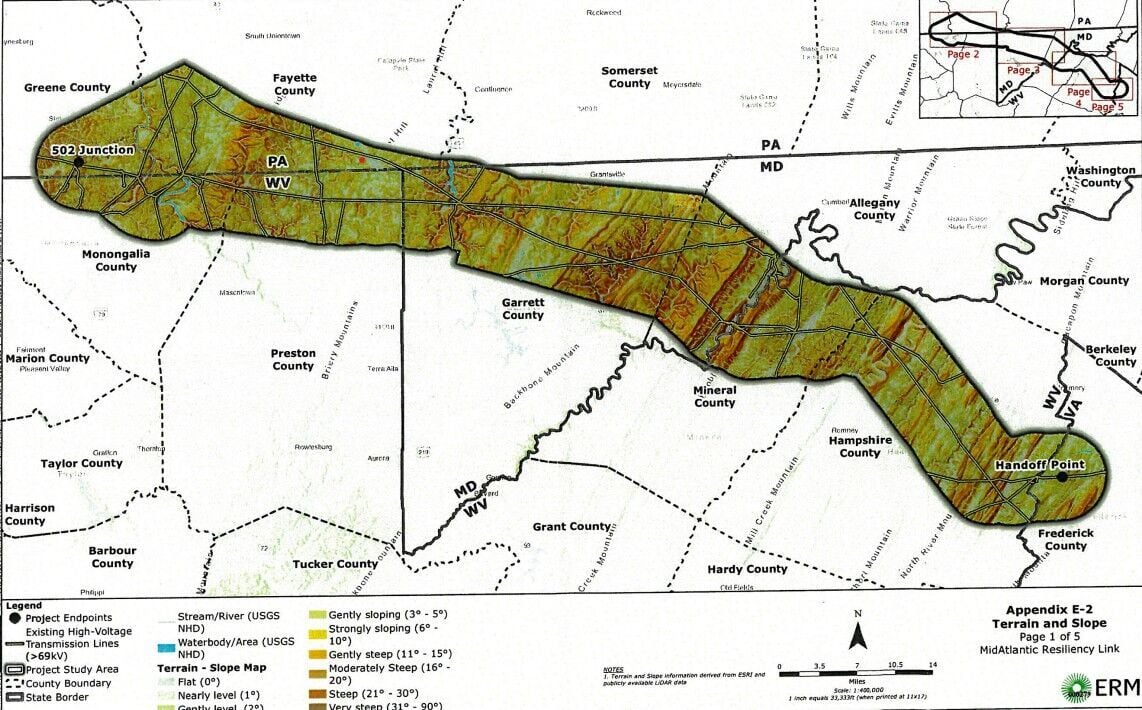
This project map was submitted in an application filed with the West Virginia Public Service Commission by NextEra Energy Transmission MidAtlantic for approval of its MidAtlantic Resiliency Link electric transmission line project.
This project map was submitted in an application filed with the West Virginia Public Service Commission by NextEra Energy Transmission MidAtlantic for approval of its MidAtlantic Resiliency Link electric transmission line project.
A $1.16 billion regional electric power line project planned to cross through West Virginia has proven deeply unpopular with residents and officeholders throughout the state.
Now the project has provided new fodder for critics fearing its costs.
NextEra Energy Transmission MidAtlantic Inc. on Wednesday amended its application filed with the West Virginia Public Service Commission on Jan. 30 for approval of its project to construct, finance, own and operate the West Virginia segments of its MidAtlantic Resiliency Link project — a new, 107.5-mile, 500-kilovolt transmission line that will cross parts of Pennsylvania, Maryland and Virginia in addition to the Mountain State.
The West Virginia segments of the MARL project are slated to consist of approximately 59 miles of 500-kilovolt transmission line and related facilities in Monongalia, Preston, Mineral and Hampshire counties.
NextEra Energy Transmission MidAtlantic, referring to itself as NEET MA in its filings, said in its Jan. 30 filing that the project will result in expected rate increases for Mon Power and Potomac Edison customers but not Appalachian Power or Wheeling Power customers.
But in a Feb. 18 revised application filing, NextEra said a portion of the cost of the project would be assigned to a zone within the PJM Transmission grid under control of American Electric Power, parent company of Appalachian Power and Wheeling Power, which would impact the customer rates of those two utilities.
NextEra’s revised filing did not specify how much the two companies’ rates would be impacted, unlike the filing’s outline of projected changes for Mon Power and Potomac Edison ranging from a low of $0.12 to a high $1 annually from 2026 to 2036, including a peak change by percentage of 0.72% in 2032.
NextEra spokesperson Brianna Green did not say what the projected rate impacts mentioned in the revised filing would be or why they were not noted in the original filing in response to a Gazette-Mail inquiry Monday.
The Consumer Advocate Division, an independent arm of the PSC that represents the interests of residential ratepayers, took issue with the notice of projected Appalachian Power and Wheeling Power rate impacts in a filing of its own Friday, lamenting that it could “only speculate as to why AEP was added� as a transmission zone to be allocated costs — the fifth across the project overall.
“Nonetheless, in the span of less than 20 days, a major aspect of the project, and one that directly impacts electric customers in West Virginia, has been altered with no explanation from NextEra,� the Consumer Advocate Division’s filing states.
The Consumer Advocate Division said it “cannot see notice being adequate in this case without similarly providing the West Virginia customers of APCo and WPCO with reasonable notice, by the increase percentages and dollar amounts, of how their rates would be impacted by this project.�
“If cost allocation is still under review and is not sufficiently referenced by the application and the testimony filed with the application, one has to wonder if the certificate application was prematurely filed,� the division’s filing added.
The revised filing from NextEra was a response to a Feb. 6 PSC staff filing that recommended a revised notice containing a more detailed description of the project’s route, including street names and numbers, existing businesses and easily recognizable landmarks relative to the project's proposed location. PSC staff also recommended a revised presentation of the projected change in average rates that included corresponding dollar amounts with percentages listed.
PSC staff had concluded in its filing that the average customer wouldn’t be able to tell easily what the projected rate impacts in terms of percentages mean for their monthly electric bills.
Appalachian Power and the FERC did not respond to requests for comment on NextEra’s revised filing.
NextEra had not responded to the Consumer Advocate Division’s filing with a filing of its own as of press time Tuesday.
The West Virginia portions of the proposed route would cost about $482.7 million, including siting, engineering, construction, procurement, financing, administration, development, legal costs, escalation contingency and taxes. NextEra warned in its original filing that its estimate is subject to change through construction and other variable factors.
In its original filing, NextEra had indicated that the project will result in increases in 2032 for average residential customers of FirstEnergy subsidiaries Mon Power and Potomac Edison in West Virginia of 0.84% and 1.11%, respectively, with lower rate impacts in other years. NextEra said it and a Virginia affiliate will seek all required approvals from utility regulators in Virginia, Pennsylvania and Maryland.
NextEra indicated that municipal electric utilities and electric cooperatives in West Virginia that procure power from Mon Power as resale customers will experience rate impacts, including the City of New Martinsville, Harrison Rural Electric Cooperative, Philippi Municipal Electric and Craig Botetourt Electric Cooperative.
In May, the Institute for Energy Economics and Financial Analysis, a Valley City, Ohio-based energy market analysis firm, published a study projecting West Virginia electricity customers would have to pay over $440 million for the MARL and another proposed transmission line that would support data centers.
NextEra’s application reported May in-house meetings in Hampshire, Mineral, Monongalia and Preston counties to solicit feedback.
But feedback throughout the project case’s PSC docket has been uniformly negative from private citizens and public officials alike.
The docket had nearly 3,900 comments in protest of the application as of Tuesday since NextEra in August submitted its notice of intent to file the application.
Potential future rate impacts from new PSC order unclear
In another filing implicating Appalachian Power and Wheeling Power ratepayers, the PSC on Friday issued an order revisiting an August 2025 order in which it authorized a base rate increase of $76.1 million for the companies. The PSC on Friday raised that increase to $91 million after the companies asked the commission to reconsider last year’s order, arguing it should approve a greater return on equity for them.
The PSC sided with the companies in their latest order, finding the record supported a revised determination of a return on equity of 9.75% rather than the previously approved 9.25%.
Return on equity is the measure of how efficiently a company derives profit from its shareholders’ equity.
The PSC has found that a 9.75% return on equity would fairly compensate the utilities on a higher capital structure of debt and equity while providing rates that are “fair and reasonable.�
But the PSC order doesn’t specify what new rate impacts might stem from the agency’s decision.
PSC spokesperson Andrew Gallagher deferred comment on potential rate impacts to Appalachian Power, which on Tuesday said it was reviewing the PSC order details and that customers will continue to be billed at current rates with no immediate changes.
Other outstanding issues must be resolved before any potential customer rate impacts, if any, can be determined, the company said Tuesday.
Appalachian Power and Wheeling Power bills have swollen over time.
The companies’ average monthly residential cost increased 207% from $55.28 in 2005 to $169.69 in 2024, according to PSC data.
CLICK HERE to follow the ÂÒÂ×ÄÚÉä Gazette-Mail and receive