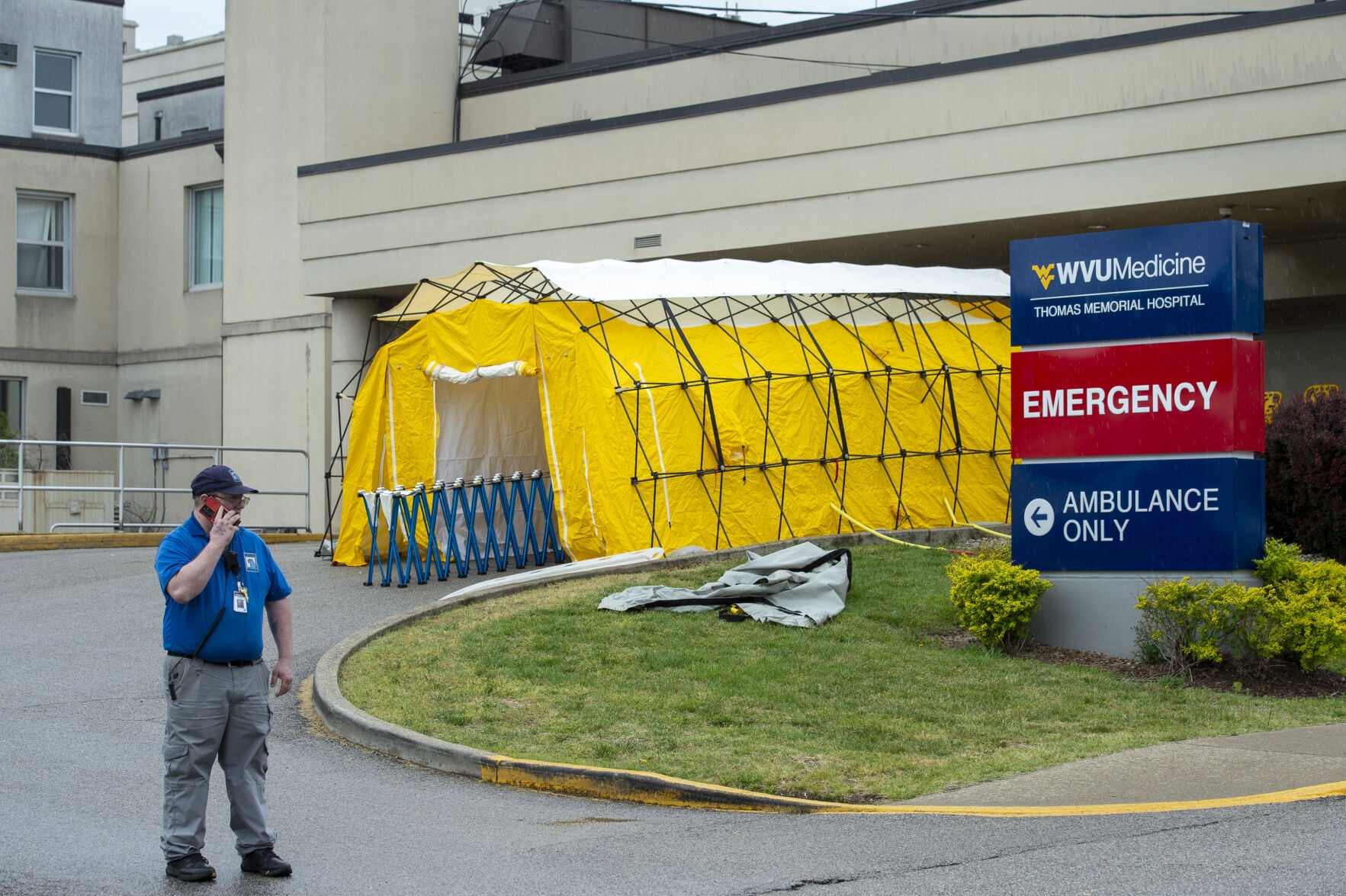
Security officer Glennis Fields stands near a decontamination tent set up in the ambulance bay of WVU Medicine | Thomas Hospitals in South ÂÒÂ×ÄÚÉä on Wednesday, April 22, 2026. The tent was set up to receive patients from a fatal chemical spill and explosion earlier in the day at Catalyst Refiners Inc. in Institute.
From left: Kanawha County Commissioner Natalie Tennant, Kanawha County Emergency Management Agency director C.W. Sigman, Kanawha County Commission President Ben Salango and Kanawha County Commissioner Lance Wheeler held a news conference at the Kanawha County Metro 911 dispatch facility in ÂÒÂ×ÄÚÉä after a deadly incident at Catalyst Refiners' facility in Nitro on April 22, 2026.
Security officer Glennis Fields stands near a decontamination tent set up in the ambulance bay of WVU Medicine | Thomas Hospitals in South ÂÒÂ×ÄÚÉä on Wednesday, April 22, 2026. The tent was set up to receive patients from a fatal chemical spill and explosion earlier in the day at Catalyst Refiners Inc. in Institute.
LAURA BILSON | Gazette-Mail
The signal word is “danger.�
That’s the word, indicating risk deemed to be severe, assigned to the hazardous chemical M-2000A on the proprietary alkaline aqueous solution’s safety data sheet, a document federally required from chemical manufacturers to communicate information on how to handle hazardous materials.
But M-2000A wasn’t on another federally required chemical inventory form annually mandated for industrial operators like Nitro’s Catalyst Refiners Inc., despite it being involved in the violent chemical reaction that left two workers dead, sent more than 30 people seeking medical care and prompted a 1-mile shelter-in-place on April 22.
Emergency officials who responded to the fatal incident say the inclusion of M-2000A in Catalyst Refiners’ chemical inventory list, called a Tier II Emergency and Hazardous Chemical Inventory form, would have benefited their response and left them better prepared.
Hydrogen sulfide is the flammable, highly toxic gas that comprised the fatal chemical reaction when the M-2000A and nitric acid — a corrosive chemical toxic after inhalation exposure — mixed during plant decommissioning work.
“If we had known that the two gases, the other product [M-2000A] was there, we might have expected hydrogen sulfide quicker,� Kanawha County Emergency Management Director C.W. Sigman said in a phone interview.
“As soon as we saw the data sheet, it was like, oh, goodness, these two are a terrible mix,� Kanawha Putnam Emergency Planning Committee Administrator Tom Keefer said in a phone interview. “So yeah, someone reviewing the sheet that knew a little bit about chemistry would have easily said, ‘This is a bad reaction if they come in contact with each other.’�
The minimum reporting threshold generally is 10,000 pounds for hazardous chemicals for which facilities are required to have or prepare a safety data sheet, so having less M-2000A at the facility than that amount would exempt it from the reporting requirement.
The amount of nitric acid at the facility has exceeded that threshold, according to a Tier II form obtained by the Gazette-Mail via a Freedom of Information Act request. The form for reporting year 2025 lists average and maximum daily amounts of 44,900 and 69,040 pounds – 365 days a year – of a nitric acid mix flagged as a skin corrosion, serious eye damage and aspiration hazard.
The mix is listed as having a maximum daily amount of 68,500 pounds in an aboveground tank in the west yard onsite, according to the Tier II form.
A spokesperson for Catalyst Refiners — a company controlled by Ames Goldsmith Corp., a South Glens Falls, New York-headquartered advanced precious metals manufacturing firm — did not respond to requests for comment.
The Emergency Planning and Community Right-to-Know Act requires that any Tier II information that a state emergency response commission or local emergency planning committee has must be made available to a person seeking the information. If those panels don’t have the information, they must ask the facility owner or operator for the information upon a request for it regarding a hazardous chemical stored at the facility for an amount above 10,000 pounds during the preceding year.
From left: Kanawha County Commissioner Natalie Tennant, Kanawha County Emergency Management Agency director C.W. Sigman, Kanawha County Commission President Ben Salango and Kanawha County Commissioner Lance Wheeler held a news conference at the Kanawha County Metro 911 dispatch facility in ÂÒÂ×ÄÚÉä after a deadly incident at Catalyst Refiners' facility in Nitro on April 22, 2026.
Keefer said that he became aware of the M-2000A being involved in the Catalyst Refiners incident through a message to Metro 911 by Sigman, who responded to the scene.
Sigman said seven emergency service workers were transported from the incident site within what he called a “warehouse-sized building� where silver is recovered from other chemical processes.
Officials came across the data sheet through a Google search within some 20 minutes of the incident call, Keefer said.
“We had no clue what M-2000A is, so we immediately went to a Google search and our staff actually talked to the manufacturer to verify what we were seeing,� Keefer said. “Within that 20 minutes, we had actually obtained the safety data sheet, phone number and had a conversation with the manufacturer.�
The data sheet lists New Philadelphia, Ohio-based AquaBlue Inc. as the M-2000A supplier.
“Maybe the biggest thing it would have helped was the decision of sheltering in place,� Sigman said in a phone interview of the potential benefit if M-2000A had been reported in Catalyst Refiners’ chemical inventory.
Sigman said Institute Fire Chief Chris Moyers made what he called “a quick call� as incident commander to issue a shelter-in-place order because of what he said was a “cloud� of toxic hydrogen sulfide inside the facility. Sigman also said Catalyst Refiners plant manager Tim Roush was on the scene, "helping us with information" despite the lack of information on file regarding M-2000A.
“Those are things you’d like to know so you can keep them separated,� Keefer said of chemical inventories.
Thousands of pounds of other hazardous chemicals listedÂ
The only ingredient listed by the safety data sheet for M-2000A other than nonhazardous substances is sodium trithiocarbonate, which is used as a metal-precipitating agent.
Other hazardous chemicals listed on the Tier II form in addition to the nitric acid mix include:
Silver compounds (maximum daily amount of 250,000 pounds)
Hydrogen peroxide (maximum daily amount of 48,000 pounds, with health hazards including acute toxicity, serious eye damage and skin corrosion)
Sodium hydroxide solution (maximum daily amount of 51,000 pounds, corrosive to metal with health hazards including serious eye damage and skin corrosion)
In August 2013, two workers were injured and transported to a hospital after a nitric acid spill at the Catalyst Refiners site prompted employee evacuations.
A September 2013 DEP inspection report stated that an inspection light fell into a reactor containing approximately 100 gallons of nitric acid, causing about 75 gallons of the acid to bubble over a vessel top onto a concrete floor as large amounts of heat and hydrogen gas evolved. The employees suffered minor acid burns and the floor was damaged, according to the report.
The Aug. 24, 2013, spill prompted an unannounced DEP site visit four days later at which then-Catalyst Refiners catalyst operations president Scott Schmidt said the facility was doubled in size two or three years earlier because business was growing, with operations expanding to 24 hours per day, seven days per week, according to the report.
On Sept. 3, 2013, 10 days after the reported 75-gallon nitric acid spill, an employee improperly filled a 1,200-gallon mixing tank with 60% nitric acid first instead of water and then acid, before adding 50% hydrogen peroxide, causing an estimated 80 gallons out of 250 in the tank to boil over onto an elevated catwalk, according to the DEP report.
There were no injuries, and most of the spilled acid was caught in plastic containers below the catwalk, according to the report. Schmidt reported hiring “a PR consultant to help him in the future,� the DEP report stated.
'Never should have been mixed'
Keefer said the nitric acid and M-2000A were mixed in a container but “never should have been mixed at the stage they were at.�
The independent, nonregulatory United States Chemical Safety and Hazard Investigation Board, which investigates industrial chemical incidents but lacks enforcement power, is investigating the fatal chemical release. The board did not respond to requests for comment.
Keefer said plant decommissioning work has been on pause amid a CSB hold as the agency investigates. Keefer said Friday the CSB had indicated last Monday it would be on the site through May 1.
A West Virginia Department of Environmental Protection spokesperson on Tuesday told the Gazette-Mail in an email it would keep coordinating with Catalyst Refiners as part of the agency’s ongoing regulatory investigation, “including once decommissioning work resumes.�
The DEP will oversee any decommissioning tied to regulatory programs within its jurisdiction, according to the agency, which said in an April 29 update it was coordinating with state, local and federal agencies on a sampling and removal plan to ensure that remaining materials inside the facility were properly characterized and safely removed offsite.
Sigman told the Kanawha County Commission at its latest meeting Tuesday that 11 air monitoring stations set up near the site have left no signs of harmful residual chemicals. The DEP said on April 29 there had been no detections of hydrogen sulfide offsite.
“How did you come about thinking that was OK?� Keefer said of mixing nitric acid and M-2000A, noting that federal investigators are examining what happened. “Correct, that’s the magic question of the day.�
CLICK HERE to follow the ÂÒÂ×ÄÚÉä Gazette-Mail and receive