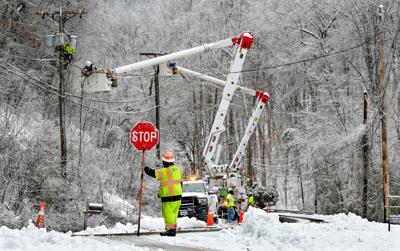
Line crews from American Electric Power, parent company of Appalachian Power, repair power lines along W.Va. 214 (Childress Road) at the intersection with Alum Creek Road on Jan. 6, 2025.
Appalachian Power and Wheeling Power have repeatedly failed in recent years to meet electric reliability targets set by West Virginia utility regulators, with exceptionally poor metrics measuring power outage duration.
Now the companies are slated for a state-ordered audit that will scrutinize their reliability.
The state Public Service Commission has approved a petition for an audit of Appalachian Power and Wheeling Power electric reliability.
In an order approving the audit petition Thursday, the PSC indicated the audit is to be conducted by an independent third party to be approved by the agency and will review:
The companies’ staffing levels, including line mechanics, line servicers and front-line supervision
The companies’ service center facilities, including the level and capability of the staffing at each facility
How the utility manages the operations of the distribution system
The audit is also to:
Identify opportunities for improving accuracy of estimated time of restoration reported to customers
Compare the companies’ distribution systems to systems of similar utilities to determine the impact that circuit length, terrain, inaccessibility and configuration may have on system reliability along with recommendations on improvements and estimated costs
Make recommendations to make improvements short-term (one to three years) and longer-term (three to 10 years) with recommendations ranked by effectiveness in cost and reliability improvements
The petition for the audit was filed last month by PSC staff and the companies themselves, citing “questions raised in cases and in the public regarding the reliability of the Companies’ electric service, including whether there are cost-effective opportunities to improve the Companies’ reliability.�
The petition was filed nine days before Appalachian Power and Wheeling Power reported failures to meet electric reliability targets set by the PSC for the utilities in an annual reliability filing.
PSC staff said in a filing last year it was prepared to launch a general investigation into Appalachian Power and Wheeling Power reliability performance since the companies “appear to lack focus� on improvements if their reliability “remain[s] unreasonable.�
PSC staff had urged the PSC to deny an Appalachian Power and Wheeling Power request for more lenient targets in metrics measuring duration and frequency of power outages, noting the companies have routinely failed to meet even minimum reliability targets set by the agency and concluding their performance negatively impacts electric reliability compared with neighboring states.
The PSC subsequently approved stronger electric reliability targets for Appalachian Power and Wheeling Power in January. The agency adjusted minimal and optimal targets downward by 2% each for the companies’ average number of customer outages per year and average interruption duration.
The PSC order states that Appalachian Power and Wheeling Power should pay for the audit. It requires Appalachian Power and Wheeling Power to prepare a proposed request for proposal and a proposed list of audit firm candidates. The request for proposal is to be filed within 30 days of the order.
The PSC ordered that its staff should have the opportunity to consult with the auditor on the progress and direction of the audit as it progresses.
But the PSC denied a request by its Consumer Advocate Division to broaden the scope of the audit to include changes to reliability targets and reporting requirements as well as allow the division to participate in the request for proposal process. The PSC indicated it could review changes to reliability targets in a future case.
The Consumer Advocate Division is an independent wing of the PSC charged with representing the interests of residential ratepayers.
Reliability metrics got worse in past year
This month, Appalachian Power reported average system outage frequency and duration rose 34.7% and 98.8%, respectively, from last year when including “major event days� when metrics exceed a threshold due to exceptional circumstances like severe weather, per a Gazette-Mail analysis of PSC filings.
Those Appalachian Power measures were 31.4% and 256% above minimum targets set by the PSC, respectively, and 49.3% above optimal, more ambitious PSC-set targets.
Line crews from American Electric Power, parent company of Appalachian Power, repair power lines along W.Va. 214 (Childress Road) at the intersection with Alum Creek Road on Jan. 6, 2025.
CHRIS DORST | Gazette-Mail
Appalachian Power’s sustained interruptions climbed 17.4% from 2023 to 2024, and its reliability complaints increased 41.7% to 85 last year. Appalachian Power’s fellow American Electric Power subsidiary Wheeling Power fared better, with system average outage frequency and duration metrics that increased 1% and decreased 14%, respectively, when including major event days.
Appalachian Power’s 16,623 sustained interruptions last year — an average of 45.4 per day — were most commonly caused by trees out of the utility right-of-way, equipment failures and high winds, the company said. Sustained interruptions in those categories increased 17.3%, 11.4% and 62.8% from their 2023 totals, respectively.
Improvement plans for Appalachian Power and Wheeling Power for circuits it targeted to upgrade last year included vegetation management, right-of-way widening and implementing technology that detects a power outage and automatically reroutes the power to reduce the number of people impacted.
History of deep outage struggles
Outages have been especially long-lasting for Appalachian Power and Wheeling Power customers.
Appalachian Power failed to meet its current optimal target set by the PSC for average system outage duration in 2023 and reported meeting its minimum duration target just twice in the past five years leading up to 2024, per PSC filings, never meeting its optimal target for that category.
A 2022 review of electric utility performance nationwide ranked West Virginia dead last among all states in overall utility performance. The report found Mountain Staters had to endure the country’s worst performance in metrics measuring average duration of power outages and average time to restore power per customer.
The review published by the Citizens Utility Board of Illinois, a consumer advocate group, found West Virginia had the nation’s second-worst average frequency of power outages, ahead of only Alaska.
Appalachian Power’s West Virginia coverage area ranked in the highest 6% of all 967 listed utilities nationwide in outage minutes per year in 2023, according to a Gazette-Mail review of U.S. Energy Information Administration data.
Storm costs growing as climate change worsens
Jason Baker, vice president of distribution operations at Appalachian Power, said at a PSC hearing in November on Appalachian Power and Wheeling Power reliability targets that much of the companies’ system in West Virginia was built in the 1930s and 1940s to extend service to coal mines and small towns “in the most economical manner that they could at the time.�
That means, Baker added, that “there’s no real pattern� to how the companies’ system is laid out, yielding a “very long circuit, miles from coal mine to coal mine.�
Baker noted line relocations could mitigate the reliability challenge posed by West Virginia’s mountainous terrain and that the state’s heavy forestation is another reliability obstacle.
Severe storms that wreak havoc on West Virginia’s power are becoming more common — and more costly for customers.
Appalachian Power and Wheeling Power have said they deferred over $94 million linked to extraordinary storm restoration costs from 2019 through 2023 and an additional $23.8 million of such costs from January through May 2024 alone. The result, the utilities said, was $118 million of deferred storm costs.
Storm costs have been a “volatile� category of operations and maintenance spending, according to the companies, ranging from $16.3 million to a high of $29.2 million during a five-year period covering 2019-23.
Worsening climate change is causing more extreme weather patterns that result in harder-hitting storms.
Nearly a quarter of West Virginia’s billion-dollar disasters from 1980 to 2024 (11 out of 45; 24%) came in just the last five years of that span, according to National Oceanic and Atmospheric Administration data.
Meanwhile, costs have soared for West Virginia electric consumers.
State ratepayers faced a 90% climb in average residential electricity retail price from 2005 to 2020, per U.S. Energy Information Administration data. Only Michigan had a greater increase by percentage.
CLICK HERE to follow the ÂÒÂ×ÄÚÉä Gazette-Mail and receive