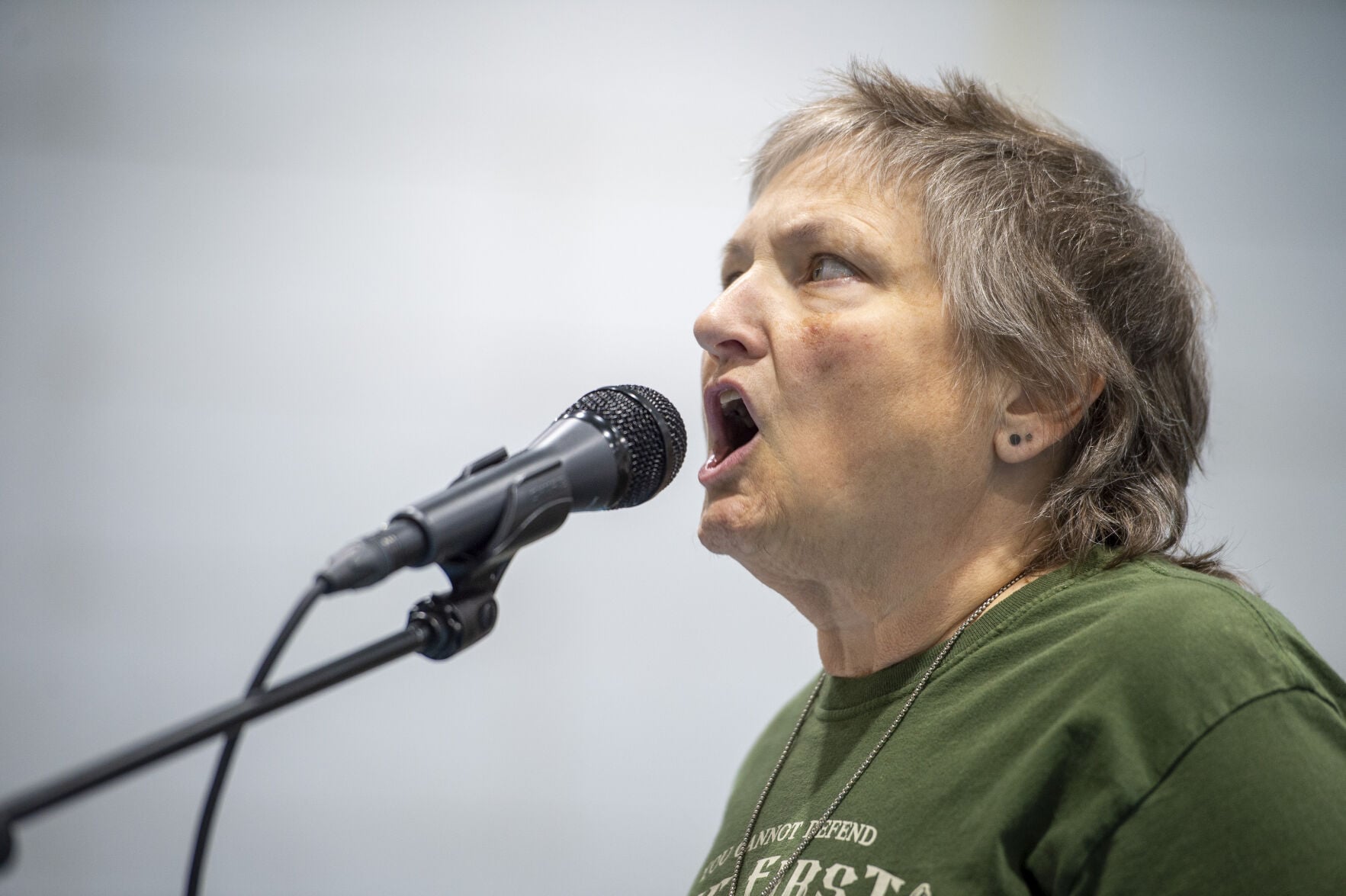
Martha "Marty" Gibson of Belle gives public comment at a July 14, 2026, West Virginia Department of Environmental Protection public information meeting and public comment hearing at Belle Town Hall on an air quality permit then proposed for a Clean-Seas West Virginia industrial facility.
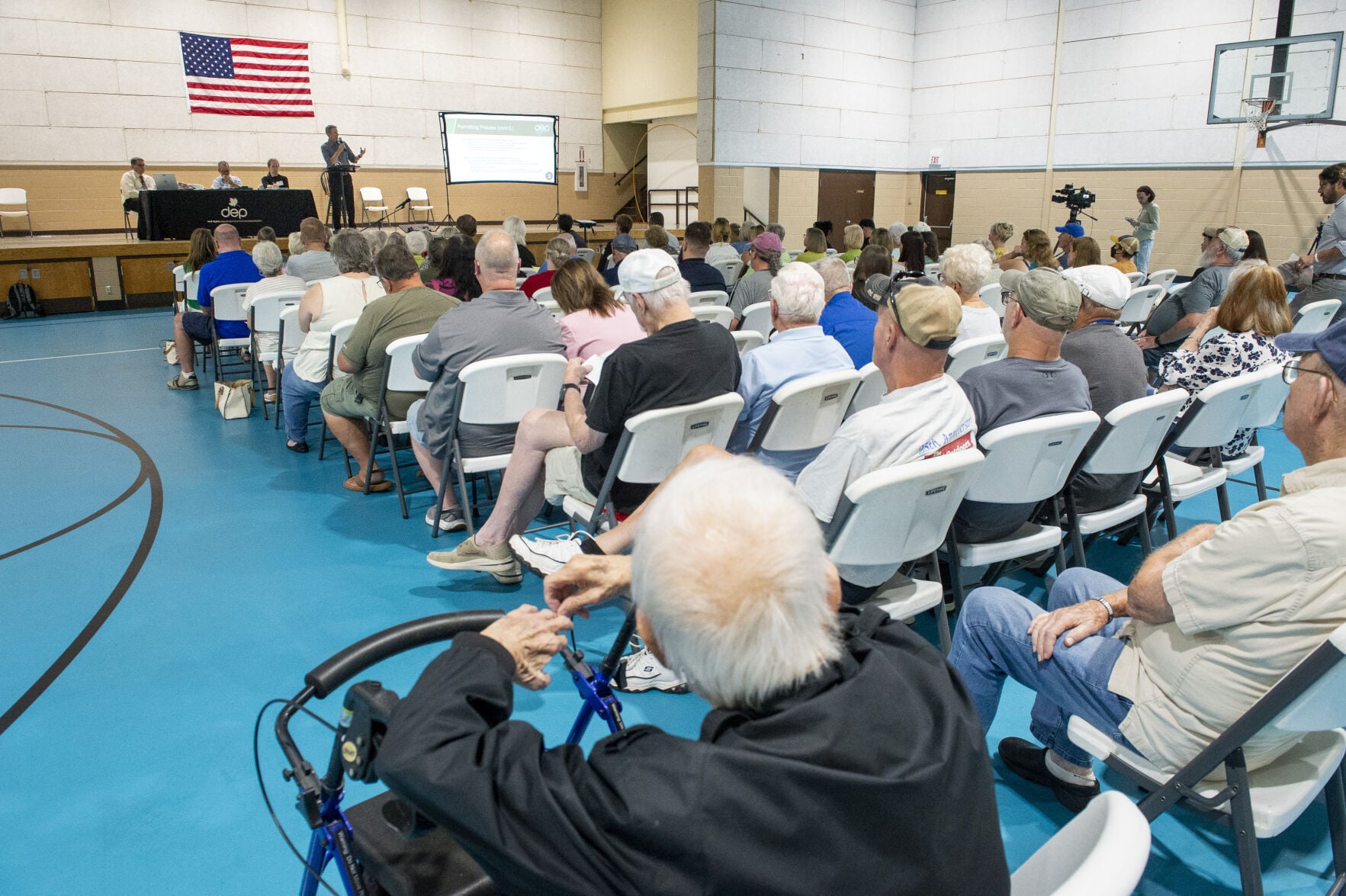
West Virginia Department of Environmental Protection public information meeting attendees listen to DEP New Source Review program manager Joe Kessler speak inside Belle Town Hall's gym on July 14, 2026.
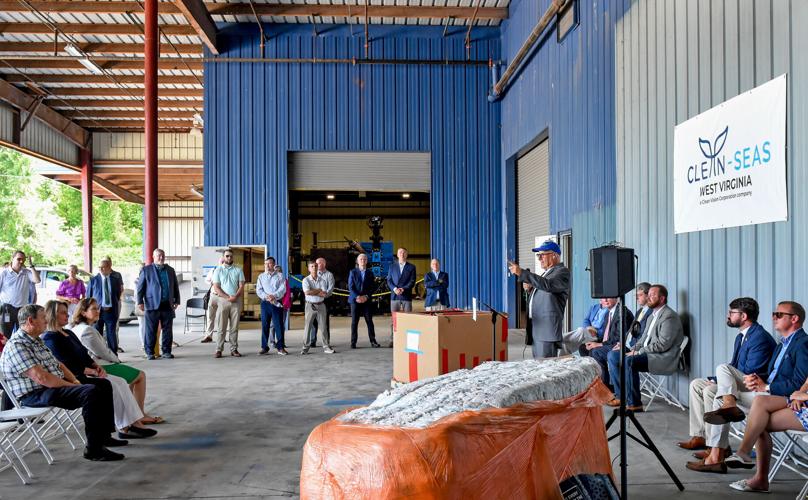
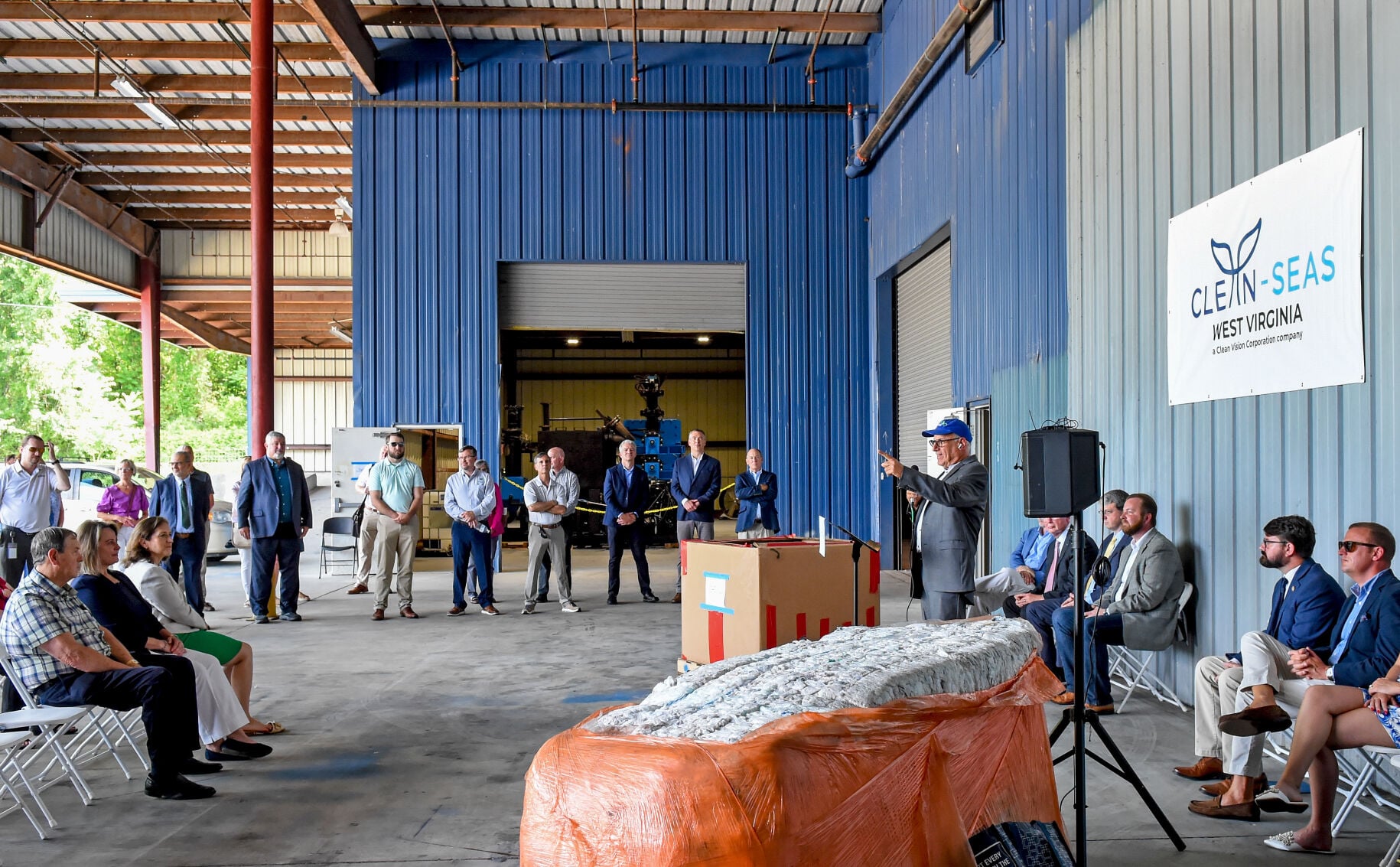
Clean-Seas CEO Dan Bates speaks at the podium during a June 30, 2025, ceremony announcing the Clean-Seas West Virginia industrial facility planned for the former 84 Lumber building near Belle.
West Virginia Department of Environmental Protection public information meeting attendees listen to DEP New Source Review program manager Joe Kessler speak inside Belle Town Hall's gym on July 14, 2026.
LAURA BILSON | Gazette-Mail file photo
The West Virginia Department of Environmental Protection has approved a permit for a planned industrial facility whose projected environmental health impacts and murky economic outlook have sparked fear among Kanawha Valley residents.
The DEP on Wednesday approved an air quality permit for Clean-Seas West Virginia Inc. to build a facility to convert plastics into other products near Belle with a planned fence line fewer than 500 feet from the entrance to Riverside High School.
The DEP set aside resident concerns that the Clean-Seas project will harm public health where they live, green-lighting operations for the company, which has secured millions of dollars of state support but has a parent company mired in financial uncertainty.
The approval follows a July 14 DEP public meeting on the permit proposal at Belle Town Hall at which agency officials insisted their hands are tied when it comes to addressing resident fears that the proposed plastic pyrolysis plant at 2700 E. Dupont Ave., near Belle, at the former 84 Lumber building between that road and U.S. 60 would be an inadequately monitored, improperly permitted addition to an already heavy community air pollution burden inflicted by other chemical facilities.
Clean-Seas has planned to convert plastic to an oil as a precursor to new plastic and ultra-low-sulfur fuels, lubricants and other products.
Pyrolysis is the thermochemical breakdown of materials by heating them in the absence of oxygen — in this case, plastic material into oil, gas and residue.
Signed by DEP engineer Edward Andrews on Wednesday, a final determination from the agency held that the proposed facility would meet state statutory requirements and federal standards.
The DEP acknowledged in the determination that the bulk of comments mainly expressed opposition “rooted in local quality-of-life concerns, land-use preferences, proximity to schools and businesses, fire risks, and regional health indicators,� with other comments arguing for regulation as a “major source� of air pollution due to potential air emissions.
The soccer field behind the Midland Trail Elementary School is less than 1,400 feet away from the nearest site fence line, according to the evaluation.
A Tractor Supply store borders the north end of the site, with the south end being an existing strip mall consisting of small commercial businesses and a West Virginia State Police detachment, per the evaluation.
Renewable energy and environmental health advocates have called advanced recycling — using chemicals, pressure or heat to break down plastics to be further reprocessed into plastic — a dangerous, public health-threatening solution to the problem of plastics pollution.
As proposed, the facility would be permitted to annually emit up to:
5.44 tons of volatile organic compounds, which can contribute to ground-level ozone and may cause cancer
2.2 tons of carbon monoxide, which can contribute to atmospheric chemical reactions that lead to ozone air pollution and climate change
2.18 tons of nitrogen oxides, which can harm respiratory systems and contribute to acid rain
1.23 tons of fine particulate matter, or soot, which has been linked to premature death in people with heart or lung disease, heart attacks, worsened asthma and diminished lung function
Clean-Seas CEO Dan Bates speaks at the podium during a June 30, 2025, ceremony announcing the Clean-Seas West Virginia industrial facility planned for the former 84 Lumber building near Belle.
Gazette-Mail file photo
In an emailed statement provided Thursday by Dan Bates, CEO of Clean-Seas, an affiliate of Clean-Seas West Virginia, the company said it was “delighted� that the DEP issued the permit for which the latter company applied in August 2025.
“Clean-Seas is excited to bring new, well-paying jobs to the Kanawha Valley and help return this region of West Virginia to the manufacturing center that it has historically been,� the statement read.
Bates did not respond when asked when the company plans to begin operations. Clean-Seas West Virginia hosted a groundbreaking event for its planned facility on June 30, 2025.
Lani Wean, West Virginia field organizer for national air quality advocacy group Moms Clean Air Force, one of the project’s most vocal critics, told the Gazette-Mail in an email Thursday the DEP’s decision to issue the permit was “deeply disappointing, but not surprising.�
Wean called the decision to approve what she called a “toxic enterprise� a “slap in the face to our community.�
Millions in W.Va. support for Clean-Seas projectÂ
Clean-Seas, a subsidiary of Manhattan Beach, California-based Clean Vision, for which the West Virginia Economic Development Authority approved a $15 million loan with a five-year term in January 2024 to build the plastics conversion facility. The Economic Development Authority indicated in an approval document that the operation came with an overall $65 million price tag.
Then-Gov. Jim Justice signed off on the loan approval for the project, which the state categorized as a “high impact development project.� According to state code governing the EDA, a “high-impact development project� is a project that the governor has requested in writing be approved for financing totaling at least $50 million. The entity undertaking the project also must privately invest at least $50 million.
Andrews said at the DEP’s July 14 public meeting that the company would operate a solid waste incinerator, with feedstock to consist of at least 85% polyethylene or polypropylene plastics and sorted, cleaned and free of free-floating liquids.
Where Andrews said “it gets a little complicated� is that a pipeline natural gas- or propane-fired training, research and evaluation unit to be used exclusively for burning samples of materials for chemical or physical analysis would be exempt from more stringent federal new source performance standards for waste incineration units.
Units are exempt if they burn samples of materials only for chemical or physical analysis.
Andrews said that if Clean-Seas were “truly burning solid waste,� it would be subject to a “very burdensome� solid waste rule.
But project opponents have argued the DEP should regulate Clean-Seas under a section of the Clean Air Act that governs solid waste incinerators.
Tom Torres, chief of staff at the Ohio River Valley Institute, a pro-renewable energy nonprofit think tank, said in a statement Thursday the DEP permit approval “represents a rollback of critical pollution safeguards put in place to keep families and children safe from the most damaging impacts of waste incineration.�
The U.S. Environmental Protection Agency in March announced it was considering revising a Clean Air Act definition of “municipal waste combustion unit� to remove the reference to “pyrolysis/combustion units,� which it said would clarify that the rule does not regulate pyrolysis units used in advanced recycling operations.
In 2022, the West Virginia Legislature approved House Bill 4084 clarifying that the state does not consider advanced recycling to be solid waste management or disposal, instead viewing the process as consisting of products to be used, processed and sold.
The legislation passed without opposition through the House of Delegates with the support of Speaker Roger Hanshaw, R-Clay, who Clean-Seas has listed as a consultant, including contact information linked to his position as an energy regulatory attorney at ÂÒÂ×ÄÚÉä-based law firm Bowles Rice LLP. The company’s tie to Hanshaw has drawn criticism contending a conflict of interest arising from his role serving Clean-Seas.
As proposed by Clean-Seas West Virginia, two pyrolysis trains rated to process 25 tons of plastic feedstock per day would be regulated as chemical manufacturing units under the Clean Air Act.
The facility as proposed would consist of three pyrolysis processing systems, two flares, a “tank farm� comprised of eight 21,000-gallon storage tanks, a glycol recirculation process heater for the tank farm, a tanker truck loadout rack and a natural gas-fired engine to drive a 150-kilowatt emergency generator, according to a DEP engineering evaluation.
The DEP has made limited revisions to the permit as proposed, including:
An additional requirement to conduct and submit annual reviews of a written feedstock plan 15 days before the facility’s receipt of any feedstock, which the DEP said in a document responding to public comments on the permit proposal would ensure compliance with feedstock purity standards
Requiring tests at least once every 61 months from the date of the previous successful compliance demonstration for dioxins and furans, which are toxic, cancer-linked compounds, after an initial performance test within 60 days after achieving the maximum production rate at which the pyrolysis units will be operated and 180 days after initial startup of process heaters
DEP chief communications officer Terry Fletcher and Joe Kessler, manager of the DEP’s New Source Review Program that oversees applications for constructing new industrial air pollutant-emitting industrial sources like Clean-Seas’, spent much of their time making a case before a dissatisfied, skeptical crowd that the DEP is statutorily prohibited from addressing most of their concerns.
Kessler presented PowerPoint slides noting the “minor source� permitting process assigned for the proposed facility doesn’t consider project economics, zoning or property values and doesn’t require a full environmental impact statement or cumulative impact analysis that accounts for nearby sources.
That approach has drawn the ire of Belle area residents reporting chemical industry impact fatigue and contending the DEP should consider the heavy industrial pollution and emergency hazard footprint stamped on their community for generations.
Attendees voiced disapproval of the DEP’s air quality monitoring network for not having any monitoring sites in Belle or eastern Kanawha County despite the area’s high concentration of chemical operations resulting in air quality pollution.
The Division of Air Quality operates 14 sites across the state, consisting of two each in Kanawha and Brooke counties and one each in Berkeley, Cabell, Greenbrier, Hancock, Harrison, Marion, Monongalia, Ohio and Wood counties.
Kanawha County’s two sites are on the roof of the South ÂÒÂ×ÄÚÉä Public Library and at 1436 Dixie St. in ÂÒÂ×ÄÚÉä’s East End neighborhood. The latter is the Division of Air Quality’s most comprehensive monitoring site and part of the U.S. Environmental Protection Network-overseen NCore Monitoring Network, a multi-pollutant network that integrates advanced measurement systems for particles, pollutant gases and meteorology.
DEP officials said they lacked the resources needed for a greater air quality monitoring presence rather than the certified self-reporting they rely on to track emissions from pollution sources.
Kessler highlighted state code holding that the DEP secretary “shall issue� air quality permitting to a stationary source unless they determine the “proposed construction, modification, registration or relocation will violate applicable emission standards[.]�
But the West Virginia legislative rule governing air quality permit applications, Title 45 Code of State Regulations Series 13, allows the DEP much broader discretion than the agency has chosen to use in its consideration of permit requests from applicants that have caused deep environmental health concerns.
The DEP legislative rule requires the agency to issue permits for construction of and modifications to stationary sources unless it determines that the “proposed construction, modification, registration or relocation will violate applicable emission standards, will interfere with attainment or maintenance of an applicable ambient air quality standard, cause or contribute to a violation of an applicable air quality increment, or be inconsistent with the intent and purpose" of the rule or Chapter 22, Article 5, Section 1 of state code.
That code section declares the state’s public policy “to achieve and maintain such levels of air quality as will protect human health and safety, and to the greatest degree practicable, prevent injury to plant and animal life and property, foster the comfort and convenience of the people, promote the economic and social development of this state and facilitate the enjoyment of the natural attractions of this state,� and “to provide a framework within which all values may be balanced in the public interest.�
But Fletcher downplayed that statutory language to the Gazette-Mail last year. Fletcher said in an email then that the DEP doesn’t review permits based on “general policy statements� in state code.
Martha "Marty" Gibson of Belle gives public comment at a July 14, 2026, West Virginia Department of Environmental Protection public information meeting and public comment hearing at Belle Town Hall on an air quality permit then proposed for a Clean-Seas West Virginia industrial facility.
LAURA BILSON | Gazette-Mail file photo
Martha “Marty� Gibson of Belle noted Friday that her neighborhood already lives with a heavy industrial pollution burden from a Quincy coal dock and Chemours’ Belle chemical site complex.
Gibson said in a statement released by the West Virginia Citizen Action Group Friday that the permit fails to provide adequately rigorous emissions monitoring to ensure guarantee “the daily safety of people like me� who live near the site.
Living with asthma, Gibson noted, means that any increase in localized air pollution threatens her health, breathing and quality of life.
“I should be able to enjoy my yard and outside without worrying what will trigger an asthma attack,� Gibson said.
'[T]esting ground for corporate experimentation'
Clean Vision acknowledged in a U.S. Securities and Exchange Commission filing for the quarterly period ending Sept. 30, 2025, that its financial conditions left “substantial doubt about the Company’s ability to continue as a going concern.�
The company founded in 2017 and formerly known as Byzen Digital Inc., reported an accumulated deficit of more than $54.3 million and net loss of over $5.6 million for the nine months ending Sept. 30, 2025.
Clean Vision admitted it had not yet “established a source of revenue sufficient to cover its operating costs,� with an “ability to raise additional capital through the future issuances of common stock and/or debt financing� listed as “unknown[.]�
The company said it believed its current cash on hand wouldn’t be enough to fund projected operating requirements for the next 12 months.
Clean Vision said in its SEC filing it received a state loan that would be forgiven if it employs 40 or more people at the facility and that the balance of the loan was $1.75 million as of Sept. 30.
On June 26, Clean Vision filed with the SEC a Form 15 — a document that companies may use to terminate their registration as publicly traded entities, allowing them to skip filing certain reports with the SEC.
“The neighborhoods, schools, and families of the Upper Kanawha Valley must not serve as an industrial testing ground for corporate experimentation.�
Like Gibson, Eric Caruthers of Belle spoke out against the permit proposal at the DEP’s July 14 meeting, saying it amounted to an “unacceptable risk to our communities’ health and well=being.�
In the West Virginia Citizen Action Group statement Friday, Caruthers suggested that risk remains intolerably high.
“The neighborhoods, schools, and families of the Upper Kanawha Valley,� Caruthers said, “must not serve as an industrial testing ground for corporate experimentation.�
CLICK HERE to follow the ÂÒÂ×ÄÚÉä Gazette-Mail and receive