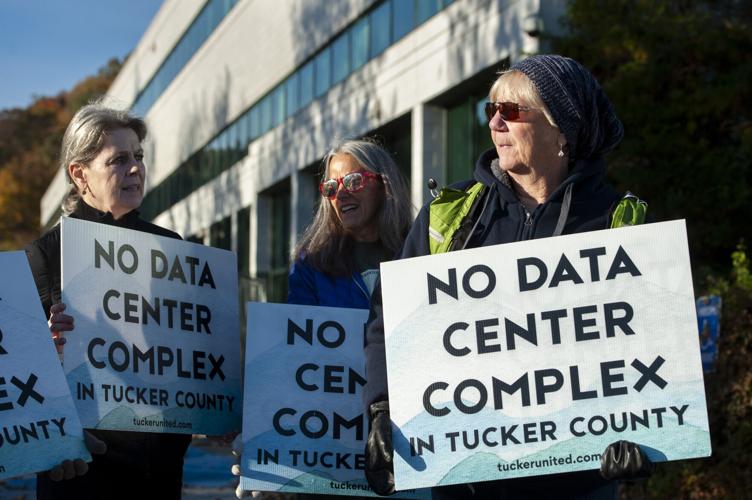
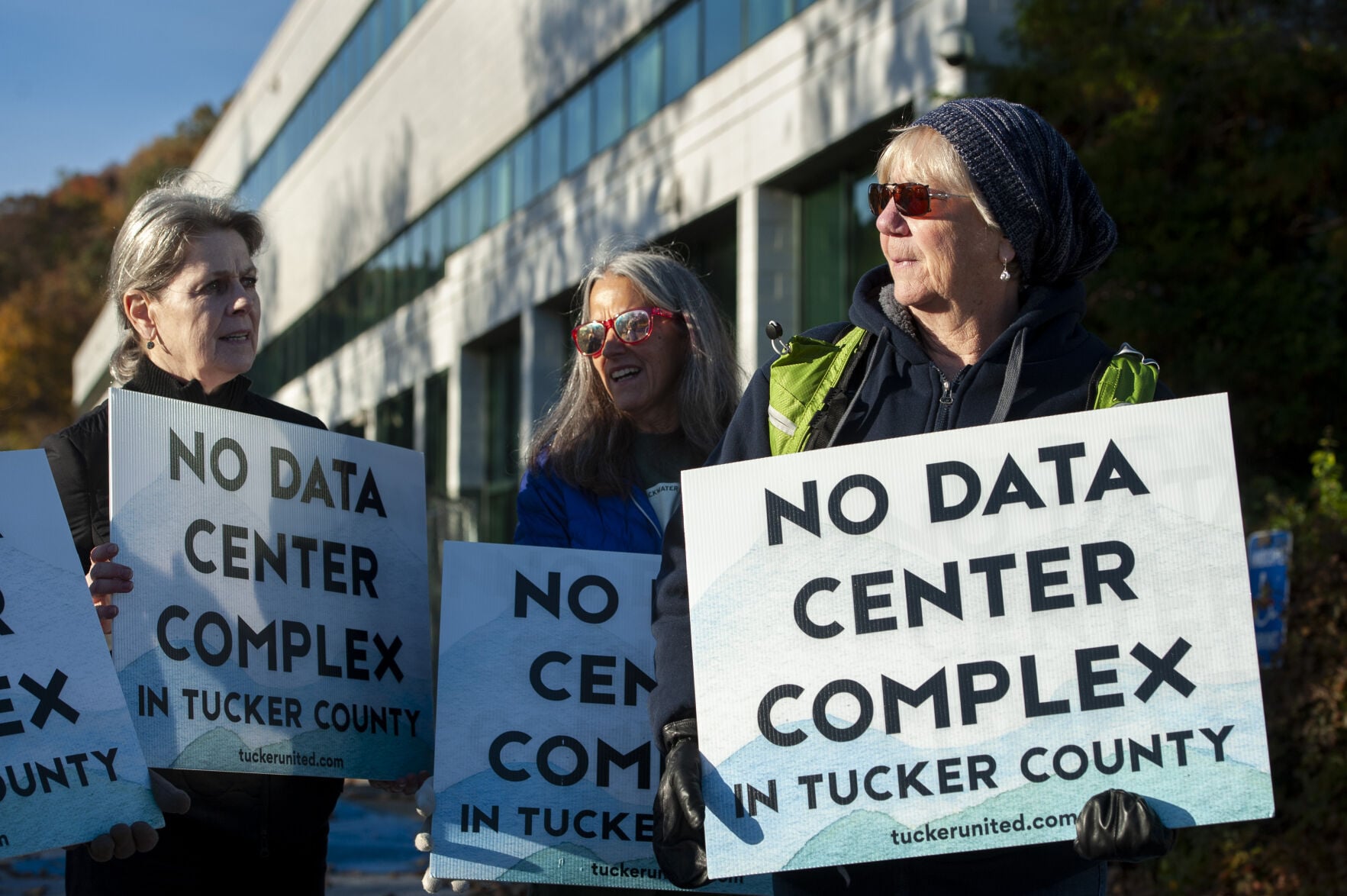
Jill Wilson (from left), Deb Mattingly and Kathy Hackney demonstrate on Nov. 5, 2025, outside a West Virginia Air Quality Board hearing at the state Department of Environmental Protection's ÂÒÂ×ÄÚÉä headquarters. The hearing was in response to community and environmental advocates' appeal of DEP approval of an air quality permit application for an expected data center-linked facility in Tucker County proposed by Fundamental Data LLC.
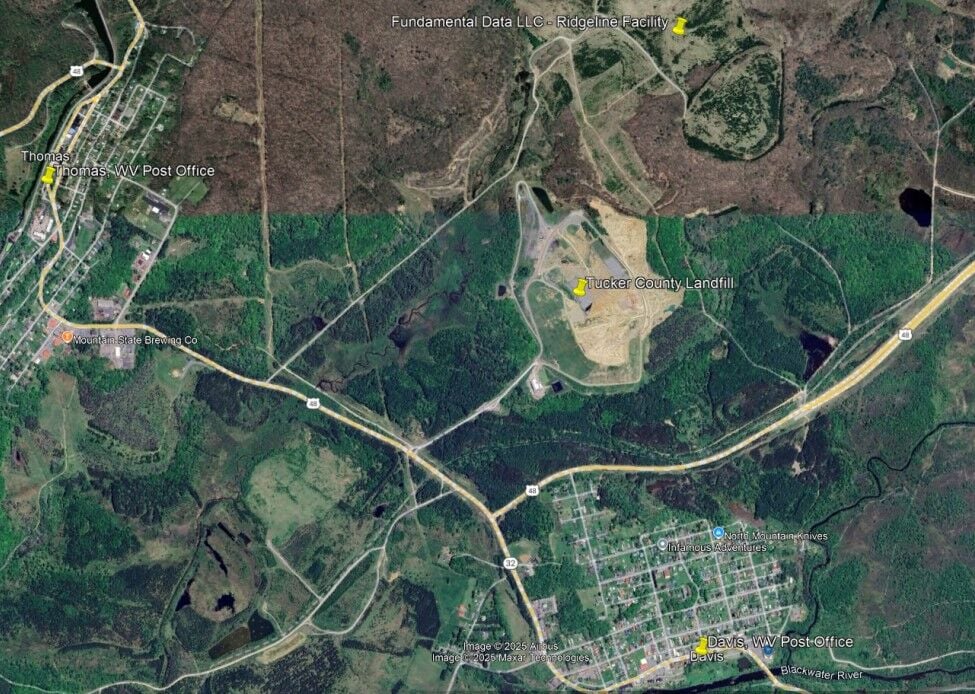
Pictured is a Google Earth aerial view of the site of a proposed gas-fueled turbine power facility in Tucker County West Virginia Department of Environmental Protection engineering evaluation, signed June 17, 2025, of a pending air quality permit application for the site from Fundamental Data LLC. The map includes markers for the proposed Fundamental site, the Tucker County Landfill and the Thomas and Davis post offices.
Pictured is a Google Earth aerial view of the site of a proposed gas-fueled turbine power facility in Tucker County West Virginia Department of Environmental Protection engineering evaluation, signed June 17, 2025, of a pending air quality permit application for the site from Fundamental Data LLC. The map includes markers for the proposed Fundamental site, the Tucker County Landfill and the Thomas and Davis post offices.
W.Va. DEP | Courtesy photo
West Virginia officials have told the developer of a controversial planned data center complex project spanning Tucker and Grant counties it appears to be violating a key state statute for large-scale data center projects.
But the developer has responded by denying that it’s violating the statute, setting up a showdown poised to test West Virginia’s ability to enforce regulations for data center projects that have become lightning rods in communities throughout the state.
The West Virginia Department of Commerce in a letter dated Thursday told Purcellville, Virginia-based Fundamental Data LLC “it appears that� the company is violating a state rule finalized in April requiring developers to seek certification from the state as a “High Impact� data center by petitioning the agency via an application containing key, basic details about the project within 30 days after they become aware that they will satisfy the definition of such a project.
The state rule that supports House Bill 2014 of 2025 requires petitioners to report:
Their proposed electrical power capacity needed to run vital computing equipment
Proposed project acreage and location
Estimated capital investment and project completion date
Proximity to schools, churches, residences, businesses, sites listed on the National Register of Historic Places, and National Historic Landmarks as designated by the National Park Service
“Any unique physical or geological condition� on any nearby parcel that could lead to the parcel “having an inordinate burden placed upon it� due to the proposed project and any actions planned to offset the possible burden
Nicholas Preservati speaks at a March 29, 2023 West Virginia Public Energy Authority meeting at the state Capitol Complex in ÂÒÂ×ÄÚÉä.
MIKE TONY | Gazette-Mail file photo
The letter signed by Nicholas Preservati, Department of Commerce deputy secretary and state Office of Energy director, cited a May 18 meeting at which the letter states Fundamental Data shared project details indicating its Ridgeline project that secured a state air quality permit last year meets the definition of a high-impact data center, a category for projects to house and operate data-processing equipment that have a power capacity of at least 90 megawatts for their computing equipment.
The Preservati-signed letter states that under HB 2014, Fundamental Data was supposed to have submitted a request for certification within 30 days of the May 18 meeting, or by Wednesday, June 17.
“No such application has been received,� the letter states.
Preservati gave Fundamental Data five business days to advise the Department of Commerce if the company had changed its plans regarding the project or believed the project wasn’t subject to HB 2014, and 10 days to file its application as a high-impact data center and microgrid — a localized power grid that can operate independently to produce electricity.
Preservati told the Gazette-Mail Thursday the May 18 meeting was held at Blackwater Falls State Park in Tucker County, with state and Fundamental Data representatives on hand in addition to members of the public. The meeting came two days after two Fundamental Data representatives made an unexpected appearance at a community meeting about the project at the Davis town fire hall in Tucker County, answering some questions and refusing to answer others regarding their plans.
Preservati acknowledged in an emailed statement that HB 2014 “does not enumerate specific penalties for violations, but the State has numerous mechanisms for ensuring compliance."
He declined to comment on the asserted mechanisms.
Fundamental Data: '[W]e will make our own decisions'
The state may have to turn to those mechanisms after the response it got from Fundamental Data.
In its own letter dated Thursday, Casey Chapman, identified in the letter as a “Responsible Individual� for Fundamental Data, argued the company isn’t violating the state rule behind HB 2014 because the high-impact data center certification “does not run to this company� and a separate certified microgrid district certification is voluntary and subject to no deadline.
Chapman contended there are no statutory grounds for 10-day filing deadline given by Preservati since it appears nowhere in the rule.
Chapman asked that the Department of Commerce confirm in writing that no violation finding has been made and that the company faces no compliance deadline.
He didn’t stop there.
“[W]e will make our own decisions regarding any regulatory pathway that may be available to us at the appropriate time,� Chapman concluded.
Fundamental Data, Chapman asserted, is not the entity that will own, operate or lease a facility “used to house and operate equipment that … processes … data� per the state’s definition of the obligation to petition for high-impact data center certification, saying that “[T]he data centers contemplated for the project remain conceptual, and what is ultimately built will be determined by the eventual users of the power we generate.
Those users may or may not qualify as high-impact data centers under the definition in West Virginia state rule, Chapman contended.
“What is certain is that the obligation under [the rule] attaches only to an entity that satisfies that definition, measured by that entity’s own awareness — and on the present record no such entity exists and no such awareness has arisen,� Chapman wrote.
Nothing in the rule imposes that obligation on a generation developer “merely because it is associated with a project,� Chapman argued.
Chapman further held that since there is “no triggering event, no 30-day clock, no compliance deadline, and no penalty� that applies to entities that may petition for microgrid district certification, Preservati’s call on Fundamental Data to file for certification within 10 days “has no basis in the rule.�
Chapman also accused the Department of Commerce of treating Fundamental Data’s participation at the May 18 meeting as “the predicate for a regulatory violation� and claimed that the company’s “candor at a public forum the agency itself convened cannot be turned into the trigger for an enforcement action.�
The Department of Commerce did not respond to a request for comment on Fundamental Data's response.
WV data economy head: no 'firsthand knowledge' of project
The company, Chapman’s letter states, “has chosen to invest in West Virginia at no cost or risk to its residents[.]�
But Tucker County residents have vocally disagreed that there’s no risk for them posed by the project.
Fundamental Data’s air quality permit application request approved byÌýthe state Department of Environmental Protection in August drew more than 1,600 comments in opposition, and residents have protested what they view in the project as an existential threat to their public health and tourism-based economy.
A study via the Harvard T.H. School of Public Health's Dominici Lab released in February estimated that Fundamental Data’s planned operation could inflict up to $35 million in health-related damages.
Jill Wilson (from left), Deb Mattingly and Kathy Hackney demonstrate on Nov. 5, 2025, outside a West Virginia Air Quality Board hearing at the state Department of Environmental Protection's ÂÒÂ×ÄÚÉä headquarters. The hearing was in response to community and environmental advocates' appeal of DEP approval of an air quality permit application for an expected data center-linked facility in Tucker County proposed by Fundamental Data LLC.
LAURA BILSON | Gazette-Mail file photo
Fundamental Data representatives at the meeting questioned the validity of the Harvard lab-generated study at the May 16 meeting, calling it unobjective and overly reliant on assumptions.
But the study by the Dominici Lab, which focuses on air pollution impacts, used the U.S. Environmental Protection Agency’s COBRA (CO-Benefits Risk Assessment screening model), which is generally viewed as a conservative estimator of potential health effects.
Tucker United, a Tucker County-based citizen group opposed to the project, the West Virginia Highlands Conservancy and the Sierra Club have fought the DEP’s air quality permit approval for the project in state court, appealing a February West Virginia Air Quality Board decision upholding the approval.
That decision followed the company's public redactions in its permit application of air emissions-related information and what the groups say is a critical underestimation of the project’s air pollution potential.
The redactions have kept the configuration of a proposed facility and information on turbines and pollution control devices Fundamental Data plans for the facility confidential.
The DEP initially challenged Fundamental Data's permit application redactions before backing down in May 2025 after the company objected to the agency's challenge.
Fundamental Data’s ability to limit its planned microgrid district area under 2,250 acres of “nearly contiguous property� as defined in state rule also has been questioned by project critics.
Fundamental Data declined an invitation to take part in a panel discussion on data centers at the Davis fire hall Monday moderated by Dan Parks, publisher and editor of area community news site Country Roads News, Parks said at that gathering.
Chris Morris, director of the Department of Commerce’s Data Economy Office established via HB 2014 to promote and coordinate data center and microgrid development, said at the panel discussion the department hadn’t received a data center or microgrid certification application for any Tucker County project.
“I don’t have any firsthand knowledge of the project,� Morris said at the event.
Morris said that “some projects that were in the works� before HB 2014 became law in April 2025 “kind of got some of the processes backwards as far as their timing,� adding that petitioners should seek water and air permits through the DEP and get approvals from other agencies after they get their data center projects certified.
Fundamental Data filed its air quality permit application with the DEP in March 2025, the month before Gov. Patrick Morrisey signed HB 2014 into law.
In a statement Friday responding to the correspondence between Preservati and Chapman, Tucker United spokesperson Nikki Forrester said the state outlined clear rules for how companies need to apply for microgrid and high-impact data center certifications, and that since Fundamental Data "did not abide by the rules established by the state," it should not be given what she called a 10-day "grace period."
“If Fundamental Data is unable to follow provisions laid out by the state and meet a clear deadline, then how can we expect the company to follow more stringent regulations surrounding the operation of their proposed power plant and data center complex?� Forrester said.
State reports sprawling, massive power wattage plannedÌý
Preservati’s letter reported that at the May 18 meeting, Fundamental Data revealed that:
The project will include a microgrid and data center
The gas-fired power plant for which Fundamental Data submitted an air quality permit application to the DEP is part of the microgrid and data center project
The gas-fired power plant will be located in Tucker County and the data center facilities will be located in Tucker and Grant counties
Fundamental Data “owns, operates, or otherwise controls� the property to be used for the project
The first phase of the project will include roughly 800 megawatts of power generated from natural gas, 1.3 gigawatts of electricity generated from solar, and 14 data center buildings that will use over 2 gigawatts of power
The second phase of the project will include an additional 3.1 gigawatts of gas-fired generation and a sufficient number of data center buildings to use that amount of generation
Those figures would make the project one of West Virginia's largest industrial complexes.
CLICK HERE to follow the ÂÒÂ×ÄÚÉä Gazette-Mail and receive