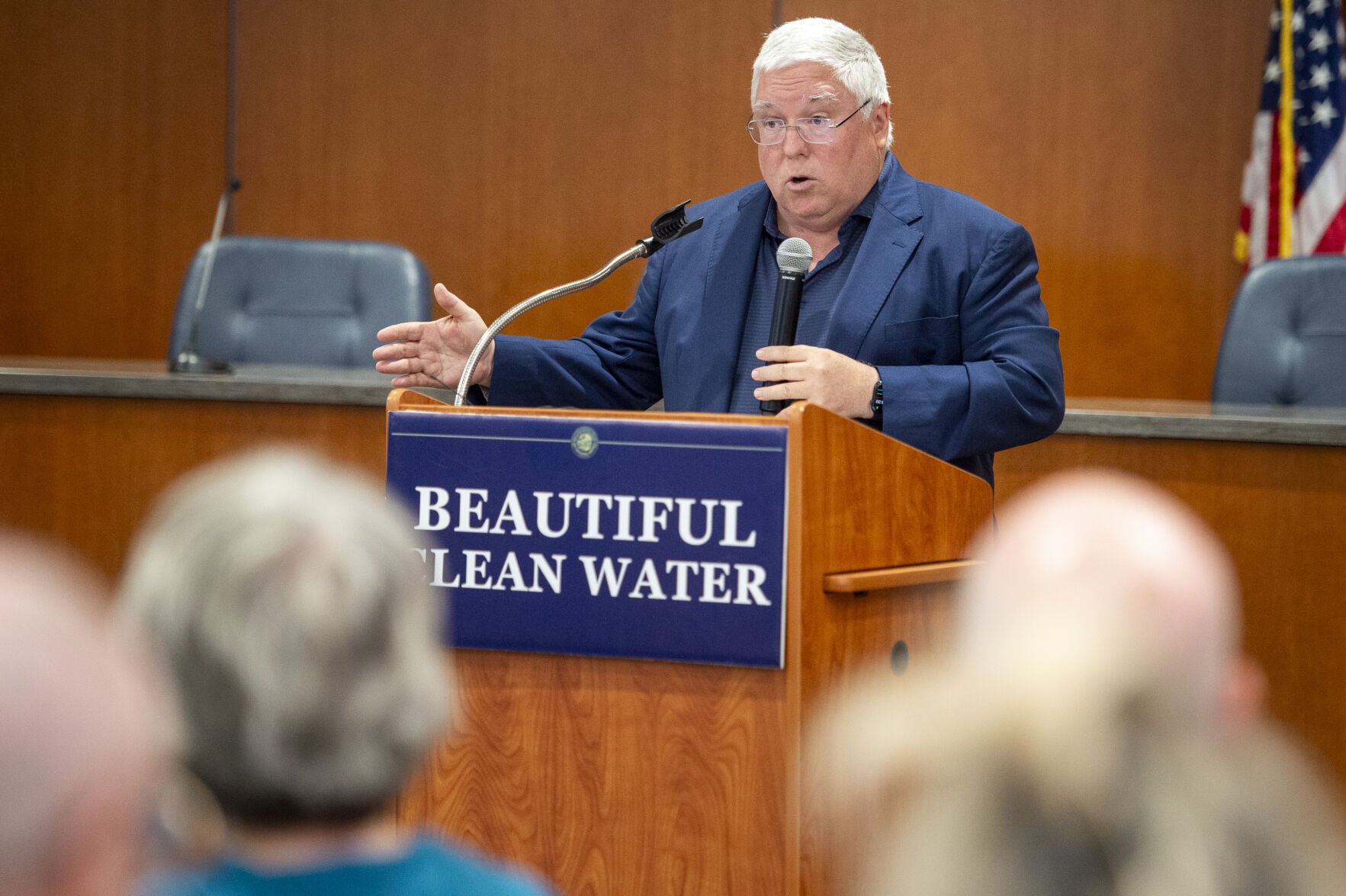
Gov. Patrick Morrisey speaks during what he billed as a "water listening tour" of southern West Virginia at the City Municipal Complex in Princeton, Mercer County, on Aug. 5, 2026.
Gov. Patrick Morrisey speaks during what he billed as a "water listening tour" of southern West Virginia at the City Municipal Complex in Princeton, Mercer County, on Aug. 5, 2026.
LAURA BILSON | Gazette-Mail
Gov. Patrick Morrisey portrayed himself as a paragon of transparency throughout what he billed as a two-day “water listening tour� of southern West Virginia counties last week during which he sought to defend his administration’s oversight regarding local water infrastructure concerns.
“I try to do my best to make sure that we’re being as transparent and open as possible on all the questions that folks have,â€� Morrisey said at an Aug. 5 news conference in Princeton to recap the tour.Â
But Morrisey’s office has frequently delayed and denied the Gazette-Mail access to basic records, concealing information about how millions in state and federal taxpayer dollars have been allocated and spent across a wide range of administration initiatives.
The West Virginia Freedom of Information Act allows inspection of public records created and maintained by public bodies.
But Morrisey’s administration has repeatedly cited a narrow exemption in the law from public disclosure requirements for “[i]nternal memoranda or letters� in denials of Gazette-Mail requests for information under the Freedom of Information Act and delayed responses to Gazette-Mail requests for months beyond the five days agencies are allotted to respond.
“The Governor’s Office rejection of public transparency is extremely concerning,� Patrick McGinley, government ethics expert and law professor emeritus at the West Virginia University College of Law, said when presented with recent Governor’s Office denials of Gazette-Mail Freedom of Information Act requests.
FOIA requests seeking water listening tour details delayedÂ
The Governor’s Office has not yet issued a final response or provided records responsive to an Aug. 4 Gazette-Mail FOIA request for written correspondence sent or received by the office’s personnel regarding scheduling or otherwise facilitating Morrisey’s two-day listening tour in southern West Virginia this month.
Governor’s Office Deputy General Counsel Katie Franklin wrote in an Aug. 11 letter that the office was reviewing its records to process the request and “anticipate[s] being able to provide you with a fuller response� on Sept. 8, more than a month after the request was filed.
The Gazette-Mail filed the request after Morrisey’s office did not make available times or locations of the stops on his tour, billed by Morrisey as southern West Virginia’s opportunity to provide feedback to him about community water infrastructure needs.
The Governor’s Office declined multiple times to provide tour stop times and locations to the Gazette-Mail, and local residents and advocates were left scrambling to find out where and when they could attend — if they could make it during prime weekday work and school hours at all.
Franklin also has told the Gazette-Mail the Governor’s Office expects to provide “a fuller response� on Sept. 8 in response to an Aug. 4 Gazette-Mail FOIA request for any records indicating project awardees, their locations and descriptions for projects receiving what the office said was more than $550 million allotted for water and wastewater projects statewide and projects receiving $174 million in state grants and loans over the last 18 months.
FOIA request on 'West Virginia's comeback' deniedÂ
The Governor’s Office on June 5 denied a May 29 Gazette-Mail FOIA request for any records in which state personnel identify any of the coal plant refurbishment projects cited in its Nov. 13 news release claiming billions of dollars in private-sector energy investments, listing as a “Key Announcement� $1.44 billion in coal plant life extensions.
Morrisey’s office announced that — in partnership with major utilities — the state had identified refurbishment projects to extend the life of six coal-fired plants by up to 20 years, preserving 10.5 gigawatts of generation capacity.
The $1.44 billion figure was listed alongside other funding commitments, by far the largest a FirstEnergy-proposed $2.5 billion natural gas plant project that has drawn the ire of ratepayer advocates due to the rate hike request and assumption of area data center development behind the plan.
But in a speech in Parkersburg the same day as his office put out the news release, Morrisey clarified that the $1.44 billion wasn’t secured by his administration. Instead, it was merely sought from the Trump administration via the Department of Energy.
Morrisey said West Virginia had “just recently� applied to the DOE to request up to $1.4 billion to extend the “reasonable, useful life� of coal-fired plants to 2045 or 2050 — beyond the 2040 date given as the latest plant end-of-life estimate among West Virginia’s utility-owned coal-fired plant fleet.
“That’s incredible,� Morrisey said. “Gas, coal and nuclear. We’re working on nuclear as well. This is West Virginia’s comeback.�
In its FOIA request denial, the Governor’s Office claimed some of the requested information was subject to a “trade secrets� exemption in the Freedom of Information Act, known as FOIA, because it includes proprietary information shielded from disclosure by the state law.
Other requested records, the office asserted, are “internal memoranda or letters received or prepared� by the office that reflect its “deliberative, decision-making process� and so are exempt from disclosure.
McGinley said that the Morrisey administration’s “blanket denial of all information about a potentially momentous turning point� for West Virginia would “no doubt raise citizen suspicions of cozy political deals with undisclosed corporate interests.�
The Governor’s Office issued a FOIA request denial to the West Virginia Chapter of the Sierra Club similar to the one it issued the Gazette-Mail after the state chapter also requested records regarding the coal plant refurbishment projects, according to state Secretary of State’s Office records.
"What we have here is a politician taking out a loan in our name, but we are not allowed to know who gets the money, what it is for, how much profit they will make, or how much we have to pay back,� Jim Kotcon, Sierra Club West Virginia conservation chair, said in a statement.
Exemption claimed on $50M loan
The Gazette-Mail on July 27 submitted a FOIA request to the Morrisey administration’s Economic Development Authority for records indicating the purpose and intended or required use of agency funding awarded to, as well as any invoices or other documents showing funding received or spent by, companies affiliated with the Omnis business network that took over the Pleasants Power Station in 2023.
The West Virginia Economic Development Authority in November 2023, with Sen. Jim Justice, R-W.Va., then serving as governor, approved a $50 million forgivable loan for Omnis affiliate Quantum Pleasants LLC to support its not-achieved conversion of the coal-fired Pleasants Power Station in Pleasants County into a hydrogen production facility with unproven technology.
Affiliate Omnis Pleasants LLC indicated in a July 27 federal court filing that the company previously misled the state and misused the loan on a self-dealing tear under former leadership that has left the plant facing bankruptcy and an uncertain future.
Omnis Pleasants LLC CEO David Hindman said so in a declaration accompanying a bankruptcy petition the company filed in federal court on July 27, reporting that its Pleasants Power Station is burdened by more than $70 million in debt obligations, including a $50.9 million unsecured loan obligation to the Economic Development Authority.
The Economic Development Authority declared defaults under applicable loan documents in July 2025, including for alleged misuse of loan proceeds, and advised Pleasants after the June 2026 maturity of its loan without repayment that it won’t accept any “consensual resolution� that places former management back in control of the plant, according to the declaration.
The Gazette-Mail already had obtained the EDA’s resolution authorizing the loan and confirmed that it included language requiring Quantum Pleasants to keep itemized records of all transactions and agreements entered into for the power plant conversion project, including the amount and purposes of project costs and expenses, company financial statements and records, the total amount of private investment in the project and the number of jobs created by the project.
But the Economic Development Authority told the Gazette-Mail all invoices and documents showing how funding was spent by Omnis companies were exempt from disclosure through FOIA under West Virginia Code Chapter 31, Article 15, Section 22, which states that “any documentary material or data made or received by the authority for the purpose of furnishing assistance to a business, to the extent that such material or data consists of trade secrets or commercial or financial information regarding the financial position or business operation of such business, shall not be considered public records.�
McGinley said what he called the “Governor’s Office rejection of public transparency� is “extremely concerning� and reflects a trend among West Virginia political leaders favoring secrecy over public disclosure that include the FOIA exemption cited by the Economic Development Authority, the Morrisey-requested House Bill 2014 of 2025 that shields data center developers from having to share basic information about their planned projects publicly, and the nearly adopted House Bill 3412 of 2025 that would have gutted state FOIA law.
Nearly year-long wait for information on FEMA responseÂ
The Gazette-Mail is awaiting a Governor’s Office final response to a FOIA request filed nearly a calendar year ago for information regarding Trump administration communications related to devastating flooding in Marion and Ohio counties that left nine people dead.
The Aug. 28, 2025, FOIA request seeks correspondence from the Federal Emergency Management Agency indicating approval or denial of any Public Assistance in response to West Virginia’s request for it connected to severe weather impacting those counties on June 14-15, 2025.
Public Assistance is a FEMA program that supports state and local governments and certain local nonprofits.
Franklin said in a July 31 letter following many delays that, “While we continue to diligently address this matter, it is apparent that this will take longer than originally expected,� and that Franklin would provide a response on Sept. 24.
FEMA denied a West Virginia request submitted June 20, 2025, for Public Assistance via an Emergency Declaration on July 22, 2025, according to a FEMA Daily Operations Briefing. FEMA approved a West Virginia Major Disaster Declaration for Individual Assistance for Marion and Ohio counties the same day, according to FEMA records — 33 days after the Morrisey administration submitted its request.
Morrisey’s office has said West Virginia subsequently waited on a federal decision on a request the state submitted for Public Assistance on July 23, 2025, as an add-on to its request for a Major Disaster Declaration after a joint review between state and federal partners.
On Sept. 11, 90 days after the June 2025 flooding hit northern West Virginia, Morrisey’s office announced Public Assistance had been approved for Marion and Ohio counties.
State employee guidance response called 'nonresponsive'
On July 30, 2026, the Governor’s Office responded to a Nov. 18, 2025, Gazette-Mail FOIA request for any guidance issued by the office under Morrisey including policies or regulations for classified-exempt employees.
The Gazette-Mail’s request was a response to the Legislature’s passage of Morrisey-requested legislation in HBs 2008, 2009 and 2013 that barred employees of the Bureau of Senior Services and the departments of Administration, Economic Development, Environmental Protection, Revenue, Tourism, and Veterans’ Assistance from the state’s classified civil service system and stripped them of the right to grievance procedures.
After over eight months of delays, Franklin issued a response saying responsive records in its possession were protected by FOIA language exempting a public body from having to disclose “[i]nternal memoranda or letters received or prepared by any public body[.]�
Franklin’s letter provided links to state Division of Personnel agency resources and laws that included some related guidance, including that agencies are not required to post classified-exempt vacancies and that there is no requirement to conduct annual employee performance appraisals.
But McGinley called Franklin’s response “nonresponsive,� noting that it asserted that unidentified responsive public records were exempt from disclosure because they were subject to state exemption mirroring federal exemptions which recognize “attorney-client,� “attorney work-product� and an executive "deliberative process" privilege.
The Gazette-Mail did not request attorney-client, work product or deliberative process information in records.
McGinley observed that a 1996 West Virginia Supreme Court of Appeals decision in Daily Gazette Co. v. West Virginia Development Office held that the deliberative process privilege only exempts from disclosure public records of a pre-decisional deliberative process prepared before an agency makes a final decision.
The agency must establish “what deliberative process is involved, and the role played by the documents in issue in the course of that process,� the court held, noting that the state FOIA imposes upon government agencies "the burden of showing the express applicability of [the claimed] exemption to the material requested.�
Letter on Linville salary, duties 'ignored your request'
The Gazette-Mail on June 30 submitted a FOIA request to the Governor’s Office seeking records indicating salary or financial compensation for former state Daniel Linville, R-Cabell, to serve as director of special projects following Morrisey’s June 29 announcement of his appointment of him to that position. The Gazette-Mail also requested records indicating duties to be asked of him, including any employment agreements or contracts between Linville and the office.
On July 29, the Governor’s Office issued a final response reporting that Linville’s gross annual salary is $120,000 and that, beyond a one-sentence summary of Linville’s duties in a news release cited in its response, it was “withholding any draft, internal and deliberative communications, and attorney-client communications that may be related to specific tasks or duties� as exempt “internal memorand[a].�
“The Governor’s Office letter did not respond to your request,� McGinley told the Gazette-Mail. “Rather, it ignored your request and simply asserted a number it claims is Linville’s salary. A public body’s obligation under FOIA is to make available to a citizen or media requester public records containing the information requested.�
'The people insist on remaining informed'
Letters from Franklin have advised seeking legal relief in Kanawha County Circuit Court following the office’s FOIA responses — potentially a significant burden for citizen requesters. Amid delays in responses, Franklin has said to “please let me know� of “any questions� but hasn’t responded to questions regarding the cause of the delays in responses.
Governor’s Office spokesperson Lars Dalseide said in an email Tuesday that “even seemingly narrow inquiries can require significant time and review.�
The Governor's Office, Dalseide said, has received 187 FOIA requests since January 2025. The office said it quantified records generated by 30 of those requests and that those 30 requests produced just over 300,000 pages requiring review.
Requests by this reporter comprised 34 of those 187 FOIA requests, or roughly 18% of all FOIA requests the office has received, Dalseide added.
“The Administration conducts electronic searches for almost every FOIA request and rarely denies requests simply because they are broad,� Dalseide said in an email.
McGinley, though, says the Governor’s Office has ignored the underlying goal of the FOIA, which he identified, in part, as this:
“The people, in delegating authority, do not give their public servants the right to decide what is good for the people to know and what is not good for them to know,� the law states. “The people insist on remaining informed so that they may retain control over the instruments of government they have created.�
CLICK HERE to follow the ÂÒÂ×ÄÚÉä Gazette-Mail and receive