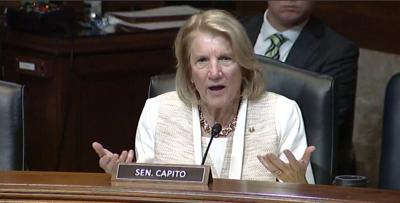
United States Shelley Moore Capito, R-W.Va., addresses Acting Attorney General Todd Blanche during a Senate Commerce, Justice, Science, and Related Agencies Subcommittee hearing on May 19, 2026.
Law experts and ethics watchdogs are calling out President Donald Trump for what they view as a flagrant act of corruption by his administration, fueled by more than $1.7 billion in allegedly misused taxpayer dollars.
West Virginia’s congressional delegation, though, is being quiet on the 10-figure, potentially constitutional boundary-costing matter.
Trump’s Department of Justice on Monday announced that it’s establishing a $1.776 billion compensation fund that could benefit his supporters who claim they have been wrongly prosecuted or otherwise targeted as “victim[s] of Lawfare and/or Weaponization,� as part of a deal to resolve his $10 billion lawsuit against the IRS over a leak of his tax returns.
The unusual agreement that creates that broad category of possible beneficiaries has been condemned by ethics authorities, Democrats and even some prominent congressional Republicans as a corruptly unilateral deal by Trump as president with himself as plaintiff — one that fits with his claims that the Department of Justice under former President Joe Biden was weaponized against him.
Backing the new “Anti-Weaponization Fund� in a statement Monday -- and before a Senate panel that included Sen. Shelley Moore Capito, R-W.Va., on Tuesday -- was acting Attorney General Todd Blanche, who was Trump’s private criminal defense attorney before the president appointed him to lead the Department of Justice.
“The machinery of government should never be weaponized against any American, and it is this Department’s intention to make right the wrongs that were previously done while ensuring this never happens again,� Blanche said in his statement, adding that his agency was “setting up a lawful process for victims of lawfare and weaponization to be heard and seek redress.�
But nonpartisan government ethics and legal experts say the Trump-approved fund is a self-dealing channel for taxpayer-extracted payouts for Trump allies who harmed law enforcement officers in the Jan. 6, 2021, attack on the Capitol.
The Capitol breach left a 35-year-old woman fatally shot, a Capitol police officer dead by suicide shortly afterward, dozens of officers injured, lawmakers hiding from rioters and the Capitol itself vandalized.
“It’s a breathtaking abuse of the tax and legal system,“ Brandon DeBot, policy director at the Tax Law Center at the New York University School of Law, said in a statement.
“This settlement should shock the conscience of all Americans,� the Society for the Rule of Law Institute, a conservative legal advocacy group led by former appointees of and advisers to previous Republican presidents, said in a statement.
But none of the spokespeople for the four members of West Virginia’s all-Republican congressional delegation responded to requests for comment on the fund. Capito, Sen. Jim Justice, Rep. Carol Miller and Rep. Riley Moore haven’t addressed the fund plan in statements they made in the four days that followed its announcement.
United States Shelley Moore Capito, R-W.Va., addresses Acting Attorney General Todd Blanche during a Senate Commerce, Justice, Science, and Related Agencies Subcommittee hearing on May 19, 2026.
At a Senate commerce, justice, science and related agencies subcommittee hearing Tuesday, Capito didn’t join other subcommittee members in questioning Blanche about the fund.
Capito instead asked Blanche to defend the Department of Justice’s uncommonly high rate of staff turnover under Trump, questioning him about departures in the “upper echelons of� the department, which she suggested weren’t a “political statement� but instead “the cost of doing business, and ebb and flow of workforce.�
“[I]sn't this the way it's always been at DOJ, people moving in and out?� Capito said to Blanche.
“[S]ometimes people come in and sometimes people leave,� Blanche replied, saying, “it’s not a political statement.�
But there has been a mass exodus of staff away from the Department of Justice under Trump.
The disintegration of the department’s past independence from the White House in the Trump administration comes after the department has shed thousands of employees under him, fueling concerns that the agency has become politicized and hobbled with him in power.
Stacey Young, founder and executive director of Justice Connection, a group of former prosecutors, judges, national security experts and other former Department of Justice officials — at a National Press Foundation event in Washington in October focused on federal government changes under Trump — reported a purge of 5,300 agency employees under Trump.
A former senior Justice Department attorney who worked under five presidential administrations in the department’s Civil and Civil Rights divisions, Young said that total included immigration judges, civil rights lawyers and counterintelligence analysts.
The American Bar Association Journal reported in November that the Department of Justice had lost thousands of experienced attorneys since the start of the Trump administration and backfilled only a fraction of the open jobs, a process it said was marred by a lack of qualified candidates, bureaucratic delays and hiring freezes.
Under Trump, prospective DOJ hires have been more likely to have political backgrounds than in the past, coming from Republican congressional offices and advocacy groups, with young attorneys with little relevant experience or mid- to late-career attorneys who have no background in prosecutions also getting more consideration, per the American Bar Association Journal.
In January 2025, soon after taking over for his second term, Trump fired 18 inspectors general, including those that oversaw the departments of State, Defense, Transportation, the Interior, Energy, Agriculture and Veterans Affairs, and the Environmental Protection Agency. The inspectors general were nonpartisan watchdogs appointed to guard against waste, fraud and abuse of power across federal agencies, sparking concern among government ethics experts and congressional leaders in both major parties.
Partnership for Public Service, a nonpartisan civil service advocacy group, released an analysis last month finding Trump’s Fiscal Year 2027 budget proposal would enact deep cuts to Office of Inspectors General funding and portend further staff reductions, with cabinet department Office of Inspectors General to receive an average of 12% less in appropriations than they got in 2024.
“Budget reductions of this magnitude would directly constrain what OIGs can do,� Partnership for Public Service said in its analysis.
Congress determines Office of Inspector General appropriation levels, but Trump still managed to reduce the average Cabinet department OIG staff by 10% in his first year, per the Partnership for Public Service analysis.
“It makes no sense to me to have that cut [proposed for inspector general offices], and I think it speaks volumes of what this administration is really focused on,� Sen. Gary Peters, D-Mich., told Blanche at Tuesday’s hearing. “And it's not about reducing waste, fraud and abuse.�
Senate Republicans on Thursday left Washington in gridlock on whether to block the Trump-planned $1.776 billion compensation fund, a sign of the proposal repelling members of Congress across party lines.
'End-run around the legal process'
Last month, a federal judge cast doubt over the constitutionality of the Trump $10 billion lawsuit against the IRS and Department of the Treasury.
Florida District Judge Kathleen Williams said it is unclear whether Trump and the agencies are “sufficiently adverse to each other.�
But the settlement agreement announced by the DOJ effectively has allowed it and Trump to avoid judicial review of the lawsuit even though legal scholars have found the claims driving it to be suspect.
“[T]his settlement is an end-run around the legal process,� the Tax Law Center said in a statement on the deal.
Democracy Defenders Fund, a nonpartisan democracy advocacy group, released a brief finding the Trump-planned payout fund likely violates the U.S. Constitution’s Domestic Emoluments Clause barring a president from accepting profit from the United States beyond their salary.
A settlement paid into a newly established fund to benefit the president's loyalists likely constitutes an emolument since the president is getting “an extraordinary advantage by virtue of having a vehicle to give away more than $1.7 billion to his political supporters, assuring him of their ongoing loyalty,� the Democracy Defenders Fund said in its brief.
'Unlawful and awful'
The settlement agreement alleges that the Biden administration abused the FACE Act, a federal law prohibiting intentionally injuring, intimidating or interfering with people obtaining or providing reproductive health services or exercising the First Amendment right of religious freedom at a place of religious worship. It also alleges without explanation that the Biden administration wrongfully labeled “certain parents as domestic terrorists� and that the IRS targeted groups “based on improper ideological criteria.�
The settlement creates a five-member commission to distribute the allotted $1.776 billion in taxpayer dollars and has raised due process concerns since it appears poised to operate with little transparency mandated regarding the recipients or application process.
The agreement directs the Anti-Weaponization Fund to provide to the attorney general confidential, quarterly written reports that include the name and address of each claimant who has received any relief and if so, the “nature of such relief.�
Blanche said at this week’s congressional hearing that the quarterly reports would be made public, but with a caveat that the department would have to comply with “applicable laws that exist around privacy and privileges.�
That could mean no public list of fund beneficiaries under the Privacy Act of 1974, which generally bars federal agencies from disclosing records about an individual without their written consent, although there are exceptions.
At a congressional hearing this week, Blanche said quarterly reports about the fund expenditures would be made public in order to provide “full transparency.� He added a caveat — that the department would still have to follow federal privacy laws when releasing the reports.
The Citizens for Responsibility and Ethics in Washington, a nonpartisan government watchdog nonprofit that filed a federal lawsuit against the DOJ, Department of the Treasury, IRS and other Anti-Weaponization Fund-aligned defendants Friday, in a statement called the DOJ's payout move a "slush fund" that is “unlawfully structured to evade transparency laws including the Freedom of Information Act and the Federal Records Act."
“This is the most outrageous example of corruption of any U.S. presidency in American history," Democracy Defenders Fund co-founder and executive chair Norm Eisen, special counsel to the president for ethics and government reform under then-President Barack Obama, said in a statement. "In essence, this is similar to Trump driving to the Treasury, seizing $1.8 billion, and heading to a picnic with Jan. 6 insurrectionists and throwing that money into the air. This is unlawful and awful, the public is rightfully outraged, and the legal fights have only just begun."
Mike Tony covers energy and the environment. He can be reached at mtony@hdmediallc.com or 304-348-1236. Follow @Mike__Tony on X.Â