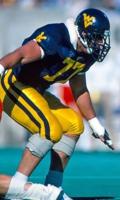
MORGANTOWN, W.Va. (WV News) — Brian Jozwiak still can't quite believe his eyes.
"Total devastation," he said. "It looks like a nuclear bomb has gone off."
He was talking about his neighborhood, from Venice to Fort Myers in Florida.
"Utter destruction," he said.
He'd just returned to his home — which was damaged but not destroyed when slammed into by Hurricane Ian two days ago — from traveling down the coast of Florida.
Ground zero.
He thought he'd known grief, known sorrow. After all, he was an All-American offensive tackle on the 1988 West Virginia University football team that stood on the doorstep of a national championship, facing Notre Dame in the Fiesta Bowl.
Eleven-and-zero they were and they expected to win, right up until Major Harris, the quarterback around whom the offensive was built, injured his left shoulder.
That losing feeling that day churned inside his stomach, as it did with his teammates, but as an athlete you know you can lose a football game, even if you are 11-0.
As a human being, though, it's so much more. Your life, your heart, your very existence is involved when Mother Nature shows you who's boss.
"There were elderly people, people with special needs, low-income people," Jozwiak noted.
The hurricane didn't care.
Jozwiak evacuated to his daughter Bri's home in Polk County up in Orlando.
Others stayed and took it on the chin.
"My neighbor is in her 80s," Jozwiak said. "She stayed. It took her roof right off the house."
Across the street, a neighbor's carport caved in on the car.
Jozwiak's damage, he sighs, wasn't as bad. A tree down, some damage to the house, but all and all he couldn't complain, considering what he'd seen around him.
But what was it like being in the midst of a hurricane?
Brian Jozwiak is 6-foot-8 and played at around 300 pounds, a physical specimen.
He is hard to impress, but he was impressed with what he saw up near Ocala, where the winds reached 100 miles an hour and was still a Category 3 or 4 as it roared through.
"It's nerve-wracking," he said. "It just doesn't stop. Think of it, 120 miles an hour for eight hours. It sounds like a freight train. It's scary. And at night it's scarier. You can't see nothing. You'd hear things banging into the things."
Tree limbs, shingles, street signs flying through the air.
And on the shore there was the storm surge, some areas up to the front door, others to the roof.
"Tampa Bay was empty," Jozwiak said, the wind having blown the water inland.
And when it was over and he drove home to see his area, what was the feeling in the pit of his stomach?
"It was such an empty feeling," he said.
But it didn't take long to fill the void, for he saw people coming together in the face of tragedy, offering up both physical aid and psychological.
As Jozwiak was pulling out of a residential park that had been devastated, The manager of the park was at the entrance and the manager summoned him over.
"We will rebuild," he said.
That got to Jozwiak.
"We are resilient in times of disaster," he said. "When something like this occurs, people pull together. In a time of crisis, we see to each other's needs."
Jozwiak knows it's a long-term reconstruction of a big part of Florida ahead, but he plans to stay.
"I'll go to my daughter's house. She has an extra room and I'll be there to see my grandchild born," he said.
Nothing like the renewal of life at a time like this.


Counter-conditioning helps cats rewire their fears after a traumatic incident, like losing a housemate. This usually involves food or treats o…