



As if there wasn’t enough news emanating from West Virginia’s athletic programs over the past few months, there have also been a number of items concerning the NCAA percolating across the college landscape.
These are just the latest proposals of what now feels like a never-ending stream of issues facing the embattled organization, which have been gaining steam since changes were approved around NIL, open transfers, Alston payments and more player empowerment in general.
While these issues take up a great deal of oxygen and serve to detract from the actual games and competitions, they can’t be ignored. They are going to have far-reaching and long lasting effects on what college sports will look like in the future.
Many of these issues and actions are complex and have many different angles — we could probably devote an entire issue to discussing all of them. To avoid that, we’ll start with some of the simpler actions that administrative groups have taken recently.
Recently the Division I Council approved several actions, including the elimination of the voluntary coach designation in baseball, softball and hockey, and increased the number of countable coaches allowed in each sport to four.
That means West Virginia baseball will be able to add a paid coaching spot to serve under Randy Mazey, and alongside Steve Sabins and Mark Ginther.
WVU’s current volunteer assistant is Jacob Garcia, who joined the program in 2019, so it’s possible that he will fill that additional paid position.
In more of a procedural move, the Council also supported an increase of two coaching positions in both men’s and women’s basketball.
These coaches would be able to do everything the current four coaches per team are allowed to do, other than recruit off-campus.
Schools have had staff members filling these roles under a waiver that allowed them to participate in skill instruction, so this move will bring those staffers under the coaching umbrella.
The Council also eliminated a criterion that was long watched by recruiting aficionados — the use of standardized test scores as one of the requirements for immediate eligibility.
A generation of potential college athletes had to sweat out some of those test score bars, but now those will no longer exist.
The NCAA had temporarily waived those requirements in 2020 due to the effects of COVID on test scores and education in general, but they are now off the board permanently.
Only a degree, and a minimum number of core classes and an acceptable GPA, will be required to participate as a freshman.
It’s not hard to imagine, as the body continues to lessen requirements and give more and more to athletes, that in a few years there won’t be any national academic requirements at all for eligibility — only what each school or conference might deem appropriate.
Finally, and very frustratingly for a certain WVU athlete, the Council passed new guidelines for those players wanting to transfer a second — or third or fourth — time.
Those players must request a waiver for immediate eligibility, and must show either an injury or mental health condition that required a transfer, or special circumstances such as abuse or sexual assault that forced a transfer.
Of course, the Council also left itself a loophole, noting that “each waiver request will be evaluated on a case-by-case basis,� so again, it’s not hard to imagine that whoever hears a waiver request will be able to find a way to approve anything he or she wants.
This rule doesn’t go into effect until the 2023-24 season, but there’s no way to avoid the conclusion that the NCAA used this as the basis for denying WVU’s Jose Perez’ application, and appeal, for immediate eligibility this year after his transfer from Manhattan, which came after transfers from Marquette and Gardner-Webb.
On a more far reaching front, the NCAA’s Division I Transformation Committee released its final report, a 48-page document that listed a number of recommendations for changes and restructuring the organization, but not much is included that would be considered ground-breaking or anything close to what was hoped for when the group was formed.
That’s no surprise, as the Committee was headed by SEC Commissioner Greg Sankey, who would be perfectly happy to keep things just as they are, with an ineffectual NCAA unable to control or regulate much in the world of college sports.
That would leave his conference, along with the Big 10, as the de facto powers with outsized influence in a landscape that has no regulation over NIL and diminishing power in many other areas.
Among the positive recommendations proposals are two years of medical coverage after college for injuries sustained there, degree completion fund availability for 10 years, and support services for mental health, academic, career, diversity inclusion and life skills services.
Of course, most of the latter have already been put in place by many schools, including WVU, so none of this qualifies as very transformative.
Undeniably, some of the recommendations are good, as they cover improved support for athletes in terms of physical and mental well being and better support for the championships the NCAA stages, but in terms of getting it to a position where it can make and enforce rules, there was nothing.
One proposal that did catch the eye was a recommendation to consider and study the inclusion of 25% of participating schools in a Division 1 championship event where more than 200 schools compete.
So, for example, in men’s basketball, where 363 teams are playing this year, the NCAA tournament would include at least 90 teams.
Many other sports, such as baseball, cross country, golf, tennis and track would also see big jumps in terms of postseason inclusion.
Past that, though, the meat of what the Transformation Committee was intended to address was left on the bone, especially in the area of enforcement and rules making.
While the final report indicates the desire to speed up the oversight and enforcement of rules infraction cases, there are no specific recommendations on how to do that.
For example, the report states the desire to “ensure the scope of the enforcement staff’s investigation (to prioritize) timeliness,� but has no recommended rules to be made or exactly how that will occur.
Instead, it recommends that the Division I Oversight Council establish subcommittees to study and create a new system to monitor and regulate rules in new areas. Wasn’t that what the Transformation Committee was supposed to do?
Behind the scenes, the NCAA clearly wants the federal government to create legislation and rules that cover some of these areas, especially NIL. Congress, of course, wants no part of that, as it’s a no-win situation that will anger a significant percentage of its constituency one way or the other.
State level NIL rules aren’t being enforced and are largely ignored, and without a huge investigative body, it would figure that any nation-wide laws would fall into the same category.
Thus, while the NCAA and the Transformation Committee are blowing their own horns with many of their recommendations, in the area of rules breaking, investigations and enforcement, nothing has changed.

West Virginia filled several coaching positions last week, hiring a new basketball assistant, a new football assistant coach and using a promotion for the open offensive coordinator job on the football side.
* * * * * *
DerMarr Johnson was hired by WVU men’s basketball coach Bob Huggins for an assistant coaching position that was left vacant after the dismissal of long-time associate head coach Larry Harrison on Jan. 12.
Johnson played for Huggins at the University of Cincinnati (1999-2000) before going on to spend 16 seasons in professional basketball, including seven in the NBA.
“Obviously, DerMarr is a guy who I know very well,� Huggins said. “He has a great amount of experience from being the national player of the year in high school, to the Conference USA Freshman of the Year, to the NBA and to a 16-year professional basketball career.
“He’s extremely well-liked by former players, coaches and fans alike. He has a tremendous presence in the Washington, D.C. area, being one of the most-recognized athletes to come out of there in a long time. I’m thrilled that he’s joining our program and look forward to him getting on the court.�
A native of Washington, D.C., Johnson had recently been working at Cincinnati, where he was the Bearcats’ director of player development for the men’s basketball program, a job he had held since May 2021. In that role, he oversaw individual development plans for UC and coordinated details related to connecting with former players.
“I’m excited for this opportunity to work with my coach, and I’m looking forward to getting to know and working with the players and staff,� Johnson said. “I can’t wait to get started to help this basketball program.�
A 6-foot-9 guard, Johnson played one season (1999-2000) at Cincinnati for Huggins, averaging 13.0 points and 3.7 rebounds in being named Conference USA Freshman of the Year, while playing on a team that featured national player of the year Kenyon Martin, as well as All-American Pete Mickeal, Steve Logan and Kenny Satterfield. Cincinnati was ranked No. 1 in the country for 12 weeks that season while posting a 29-4 record and claiming the Conference USA regular-season title.
In the 2000 NBA Draft, Johnson was selected as the sixth pick of the Atlanta Hawks. He played for the next seven seasons for four NBA teams, overcoming an automobile accident where he fractured four vertebrae in his neck following his second year in the league. Johnson played for the Hawks from 2000-03, New York Knicks from 2003-04, Denver Nuggets from 2004-07 and San Antonio Spurs from 2007-08. For his NBA career, he played in 344 games, starting 136 of them.
Following his NBA career, he continued to play professionally until 2016, competing in China, Italy, Saudi Arabia, Venezuela, Colombia, Lebanon, the Philippines, Argentina, Puerto Rico and the Dominican Republic.
Once his playing career ended, he joined the Cincinnati staff in 2017 as a student assistant coach, completing his undergraduate degree in 2019.
Johnson was a consensus McDonald’s, Parade Magazine and USA Today high school All-American as well as Parade’s National High School Player of the Year in 1999 at Maine Central Institute in Pittsfield, Maine.
* * * * * *
Graham Harrell spent one year as the offensive coordinator for the Mountaineer football program, leaving this offseason to take a similar position at Purdue.
WVU head football coach Neal Brown didn’t have to look far to find his new O.C., as he appointed current assistant coach Chad Scott to that position.
“Chad knows what our strengths are, and he has earned this opportunity,� said Brown of West Virginia’s fifth-year running back coach. “I have coached with him for 13 years, and I trust him and the positive energy he brings every day to our team.
“Coach Scott has been a part of elite offenses in the past at Troy, Texas Tech and North Carolina and that experience has prepared him for this leadership role. The fact that he has built strong relationships with our players and is a tremendous teacher of the game will have a positive effect on our entire offensive unit.�
Scott was the co-offensive coordinator for his first three years at West Virginia before serving as the run game coordinator in 2022. Scott will continue to lead the running backs in addition to his new duties as offensive coordinator.
“I appreciate Coach Brown’s confidence in me to take this next step in my coaching career and become the offensive coordinator of the Mountaineers,� Scott said. “We have a strong nucleus returning, and we know what we need to do to be successful on offense. It’s time to get to work.�
Prior to WVU, Scott worked with Brown during three different coaching tenures: Kentucky (RB/2013-14), Texas Tech (RB/2010-12) and Troy (RB/2007-09). He also was a teammate with Neal Brown at Kentucky. He came to Morgantown after serving as the tight ends and hybrids coach at North Carolina from 2016-18.
Scott will enter his 18th season as a collegiate coach that has included stops at Troy, Texas Tech, Kentucky, North Carolina, Louisville and West Virginia. He also spent time in the National Football League with the Cleveland Browns and Pittsburgh Steelers.
A native of Plant City, Florida, Scott graduated from UNC in 2004 with a degree in sociology. He is married to the former Brica Jones, and the couple has a daughter, Kori, and a son, Jakobe.
* * * * * *
Brown also hired a new wide receiver coach, Bilal Marshall, a couple weeks ago, and then last Friday announced the hiring of Blaine Stewart to fill WVU’s final opening in its football coaching staff.
Stewart will coach West Virginia’s tight end, and last year’s tight ends coach, Sean Reagan, will switch back to working with the Mountaineer quarterbacks. Reagan had previously coached WVU’s QBs before moving over to tight ends prior to the 2022 season to make room for Harrell at the quarterback spot.
“Blaine Stewart is certainly no stranger to West Virginia University football,� explained Brown. “His father was a part of this program for 11 years, including three as the head coach, and Blaine grew up around Mountaineer football. I am happy to welcome him home.�
Stewart comes to the Mountaineers from the NFL’s Pittsburgh Steelers, where he has worked as the assistant wide receivers coach for the past two years. In that role, he assisted in game plan preparation and installation, coached the defensive scout team, broke down opponent film and conducted self-scouts. He assisted a wide receivers room in 2020.
From 2018-20, Stewart was a coaching assistant on Mike Tomlin’s staff in Pittsburgh, and he brings a total of four years of NFL experience with him to Morgantown.
In his first two NFL seasons, he worked with the offense and special teams and was responsible for quality control of the entire offensive unit. He coached the defensive scout team, compiled weekly offensive installation plans and produced opponent scouting reports. Stewart also played a significant role in leading the wide receiver position group during a coaching vacancy as well as helping the personnel department prepare for the NFL Draft and free agency.
“He has worked with multiple position groups, coordinators and offensive systems with the Pittsburgh Steelers to go along with their special teams,� said Brown of Stewart. “I have a tremendous amount of respect for coach Mike Tomlin and the entire Steelers organization and Blaine comes highly recommended.
“He builds relationships, and you can tell that he is the son of a coach. He knows and has worked with members of our current coaching staff in the past, which will also be an asset. His enthusiasm and love for this program will be contagious.�
During his four seasons with Pittsburgh, the Steelers were the AFC North Champions in 2020 and made the playoffs twice. He coached three Pro Bowl receivers in Antonio Brown, JuJu Smith-Schuster and Diontae Johnson.
In January 2020, Stewart coached the West quarterbacks at the East-West Shrine Bowl, leading individual meetings and being involved in all aspects of offensive installation, game planning and practice schedules.
“I am so thankful to Coach Neal Brown for the opportunity to return home to a program that means so much to me and my family. West Virginia will always hold such a special place in my heart,� Stewart said. “It is an honor and privilege to come home to represent not only the University but the entire state. I am ready to get to work to provide a product that Mountaineer fans will be proud of on and off the field.�
A 2013 graduate of Morgantown High School, Stewart started his collegiate playing career at James Madison (2013-15) as a wide receiver and holder for coaches Mickey Matthews and Everett Withers. He finished his playing career at the University of ÂÒÂ×ÄÚÉä (2016-17) where he was coached by former Mountaineer football staff member Pat Kirkland. He earned two varsity letters at each school for a total of four as a collegiate player.
He received his bachelor’s degree from James Madison in 2016 and a master’s degree from ÂÒÂ×ÄÚÉä in 2017. Stewart played high school football at Morgantown High School for coach John Bowers. While at MHS, Stewart also played baseball and ran track.
Blaine is the son of the late West Virginia head football coach Bill Stewart, who led the Mountaineers to a 28-12 (.700) three-year record from 2008-10. His mother, Karen, still resides in Morgantown.

The Town of Clendenin will hold its election for mayor, recorder and five town council positions on Tuesday, June 13.
DR. BETTY-LOU WATERS, 81 of Powellton, passed away at home on August 10, 2022. She was one of three children born to William and Dorothy Water…
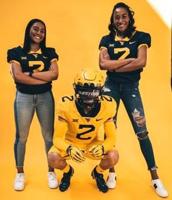
Rodney Gallagher didn’t rest on his laurels this past summer.
Since committing to West Virginia’s football program on May 25, the four-star receiver from Laurel Highlands High School in Uniontown, Pennsylvania, concentrated more on his craft than all the outside aspects that go with being one of the nation’s most highly recruited two-sport prospects.
“It’s changed a lot,� Gallagher said of his work this summer. “I focused on football and getting better at the things I need to work on. I made sure my body was getting better, and I’m way better mentally now that my recruitment is done. I’m glad I got that out of the way.�
Gallagher’s recruitment was intense prior to his commitment to WVU in the spring. He also strongly considered Notre Dame, Penn State and Virginia Tech, as well as Pitt, Texas, Oklahoma State and Oregon. He took visits to many of those suitors.
“When I first started being recruited, I had a lot of fun with it,� noted Gallagher in a recent interview on the “MetroNews Statewide Sportsline.� “But when I came closer to being a senior, closer to a decision, it got hectic.
“I developed a lot of great relationships with coaches, and I had fun visiting a lot of the schools, but in the end, you can only pick one,� he added. “It got crazy at the end with all the calls and texts. Eventually, you have to man up and make a decision, and that meant calling the coaches and delivering the news. I’m glad that I found a school I wanted to go to. I’m comfortable with my decision.�
In all, Gallagher had scholarship offers from dozens of FBS programs, but West Virginia, whose campus is about a 20-minute drive from his Fayette County, Pennsylvania, home, was involved early, and he quickly developed a strong relationship with WVU coach Neal Brown and his Mountaineer staff.
“My first contact (with WVU) was after my freshman year,� recalled Gallagher. “At the time, I was really focused on basketball, but I surprised some people on how well I did in football as a freshman. My phone started ringing after that. I think I got eight offers in one day, and it continued from there.
“Coach Brown reached out to me then and offered me, and from there, someone from West Virginia reached out to me almost every day. I developed a great relationship with them. Now I think of them as family.�
Gallagher was — and still is — an outstanding basketball player as well. The 6-foot point guard averaged 18.6 points and 4.0 assists per game last season, earning Fab 5 honors from the Pittsburgh Post-Gazette for the third straight year in leading Laurel Highlands to a 27-1 record. For a while he considered trying to be a dual-sport athlete in college as well, but he’s since decided to concentrate on football, though he’ll have one more season on the hardwood with LH this winter.
“It was all football this summer,� stated Gallagher shortly before his season began. “The traveling (for basketball on the AAU circuit) was tough, because you’re gone every weekend in the summer. It was fun playing against the best basketball players in the country, but I concentrated on football this summer.�
He’s certainly been successful on the gridiron as well. A starter at receiver and defensive back for LH as a freshman and sophomore, he spent most of his junior year at quarterback, where he passed for 1,365 yards and rushed for another 1,130 in leading the Mustangs to an 8-4 record and the school’s first-ever victory in the WPIAL playoffs.
He started off his 2022 campaign in fine fashion as well, scoring five touchdowns (four through receptions and one defensively off a fumble return) in leading Laurel Highlands to a 50-6 blowout of its rival, Uniontown High, in the season opener.
Gallagher’s future is at slot receiver, and he moved back to that position for his final high school season.
“I’m working at getting faster, getting my body 100%,� he explained.
“I love practicing in-game situations. For me, that includes a lot of route running and catching the ball. I’m focusing on the deep ball and getting better at that. I also am concentrating on high-pointing the ball, looking it in all the way, the fundamentals like that.
“I’ve drilled, drilled, drilled,� he said. “My trainer has helped me a lot. He’s made me a 10x better wide receiver already, and we’ll just continue to work and work and work.�
Gallagher’s senior football season at Laurel Highlands began with the win over Uniontown High.
From there, it is off and running on a Mustang schedule filled with opponents from southeast of Pittsburgh, most of whom are members of the WPIAL AAAA Big Eight Conference.
The dynamic athlete will concentrate on his final go-round in high school, but he’ll also make the short drive down to Mountaineer Field on a regular basis to keep an eye on his future team.
“I’ll be at all the home games,� Gallagher said of his trips to Morgantown this fall.

Practicing yoga outdoors is one one to try to lessen stress.

Jean Randolph JEAN RANDOLPH, 82, of Ripley, passed away on Friday, March 11, 2022, at ÂÒÂ×ÄÚÉä General Hospital surrounded by her family. Sh…
MORGANTOWN, W.Va. — Despite yearly, monthly, weekly and even daily warnings that the football depth charts put out by West Virginia University aren’t always (often?) a reflection of reality, their first appearance in the spring and fall, along with the version that hits in the pre-game notes for the first contest of the season, are always scanned for clues as if they are the Rosetta Stone.
Truth be told, there is some information to be gleaned from it, as position changes and competitions that played out during August are reflected. There are however, many realities, such as players holding down multiple backup slots or changes that can take place with situational substitutions, that aren’t reflected on the page released to the public.
With those caveats, here are some notable items from West Virginia’s first pre-game football depth chart of 2021.
— Parker Moorer and Wyatt Milum are listed as ‘or’ as starters at right tackle, showing both are considered as co-starters. Such a listing often indicates both will play, and that’s expected at this point.
— Sean Ryan and Isaiah Esdale are ‘ors’ at the Z receiver.
— Justin Johnson is listed as the No 3 tailback. He’s one of four true freshmen on the chart, including Milum and Kaden Prather (No. 2 at X receiver), and Aubrey Burks at free safety.
— Burks had earned notice as camp progressed, and is one of a number of safeties who could get work at different spots, and in different packages. Charles Woods, anticipated to be a safety, is listed as a second teamer at spear, while Kerry Martin Jr. is backing up Sean Mahone at the cat.
– Jalen Thornton (tackle), Jordan Jefferson (nose) and Sean Martin (end) hold down the initial backup positions on the defensive line.
– VanDarius Cowan and Jared Bartlett are the sole ‘or’ listings on defense at bandit.
– Transfer linebackers Lance Dixon (will) and Deshawn Stevens (mike) have earned second team spots behind Exree Loe and Josh Chandler-Semedo.
– Malachi Ruffin, who recently earned a scholarship, is slated to back up Nicktroy Fortune at left cornerback.
– Casey Legg has won the kicking job for week one, with Tyler Sumpter as backup. Sumpter is also the punter, while Evan Staley will handle kickoffs.
– The very tight battle for long snapper also continues apace, with JP Hadley and Austin Brinkman getting the ‘or’ at that spot.
– Speed rules on the kick return positions, with receivers Winston Wright and Sam Brown getting the nod on kickoffs, while Wright, Reese Smith and Isaiah Esdale are all on the ‘or’ list as punt returners.

