

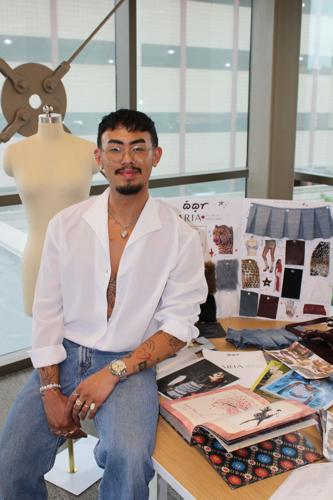
ÂÒÂ×ÄÚÉä-based designer Kay Tiamzon Andrada creates clothing that feels like it belongs to more than one world.
While growing up in the Philippines, fashion did not always feel like an obvious or encouraged path, he said. Instead, it lived in the background as an interest and a way of seeing.
As he looks back, Andrada can see the thread connecting past to present. He was always drawn to dressing up and finding ways to make ordinary pieces come alive. There was a creative impulse waiting to become something more.
A few years after moving to West Virginia, Andrada received his first sewing machine as a Christmas gift from his in-laws. In many ways, the Brother machine marked the beginning of a fashion journey.
As a self-taught designer, Andrada learned through trial, error, persistence, YouTube and TikTok. Four years into his practice, he has found creative residence between instinct and intention.
Using what's available
Andrada's creative approach is rooted in resourcefulness — making it work with what is readily available. He looks for materials that can be repurposed, such as thrifted denim, curtains, tablecloths, and the occasional leftover material patiently waiting for the right idea. Upcycling is an ethical choice and a practical reality as a designer in West Virginia with little access to major fabric retailers.
Sustainability matters deeply to Andrada, who is aware of the waste produced by the fashion industry. Though some might see creating with secondhand materials as a limitation, he has adopted it as part of the work’s identity.
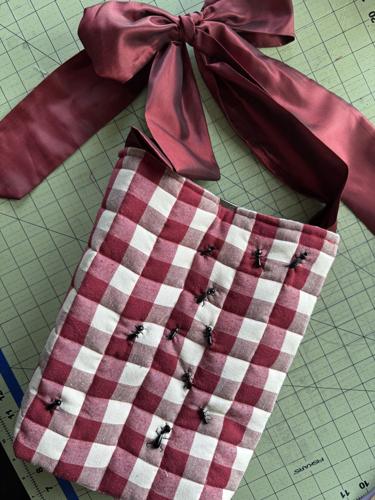
A recent creation made from a curtain is a perfect example of his ingenuity. He held onto a curtain knowing he could repurpose it, but unsure of what it wanted to become. Later, he realized it looked like a red gingham picnic blanket. He created a tote bag with tiny, hand-beaded ants — bringing humor and artistry to an everyday object.
It is playful, but thoughtful. Whimsical, but considered. That balance is where much of Andrada’s work lives.
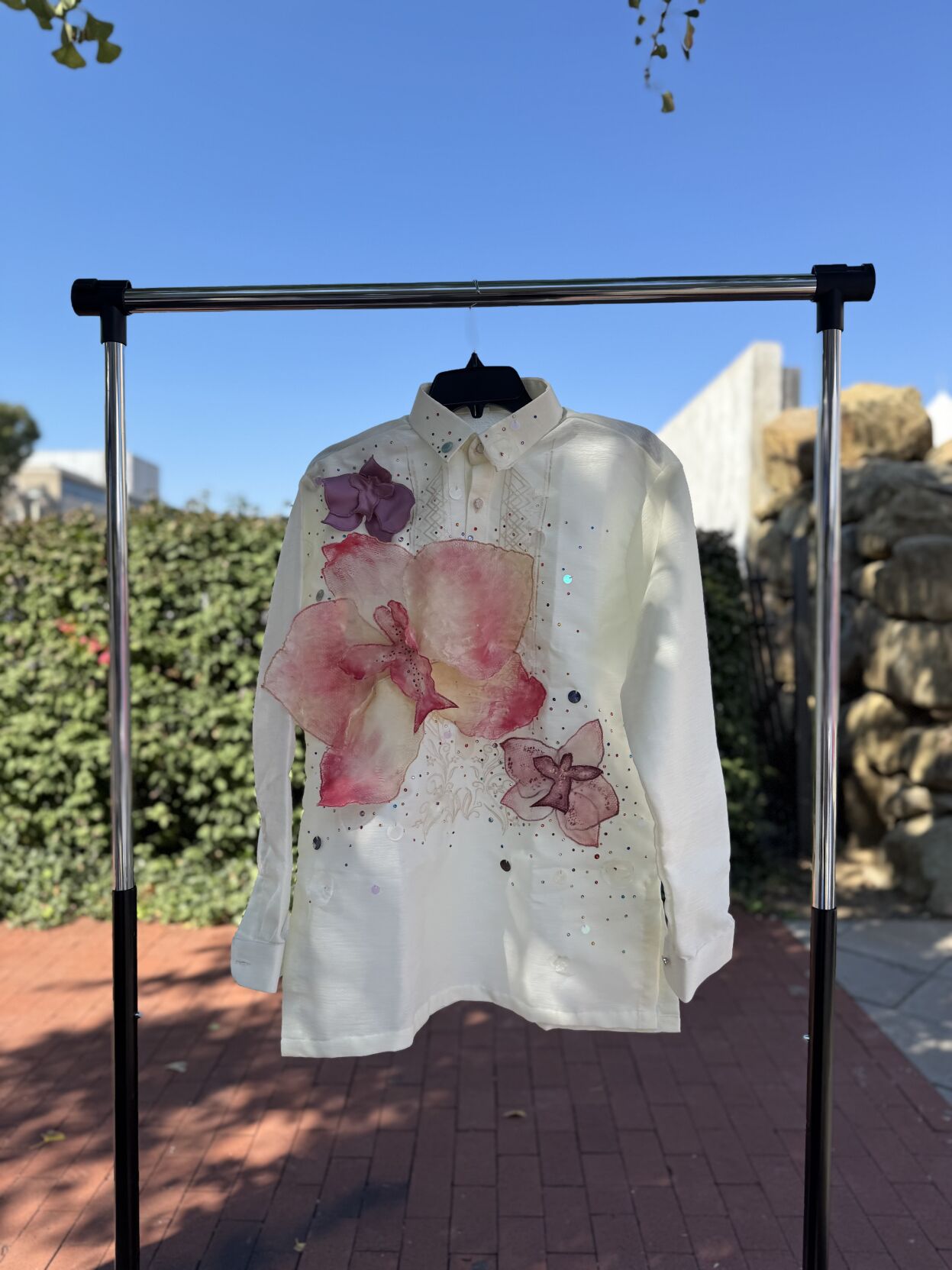
His pieces also carry a conversation between his Filipino heritage and his life in West Virginia. One of his best-known designs is a barong, a traditional Filipino garment made from organza adorned with floral elements, often orchids.
Andrada began adding floral elements while working on "Water," a collection inspired by the Philippines, tropical environments and flowers. It was an accidental discovery that became a signature for him.
The barong pieces are traditional in construction and feeling. However, it is not a replica of something inherited. It is a beautiful continuation — evident through the balance of tradition and reinvention.
'Make it into something that's me'
Stories you might like
Andrada often asks himself, “How can I make something traditional and make it into something that’s me?�
That question continues to guide his practice. Sometimes the answer is an orchid. Sometimes it is Sampaguita, the national flower of the Philippines. Sometimes it is denim stitched into a garment that would not have existed without imagination, boldness and the “let’s see what happens� of it all.
For the past two years, Andrada has shown collections at Wheeling Fashion Week, an experience that has helped him see the hunger for fashion in the Mountain State. "Water" -- his first collection -- was inspired by his upbringing in the Philippines with references to pearls, seashells, sheer fabrics and the appearance of water.
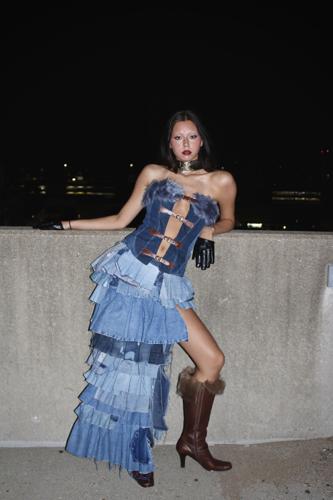
His second collection, "Maria, the Life of a Small Town Pop Star," imagined the wardrobe of a big fish living in a small pond. What would she wear to dinner? What would she wear on stage?
In some ways, Maria is fictional. In other ways, Maria is Andrada. The collection speaks to the specific experience of building a creative practice in a place where people may admire the work, but not always see themselves in it.
Andrada is familiar with the surprise that comes when people learn he is based in West Virginia. Online, many assume he is based near a large fashion scene, such as the West Coast.
But he is here. And being here matters.
“It’s a little difficult,� he said. “But it’s more of a challenge than a downer for me.�
That challenge has become a part of his purpose. Andrada understands that fashion — especially with a unique aesthetic — is not the most visible art form in his area. Instead of seeing it as a reason to leave, he sees it as a reason to stay.
Moments that reinforce Andrada's place as a designer in West Virginia span from someone buying a piece and wearing it until it wears out to someone trying one of his tutorials and tagging him online in the result.
“They make me realize that there’s space for me here,� he said. “And if there’s no space for me, that’s when I make space for myself.�
That statement holds so much of what Andrada’s work is doing. His practice is not only about fashion. It is also about visibility. It is about what happens when a young, queer, BIPOC, self-taught creative chooses to stay, make, learn and be seen in a place where his art form is still carving out its own room.
One of his favorite recent looks is a denim finale piece from Maria — a denim corset with fur trim and a large, ruffled denim skirt. The silhouette is reminiscent of one of the first pieces he made only a few years ago. Looking at them side by side, Andrada can confidently say the growth is present.
When looking to the future, he is grounded in the craft itself. He aims to sharpen his skills, create new work, return to Wheeling Fashion Week, build community, and maybe, one day, be on "Project Runway."
While younger Andrada did not imagine being a designer, he says he likely had an idea that fashion would be present. Now, that idea has life. It has seams. It has orchids, denim, organza, beads, and a little bit of small-town pop-star energy.


