Scattered thunderstorms early, then variable clouds overnight with more showers at times. Storms may contain strong gusty winds. Low 69F. Winds W at 5 to 10 mph. Chance of rain 60%..
Tonight
Scattered thunderstorms early, then variable clouds overnight with more showers at times. Storms may contain strong gusty winds. Low 69F. Winds W at 5 to 10 mph. Chance of rain 60%.
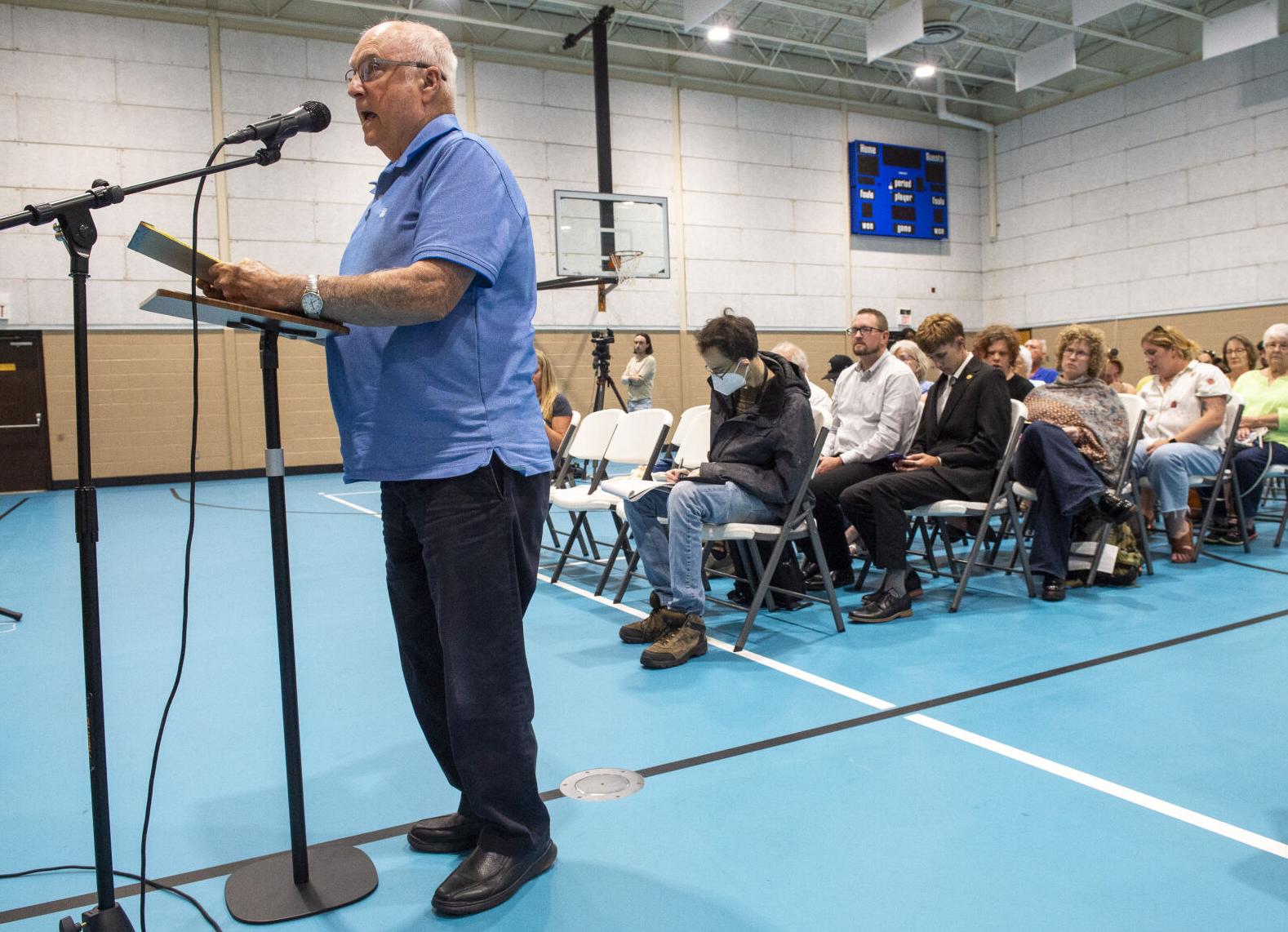
James Tackett of Shrewsbury speaks during a West Virginia Department of Environmental Protection public comment session on an air quality permit proposal from Clean-Seas West Virginia inside the Belle Town Hall gym on July 14, 2026.
Lani Wean took a moment to say she had “the immense privilege of getting to know dozens, if not hundreds, of folks� in the Belle area of Kanawha County concerned about the construction of an industrial facility projected to spew tons of hazardous air pollutants annually with a fence line less than 500 feet from the community’s Riverside High School.
Wean, West Virginia field organizer for Moms Clean Air Force, a national environmental advocacy group, was speaking to a panel of West Virginia Department of Environmental Protection regulators at a July 14 agency public meeting at Belle Town Hall.
The purpose of the meeting was to take public comment on a proposed air quality permit for a plastics conversion facility planned by Clean-Seas West Virginia, Inc. at the former 84 Lumber building at 2700 E. Dupont Ave., an area already burdened by air pollution from other chemical facilities.
Wean told DEP officials she had gotten to know “smart, kind, thoughtful people who are sitting in front of you today who recognize that West Virginia has long been exploited and exposed to deadly pollutants� by industrial facilities.
“This facility is poised to set a dangerous precedent for new petrochemical development in Kanawha County, and we know it,� Wean said early in a 70-plus-minute slate of public comments nearly universally opposing the proposed air quality permit.
James Tackett of Shrewsbury speaks during a West Virginia Department of Environmental Protection public comment session on an air quality permit proposal from Clean-Seas West Virginia inside the Belle Town Hall gym on July 14, 2026.
LAURA BILSON | Gazette-Mail
“I cannot believe this type of facility will be opened near our high school and our elementary schools, also shopping areas and local eating places,� James Tackett, of the nearby community of Shrewsbury, told the DEP during the public comment session, adding that he has two granddaughters who attend Riverside High School. “Our community deserves better.�
Eight days later, on Wednesday, Wean again spoke to environmental regulators — this time to defend West Virginians’ right to have any say when it comes to permits like the ones Clean-Seas and a wave of developers of unpopular, environmental health-threatening data center projects throughout the state have been seeking.
“This state has been ransacked by greedy industry, regulatory bodies, lawmakers or power-hungry people making decisions behind closed doors and without public input,� Wean told U.S. Environmental Protection Agency officials during a virtual public comment hearing. “I have no doubt in my mind that this proposal will exacerbate those very issues and is intended to do that.�
The EPA proposal that Wean and dozens of other community and environmental advocates condemned at Wednesday’s hearing would eliminate Americans’ right to public participation regarding “minor sources� of air pollution.
What on July 14 was a gathering of community residents speaking up to a taxpayer-funded agency in their own defense has been determined by the Trump administration to be “red tape� ripe for a slashing.
“[T]his EPA has also proven that we can follow the law and streamline processes to apply commonsense. In doing so, we are cutting unnecessary and burdensome red tape, unleashing American energy, and advancing cooperative federalism,� EPA Administrator Lee Zeldin said in a statement upon the agency announcing its proposed rule change on July 1.
The construction of new minor stationary sources and modifications of existing stationary sources of air pollution are regulated through the minor New Source Review programs under the federal Clean Air Act, with new stationary sources considered “minor� if they don’t have the potential to emit air pollutants in amounts above “major source� statutory thresholds.
New Source Review is a Clean Air Act program that requires industrial facilities to install pollution control equipment when they are built or when making a change that increases emissions significantly.
The Clean Air Act generally defines a major source as producing 250 tons or more per year of any pollutant, but over two dozen specific source categories have a definition of a major source expanded to include sources that produce 100 tons per year or more of any pollutant.
Minor New Source Review programs also apply to “synthetic minor� sources and modifications, which are new facilities or modifications to existing sources that would typically increase emissions of regulated pollutants by amounts equal to or exceeding the applicable “major source� thresholds, but which voluntarily accept one or more enforceable limits that keep their emissions below the “major source� thresholds.
State and local air agencies issue the majority of New Source Review permits, doing so under EPA-approved State Implementation Plans that states must meet to maintain and enforce National Ambient Air Quality Standards, which apply to six common air pollutants: carbon monoxide, lead, nitrogen, ozone, particulate matter (which includes soot common in coal-impacted communities) and sulfur dioxide.
The Clean Air Act establishes the basic requirement that state and local air agencies must provide an “opportunity for public comment on information submitted by owners and operators� on the new construction or modification of any stationary source. It provides that the public must have access to and a chance to comment on the air agency's "analysis of the effect of construction or modification on ambient air quality," including the agency's "proposed approval or disapproval" of the proposed new source or modification.
Per the law, “opportunity for public comment� consists of three mandated elements:
“Availability for public inspection in at least one location in the area affected of the information submitted by the owner or operator and of the State or local agency's analysis of the effect on air quality�
“A 30-day period for submittal of public comment�
“A notice by prominent advertisement in the area affected of the location of the source information and analysis�
The EPA is proposing to remove minor New Source Review public participation as a minimum requirement for State Implementation Plan submissions, thus leaving decisions regarding public participation requirements in state and local minor New Source Review programs up to those air agencies.
In West Virginia, such a move would put public participation at the mercy of a Republican-supermajority state Legislature that has routinely weakened water quality standards, approved resolutions critical of strengthened environmental rules under the Biden and Obama administrations and considered hindering local community air monitoring efforts.
A DEP spokesperson noted that West Virginia’s public participation requirements for minor source air permits are set in state law and legislative rules, with any changes to those requirements requiring revisions to those rules through the state’s legislative rulemaking process, including review by the Legislative Rule-Making Review Committee and approval by the Legislature.
“West Virginians have already carried more than our share of the nation's energy burden. We shouldn't also be asked to give up one of the few opportunities we have to participate in decisions that affect our health and our future,� Lisa Di Bartolomeo, Beyond Coal campaign organizer for the West Virginia Chapter of the Sierra Club, said during the EPA’s public comment hearing Wednesday.
'West Virginians deserve better'
Scrutiny of minor source air permits has intensified in West Virginia due to developers’ pursuit of them for large-scale data center projects that have proven unpopular in part because of their estimated air pollution impacts.
Community advocates have filed legal challenges of DEP minor source air quality permits granted for data center-linked projects in Tucker, Mingo and Mason counties.
In August, the DEP approved an air quality permit for a Purcellville, Virginia-based Fundamental Data LLC data center project proposed as a “synthetic minor� facility. Since Fundamental Data hasn’t reported the proposed facility as having the potential to emit more than 100 tons per year of any regulated pollutant, it’s not defined as a major stationary source.
But the proposed facility comes close to the 100-ton annual threshold with the potential to emit 99.35 tons per year of nitrogen oxides, which can harm the human respiratory system and contribute to acid rain.
In January, a report via the Harvard T.H. School of Public Health's Dominici Lab, which focuses on air pollution impacts, was released estimating Fundamental Data’s planned operation could inflict up to $35 million in health-related damages.
Using the EPA’s COBRA (CO-Benefits Risk Assessment screening model), the report commissioned by Tucker United, a group of local advocates opposed to the project, found the planned facility could result in 1.2 to 2.3 additional deaths per year, costs valued at $18-33 million.
Per the report, air dispersion modeling shows that more than 250,000 people would be exposed to additional fine particulate matter, or soot, which can pierce the lungs and lead to asthma attacks, heart attacks and premature death. The findings indicate that the proposed gas turbine-powered facility would increase the concentration of air pollution in communities in Tucker County, Grant County and in neighboring Maryland and Virginia.
In a formal response to comments on Fundamental Data’s air quality permit application, the agency called dispersion modeling “resource intensive� and said it therefore uses federally established major-source thresholds for determining when modeling is required.
The EPA struck a similar note in its proposed rule to attempt to justify it, saying that state governments face budget shortfalls that restrict the resources available to state and local air agencies, suggesting public participation on all minor source permit proposals is an ineffective use of their limited resources.
But residents living in the shadow of planned data centers and other industrial facilities feel just the opposite.
“Right now in West Virginia, we face numerous proposed data center sites, and eliminating this chance to comment on air permits from the federal level would shut down one of the few ways for local residents to raise their voices given the reality on the ground in our state, where state regulators favor industry over communities,� Di Bartolomeo told the EPA during its public comment hearing Wednesday.
“This rulemaking would intentionally exclude community input from the data center decision-making process,� Emma Simon of the Natural Resources Defense Council, a global environmental advocacy group, said during Wednesday’s EPA hearing.
Compounding what community and environmental advocates view as a problem with leaving minor source public participation up to state officials is their distrust of the DEP and Department of Commerce over their handling of information claimed as confidential by data center developers.
Those agencies have backed down from initial, respective requests for Fundamental Data to reveal what the company deemed “confidential business information� regarding air pollution control equipment in its DEP air quality permit application and to file with the Department of Commerce an application for certification as a high-impact data center that would reveal basic project details to the agency.
Such details would include proposed acreage, electrical power capacity for vital computing equipment, proximity to schools and residences, and estimated capital investment and project completion date.
Even if those details were to be revealed to the Department of Commerce, though, they would remain hidden from the public under a controversial 2025 state law, House Bill 2014, that deems confidential all petitions seeking certification of a high-impact data center, which could be any data storage or equipment facility with a critical power demand of at least 90 megawatts.
HB 2014 mandates that any information provided by a data center that it identifies as confidential business information is exempt from the Freedom of Information Act. The law requires the Department of Commerce secretary to make available to the governor and Legislature a list of all certified high-impact data centers “and all relevant information,� with specifically identifying information to be removed to ensure confidentiality.
“EPA's proposed rule change would mean citizens would no longer have the right to comment on, or even know about, these kinds of pollution sources in their backyard,� Jim Kotcon, conservation chair of the West Virginia Chapter of the Sierra Club, told the Gazette-Mail. “West Virginians deserve better.�
'Death by a thousand paper cuts'
Community air quality advocates note that developers of data centers and gas pipelines could evade public participation opposed to their projects by persisting in sizing related projects just below the major source threshold.
Kotcon pointed to Mountain Valley Pipeline LLC in recent months seeking minor air quality permit modifications that would increase its potential to emit over 260 additional tons per year of common air pollutants combined for projects that include adding eight new turbines across gas compressor stations in Fayette, Braxton and Wetzel counties.
“We need stringent standards and strict enforcement to protect the very air we breathe,� Kotcon said.
The EPA’s proposed rule, opponents say, risks allowing the public to be uninformed about and disempowered to speak up against projects that may meet minor source thresholds but pile up cumulative impacts in communities like Belle already contending with high concentrations of chemical and other chronically polluting industries.
“And it's all connected, and we can't just say that this one little thing is minor, is small,� Zoe Morris, of Rand, said at the DEP’s public comment session in Belle. “It's death by a thousand paper cuts, is what it is. You're still dead at the end of the day, no matter how you die.�
The EPA’s move toward narrowing public participation requirements builds on a pending May proposal from the agency to allow building non-emitting components or structures for data centers, power generation and manufacturing before getting a permit to control air pollution.
The EPA is proposing revisions to New Source Review air permitting regulations to remove restrictions to allow constructing components that don’t emit air pollutants, like utility service infrastructure for a site, concrete pads and some types of buildings and building components before securing a New Source Review air permit. Â
The EPA’s public comment period for its minor source public participation overhaul ends Aug. 21.
“What happens next year when federal and state environmental regulations are dropped even lower and so, therefore, they’re allowed to put more [of a] percentage of VOCs in the air?� Morris said, speaking of volatile organic compounds. “What happens in 10 years when the regulations are even looser? You give them a foothold now under these regulations, you’re not going to be able to take that back.�
CLICK HERE to follow the ÂÒÂ×ÄÚÉä Gazette-Mail and receive