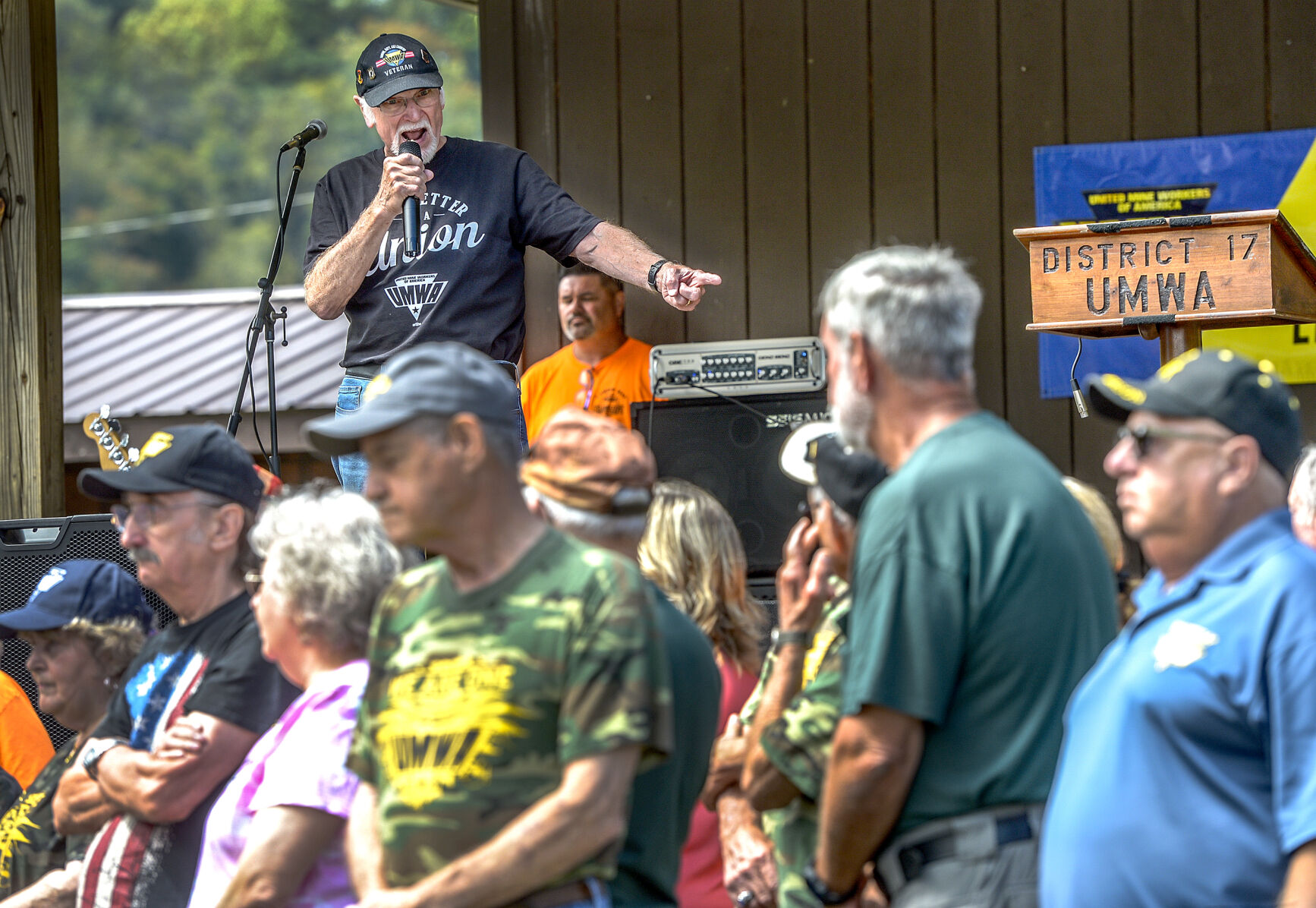
At the United Mine Workers of America’s 86th annual Labor Day celebration on Sept. 2, 2024, in Racine, UMWA International President Cecil Roberts gives a fiery speech to miners and their families.
At the United Mine Workers of America’s 86th annual Labor Day celebration on Sept. 2, 2024, in Racine, UMWA International President Cecil Roberts gives a fiery speech to miners and their families.
Gazette-Mail file photo
The UMWA International president plans to retire in October after 30 years in that role, the union announced in a news release Tuesday.
“I have been blessed and honored to be your president of the greatest union in the world for the last 30 years,� Roberts said in a statement.
A Cabin Creek native and sixth-generation coal miner, Roberts has long been one of the most fiery leaders of the labor movement. Roberts is in his seventh straight term as president after taking over for subsequent AFL-CIO leader Richard Trumka in 1995, making him the second-longest-tenured president in UMWA history behind only John Lewis (1920-60).
Roberts led the UMWA in its fight to secure the health care and pensions of more than 92,000 retired miners through congressional legislation in recent years.
Roberts endorsed UMWA International Secretary-Treasurer Brian Sanson to succeed him as president in a statement. Roberts said he would put his name on “every piece of material I can� to support Sanson, who negotiated portions of 2007, 2011, 2016 and 2020 national collective bargaining agreements with bituminous coal companies.
“Brian Sanson is going to be your next president,� Roberts said in the statement.
Roberts’ announcement follows UMWA words of warning
Roberts, 78, is preparing to relinquish the helm at the UMWA at a precarious point for mine workers amid expectations of weaker labor protections under the new Trump administration.
A UMWA news release issued Friday raised concerns about the Department of Government Efficiency, a new commission charged with cutting federal spending and co-launched by Tesla CEO and X owner Elon Musk, indicating on its website at doge.gov/savings that the leases of 29 U.S. Mine Safety and Health Administration offices have been terminated, including one in Summersville and many more throughout central Appalachia.
The UMWA said closing offices “could be a recipe for disaster.�
MSHA spokesperson Frances Alonzo declined to comment on the status of any staff reduction or relocation last week. Alonzo referred comment on the leases to the General Services Administration, which manages federal property and provides contracting options for government agencies.
A GSA spokesperson did not answer questions about the status of MSHA leases last week. Instead, in an email, the spokesperson said the agency is reviewing all options to optimize its footprint and building use. The GSA is working to secure suitable alternative space to the extent termination of leases impact public-facing facilities and existing tenants, the spokesperson said.
Miner allies have worried that the Trump administration will be lax in its enforcement of a long-awaited mine worker protection rule the MSHA adopted last year after years of advocacy from Roberts and the UMWA.
The MSHA finalized a landmark rule cutting in half the federally allowed limit for toxic silica dust responsible for driving a sharp rise in black lung disease among increasingly younger miners throughout central Appalachia.
The new rule came 50 years after the National Institute for Occupational Safety and Health, the federal agency that makes recommendations for preventing work-related illnesses, recommended the exposure limit.
But Republicans holding the majority in Congress have threatened to use the power of the purse to effectively kill the silica rule and will determine how much funding the MSHA gets for inspectors and other safety initiatives. The Trump administration has implemented sweeping staff cuts across the federal workforce.
“We will continue to do all we can to keep miners safe where we represent the workforce. But in the absence of a union and the absence of strong government enforcement, workers’ safety will be left solely in the hands of employers,� the UMWA warned in a March 7 news release. “History has shown us time and time again that doing so is a recipe for disaster, especially in the mining industry.�
Only after generations of advocacy from union members and other miner allies did Congress pass the Federal Coal Mine Health and Safety Act of 1969, which instituted mandatory fines for all violations, required four annual inspections at all underground coal mines and enacted criminal penalties for knowing and willful violations.
By then, Roberts already was a Vietnam War veteran, recalling in Tuesday’s statement it has been 59 years since he was drafted.
From Winifrede to union presidency
Roberts worked at Carbon Fuel’s No. 31 Mine in Winifrede, Kanawha County, after his return from Vietnam. In 1977, he was elected vice president of UMWA District 17, setting up his rise through the union ranks.
At the UMWA’s 86th annual Labor Day celebration in September, Roberts rallied a crowd at John Slack Memorial Park in Boone County, predicting a resurgence for unions — even in West Virginia despite the state GOP supermajority’s hostility toward them.
“The day is coming when unions are going to be the most powerful institution in the United States and in West Virginia,� Roberts said. “It’s coming back, folks! It’s coming back!�
In West Virginia, the number of employed wage and salary workers represented by unions increased 1.4% from 2022 to 70,000 in 2023 — a higher increase than the state’s 0.3% uptick of total employed wage and salary workers, according to federal Bureau of Labor Statistics data.
“Cecil — your unyielding fight for our miners’ pensions, health care, and safe working conditions have made an incredible impact for so many families in West Virginia and around the world,� former West Virginia Gov. and U.S. Sen. Joe Manchin, a frequent UMWA ally, said in a Facebook post Tuesday. “It was an honor to fight alongside you and our miners.�