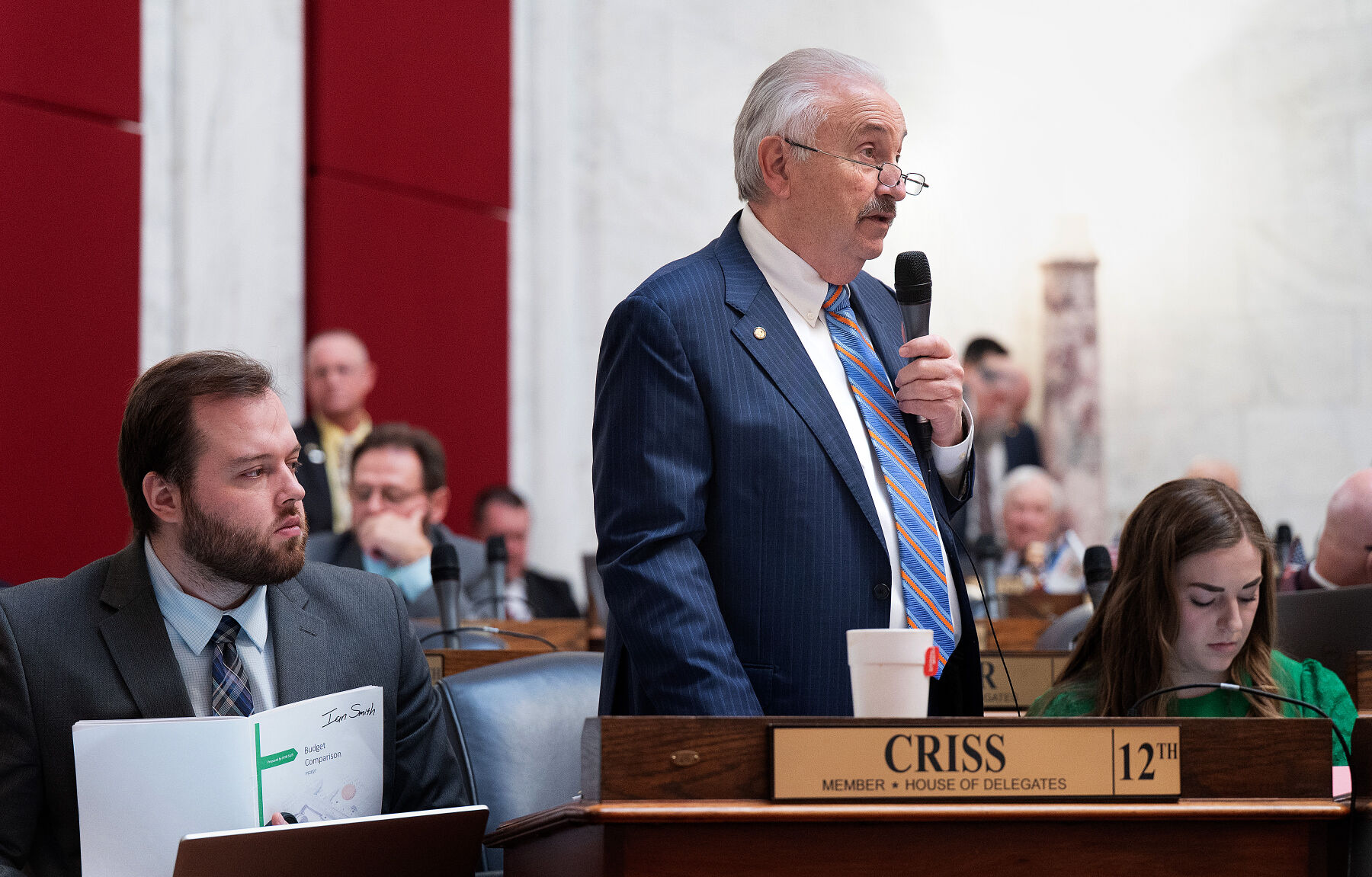
House Finance Chairman Vernon Criss (standing), R-Wood, speaks about proposed amendments to the Senate’s budget bill on Feb. 25, 2026.
PERRY BENNETT | W.Va. Legislative Photography
After reaching an agreement on tax cuts and pay increases, state lawmakers in both houses took steps Thursday to avoid a repeat of last year’s executive veto-fest by passing the Fiscal Year 2027 budget with nine days remaining in the legislative session.
Thursday marked the 51st day of the session, which theoretically affords lawmakers enough time for an override, should Gov. Patrick Morrisey choose to veto any portion of the proposal. In 2025, the budget was forwarded to Morrisey’s desk on day 55 of the session, leaving only four days in the session. This year, the across-the-board 3% pay increase for state workers that Morrisey had requested was included in the Legislature’s budget, although the 3% is now an approximation, as opposed to a hard number. However, Morrisey’s challenge to reach a 10% reduction in personal income tax went unanswered by lawmakers.
Last year, Morrisey used his line-item veto 29 times on the Legislature’s approved budget, cutting millions in state funding. As Morrisey stated in an April 17 letter to Secretary of State Kris Warner, “It is imperative that we take steps to limit new spending.�
While Morrisey’s vetoes did “limit new spending� from programs such as the Economic Development Project Fund and the Military College Advisory Council Fund, they also reduced existing spending. The Martinsburg Berkeley Public Library and the Safe Schools Program each saw their funding reduced by at least $200,000, while the Court-appointed Special Advocates Program — a program designed to aid minors experiencing abuse or neglect — was slashed by $800,000.
What’s in the budget
Lawmakers included an average 3% (or approximately $1,500 per year) across-the-board pay increase for most state employees. While the board of public works is exempt from this increase as its salaries are determined by the Legislature separately, all other employees paid through the general revenue fund would receive the increase, as would the state’s highway and road workers.
This salary increase has been a primary talking point of Morrisey’s since late last year, with the governor including it in his Jan. 14 State of the State address. Critics of the 3% plan, however, cite the matching 3% PEIA premium increase scheduled to take effect on July 1, coupled with a $200 monthly increase to the spousal surcharge as evidence of an imbalance. Even with the 3% salary increase, these increased health insurance costs would leave some state employees experiencing a net reduction in their earnings.
While Kelly Allen, executive director of the West Virginia Center for Budget and Policy, thinks giving a pay increase to state workers is “a good investment,� 3% will still leave many workers worse off than they were last year.
“There was no pay raise for state workers or school staff in 2025,� Allen explained. “Somebody making $50,000 a year back in 2024, just to be keeping pace with inflation, would need to be making about $53,000 a year this year. The raise only gets you about halfway.�
In the budget, lawmakers invest in their three-year-old West Virginia Flood Resiliency Trust Fund to the tune of $5 million. The House’s version of the budget initially included $25 million for the fund at the request of House Minority Leader Sean Hornbuckle, D-Cabell, but the total was reduced to $5 million in the final draft.
The Hope Scholarship, yet another of Morrisey’s asks, would be funded to the level at which he requested. Including the $20 million carry-over balance remaining from last year, approximately $300 million would be allocated to the Hope Scholarship, enough to sustain the program through fiscal year 2028.
Perhaps the most glaring omission from the Legislature’s budget is Morrisey’s requested 10% personal income tax reduction. Morrisey’s submitted budget included only a 5% reduction and challenged lawmakers to find enough revenue offsets to make up the additional 5%.
While the Senate’s version of the budget did include Morrisey’s requested 10%, senators left the tax cut unfunded by approximately $130 million. An across-the-board 10% income tax reduction would come at an estimated cost of $250 million to the state, and Morrisey’s budget proposal only increased revenue projections enough to account for half of that amount.
As an offset, the Senate proposed an increased tax on vape products. However, this was only projected to result in slightly more than $20 million in additional revenue, still far short of the $150 million needed.
After passing the budget on Feb. 20, Senate Finance Chair Jason Barrett, R-Berkeley, expressed his hope that the House of Delegates would “come to the table� with offsets of their own.
The House Finance Committee was not interested in looking for tax cuts until a spending bill was finalized.
“The tax cut is a reduction in revenues,� said House Finance Chairman Vernon Criss, R-Wood. “[Morrisey] claims that the 5% he introduced, that he has it baked into his revenue estimates. The House has still not taken up the tax cut. We’re still observing to see what he does before we take a look at that.�
What’s next?
The finalized budget bill has been sent to Morrisey, who now has the option of signing or vetoing all or some of the bill. In the event of either a line item or full veto, and while lawmakers have allotted themselves additional time for an override vote, two-thirds of both the House of Delegates and the Senate is required.
“If you look at what [Morrisey] did last year, there were 29 line-item vetoes in a variety of ways,� Criss said. “He kept maintenance dollars from the Highway Department. He also kept $25 million out of the back of the budget for the painting program and cut education programs last year.
“If he’s in the same posture of mind, he could be doing that again,� Criss added. “But I don’t know. We can only speculate.�
A balanced budget must be signed into law three days prior to the conclusion of the legislative session, which is scheduled to end on March 14. If the budget is not signed before the required time, the session would be extended.
Matthew Young covers politics and general assignments. Contact him at myoung@hdmediallc.com or 609-444-7257.