


The West Virginia Futbol Club played timely defense to hold on to a 2-1 victory over Rhode Island Surf Elite in the 17U boys division of the U…
Officiating is difficult no matter what the sport and no matter what the level.
Those working at the youth level often get grief from parents, and the intensity only ramps up from there.
Basketball is arguably the toughest sport to officiate, as bang-bang plays happen most every time down the court. As the games move into the college and pro ranks, the play becomes more rugged and the pressure on officials increases exponentially.
Coaches don’t usually cut the referees a break either.
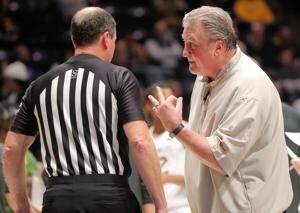
West Virginia’s Bob Huggins often has harsh words for the officials during the game, and he’s far from the only one. He admitted that basketball officials have it even tougher now, as the athletes have gotten bigger, stronger and quicker.
“It’s harder probably, but it’s also harder on players,� noted WVU’s Hall of Fame coach of today’s college game. “We’re in a world now where you don’t want to do something stupid because the rest of the world is going to see it. But does that mean that if you miss a call, the world shouldn’t see it? I don’t think so. That’s what they get paid for. If I screw something up, I’m going to get vilified for it, and I should. I’ve never bitched about it or said a word, because I realize that and take the blame. I think it’s a huge thing when you get a 21-year-old coming in here apologizing and taking the blame. Aren’t we supposed to have grown men take the blame? That’s real life.�
Officials are under a microscope more so now than ever, but they are making more than ever. The top college conferences pay officials as much as $2,000 per game, and the premier refs will often work upwards of five games per week through the 20-week regular season.
“They are getting paid more than they ever been paid. I remember back when coaches were making less than $100,000 per year, and they had as much pressure as we have now. OK, maybe a little more with TV and stuff, but still,� noted Huggins. “If that’s what you want to do, then do it and do the best you can possibly do. It’s just like coaches. If we don’t win, we’re not going to last long.
“I coached in the day when there were two of them (instead of the three-person crews that are utilized now), and that was hard,� continued Huggins. “I honestly think that the majority of them do a good job. They work at their craft. It’s the same for players; they aren’t any good unless they work at their craft. Coaches aren’t any good unless they work at their craft. Aren’t (officials) part of the game? You can’t put one foot in and take it back out. You have to put both feet in, and they’ve decided to put both feet in. Deal with it.�
Officiating basketball, at least for those who take their job seriously, isn’t limited to just the five months of the college season.
“The good ones stay in great shape,� explained Huggins. “The good ones watch a lot of film, and they’re involved in helping younger officials make the step. They do it all summer, so you’re not talking guys who work for just seven or eight months and take the rest of the year off. They don’t. They feel compelled to help the younger guys move up the chain.
“It’s just not guys running out there blowing the whistle. I know when I was on the rules committee, we had (referees) from the far west come in so they could observe the rules committee and how the rules were expected to be called the following year. They weren’t on the committee; they just asked if they could sit in. Then what they did was disperse that to their group of guys. Because of the work they put in the summer time to help the younger guys, there is more collaboration between those guys than there ever was.�
MORGANTOWN, W.Va. (WV News) — In the course of a day, we all find ourselves caught up in a blizzard of internet messages, coming at us from all sides ... Twitter, Facebook, Instagram.
They are, in many ways, like snowflakes, all looking the same but each one different. It is often hard to keep track by mid-afternoon what you'd seen in the morning, be it on Twitter or Facebook, be it a fan's message or a broadcaster's or a journalist's.
And so it was on Friday when walking in on Bob Huggins' pre-Kansas media session. His team had come out of two losses on a road trip to Kansas State and Oklahoma State, and one might say that the officiating played a key role in both games.
There were whistles blowing, free throws being shot, scrums on the floor, steps out of bounds. And so it was as we entered the West Virginia basketball facility that this one tweet was bouncing around the old cerebellum, a tweet that I felt had come from the former coach turned broadcaster, Fran Fraschilla.
I wasn't sure if he had originated it or what it said word for word, but the gist of it was that officiating today's basketball is more difficult than it's ever been, and with such a key game as WVU vs. Kansas little more than 24 hours away, it seemed like a topic worthy of discussion with Huggins.
It was breached sensitively to him, not meant to inflame him or put him in Big 12 officiating jail, but coaches have long memories, and he immediately took it in a direction not intended.
"Think about where the statement came from," Huggins said, thinking back to last year's New Year's Day game between WVU and Texas when the Mountaineers stole the ball in the first half and broke away for what seemed like a sure basket only to be hit savagely from behind by Brock Cunningham.
When the dust and blood cleared, Cunningham was hit with a technical and headed for the dressing room, flashing a "Horns Up" sign to an enraged WVU crowd.
Anyway, Fraschilla was on the air then, and Huggins remembered what he said.
"It came from a guy who said it was just a basketball play when a guy on Texas tried to take our guy's head off," Huggins said. "That just says to me, he's never played much. If a guy does that to me, they are going to take about three or four guys to stop me.
"That was totally uncalled for, not part of our game, not what's supposed to be and not what's supposed to happen," Huggins went on.
That, of course, was one instance in a game.
But there is something every time, up and down the court. Basketball has come to be played by bigger, stronger, faster players than ever. It is now a more physical game than ever ... so much so that where it once had two officials to call a game, it now has three.
That may make being in the right place at the right time easier, but there can be no doubt that with the fans on top of the court, with the unblinking eye of replay cameras coming from every angle and with officials flying all over the country to do games, at least a discussion of what the role of the official should be in the game is fair.
It's even difficult to figure out what the rules really are sometimes, I offered up to Huggins.
"Wait a minute," he said with a smile. "I was on the rules committee."
Indeed he was, and no one still knows what the hell the cylinder rule is or if it's a block or a charge.
Huggins feels no pity for the poor, overworked, on-the-spot officials of the game.
"They get paid more than they ever got paid," he noted. "I remember back when coaches weren't making $100,000 a year and they had the same pressure they had — well, maybe not quite as much because of television and that other stuff — that have now.
"If that's what you want to do, do it and do the best you can possibly do. It's just like coaches. We can't win, we're not going to last wrong."
The inference, of course, is that in officiating, as in every other profession, the best should survive, and those who can't handle it ought to be replaced.
Officials, of course, have always been part of the show ... some more than others. But since replay came in, some wind up with more air time than Sean Hannity and Joe Scarborough get combined on the news.
"It's harder, probably, yeah," Huggins said of the effect replay has on their performance, which is scrutinized in slow motion on big screens in the arena and on small screens across the nation. "It's hard on players, too. We're in a world now where you don't want to do something stupid because the world is going to see it.
"Should it be if you miss a call that the world shouldn't see it? I don't think so," Huggins said. "If I screw something up, I'm going to get vilified for it .... and I should. I've never bitched about or said a word. I take the blame."
There was a perfect example of the right way to handle it just a few minutes earlier when WVU player Erik Stevenson, who was caught making an obscene gesture to the home crowd at Oklahoma State and was assessed a technical, opened his press conference Friday with an apology.
"It's a huge thing when you get a 21-year-old to come in here and apologize because he's taking the blame for his actions," Huggins said. "It's real life."
Huggins remembers how it used to be, noting he coached in the days when there were only two officials on the floor.
"Now that's hard," he said. "I honestly think the majority of the officials do a great job. They work at their craft. You know, it's the same thing, players aren't any good unless they work at their craft. Coaches aren't any good unless they work their craft.
"Aren't officials part of the game? You can't put one foot in and take it back out. You have to put both feet in. They have decided to put both feet in. Deal with it."
So, now we've had our discussion. What's your over/under on the number of whistles blown in Saturday's Kansas-WVU game?


MORGANTOWN, W.Va. (WV News) — The other night against Navy, just 2 minutes and 36 seconds into play, Bob Huggins was forced to rise out of his stool by the scorer's table as a foul was whistled on his point guard, Kedrian Johnson.
On Friday afternoon, as he Zoomed with the media ahead of Saturday evening's Coliseum matchup with UAB, he made an admission.
"I'll be honest," Huggins said. "I saw Keedy's first foul and don't know what it was."
Naturally, he asked and got an explanation, but before he could return to his stool, there was another shrieking sound coming from an official's whistle. It was foul No. 2 on Johnson, just 13 seconds after the first one.
This really got to Huggins.
See, the officials this year have been asked to take the physicality out of basketball, which is like turning football into a game of two-hand touch.
Huggins says he's all right with the meaning behind the rule, just not the application of it.
"To think, you have 10 really good athletes out on the floor, and not being allowed to touch each other is absurd," he said.
We're not talking about just athletes, we're talking big, fast, physical athletes confined into a relatively small area, battling for position, moving with lightning speed, sometimes with the agility of a ballet dancer.
The fact of the matter is, there may not be any crying in baseball, but in basketball, you have to let the players go at it.
Think of Charles Barkley trying to play under today's rules. Dennis Rodman? Think of trying to guard Larry Bird without touching him. How do you stop Wilt Chamberlain if you aren't banging him under the boards to get him away from the basketball?
In the case of the Navy game, sending Johnson to the bench within two and a half minutes is one thing. It will be different in Saturday night's game as Johnson will be charged with guarding the Blazers' Jordan Walker. Walker averages 25.7 points a game, and Johnson is the man who is supposed to guard him.
He did so last season, taking him pretty much out of the game before the new emphasis on taking physicality out of the game.
"Keddy is the key for us," Huggins said. "We're hoping he will do the job on him he did last year. He can run with him. "The idea is to match speed on speed, and Keddy is capable of playing at the same pace."
But not if he's on the bench.
Huggins, of course, made his reputation on having physical teams. His early Cincinnati teams led sportswriters to often refer to him as "Thuggins."
And the "Press Virginia" defense that he devised wouldn't have been quite as effective under the way they are interpreting fouls today.
Huggins expects by the time conference play begins, the officials will lighten up.
"As the season goes on, you won't see those calls," Huggins said. "For whatever reason, we got into this 'touch me not' deal. You can't play like that."
Huggins believes there must be contact, the defining factor in whether it is a foul being whether it interferes with play.
It was a different game years ago.
"At Cincinnati, we didn't let people cut," he said. "We took away the motion out of their offense, but [the officials] let us. It wasn't just us. We played Cal with Jason Kidd four times, and they were tough. They had two guys who wound up being all-league tight ends in the NFL."
Huggins, by the way, is not against that. Just the other day, he talked about Jimmy Bell's size and athletic ability and admitted he could see him wind up playing left tackle in the NFL at 6-foot-10, 285 pounds and up.

GHENT — If you haven’t noticed, there is a nip in the air and that means Old Man Winter will be knocking on the door pretty soon.

ARLINGTON, Texas — Faking injuries. Blocking below the waist, in too many situations and scenarios to count. Uniform issues, which are anything but uniform. All of those items and more are on the plates of Big 12 Coordinator of Officials Greg Burks and the officials he supervises as a wide-ranging list of rules changes, modifications and interpretations are on tap for the 2022 season.
One of the biggest is further restriction of blocking below the waist. Cut blocks will now be limited to the initial charge of offensive players inside the tackle box (defined as the outside shoulder of the offensive tackle on either side of the line, and any players in the backfield lined up behind them) and to the defenders facing them across the line of scrimmage.
Now banned are cut blocks on pulling plays that put the blocker outside the box, and also submarining by defenders to try to take out potential blockers outside the same area. With few exceptions, below-the-waist blocks are now prohibited anywhere outside the box.
“I think the low blocking rule is a step in the right direction. Probably the hardest block for us is downfield blocking,� said Burks, noting that calling it previously involved judgment of where it occurred, where the player initially lined up and who initiated the contact. “Now, it’s going to be a foul no matter what.�
A second issue, and one that has drawn a good deal of fan ire, is the faking of injuries to slow down rampaging offenses. Officials, as they always have, will treat every such stoppage as an injury, and they will not try to assess whether or not a player might be feigning it.
Instead, a process has been put in place where a school or conference can request an opinion from Steve Shaw, the national coordinator of officials, who will then review it, and, if deemed appropriate, refer it back to the conference for action.
This rather Byzantine process won’t, however, address any advantages provided to the team faking the injury during the game. Instead, an offending school might get some sort of verbal or written reprimand from the league after the contest, in the hopes that the highlighting of such deceptive and unsportsmanlike actions will be removed from the game, or perhaps a nominal fine.
Again, though, that’s depending on coaches giving up what is, in many instances, a very successful tactic. Stiffer penalties could be levied by the school or conference after repeated instances, but that will be of cold comfort to an opponent that had a drive stalled or a game outcome severely affected by such actions.
Burks admits that the hope that schools will self-adjudicate this issue might be a stretch, but that is the process that has been put in place this year. Stay tuned on this one, as future modifications are likely.
* * * * * *
A third major change is in the appeals process for targeting. Starting this year, a player ejected in the second half for targeting can have his suspension for the first half of the following game reviewed by Shaw, if requested by the school and the conference. If it is clearly obvious that targeting should not have been called, Shaw can overturn it, which would allow the player to participate in the first half of the next game.
Burks does not anticipate many such reversals, as targeting is already reviewed exhaustively at the time of the penalty.
As an adjunct to the targeting issue, the definition of the crown of the helmet, which is involved in determining one of the aspects of targeting, has been redefined to a six-inch radius from the top of the helmet (the button) in all directions. That was clarified due to the changing dimensions and construction of helmets.
* * * * * *
Observance of uniform rules has become a losing battle for officials. An effort a few years ago to enforce them more strictly was a failure, and over the past few seasons more issues, such as pants creeping far above the knee and the jettisoning of pads, predominating.
Burks noted that officials do not want to impact a game with a penalty for pants being too short or a lack of hip or thigh pads, so enforcement will more likely consist of surveys of teams in warm-ups and notifications to coaches to correct any issues prior to the start of play. That could also happen during a game, but given the tenor of Burks’ comments, it’s hard to image that this will occur.
“It’s become more of an aesthetic issue than a safety issue. The information I get from coaches is, ‘Show me data that a kneepad covering the knee helps prevent an MCL or an ACL injury.’ It’s more important to the players that they run as fast as they can to perform well at this level,� Burks explained. “That outweighs having a pad over the knee. These players are incredibly tough, and they will sacrifice pain to be able to run fast.�
* * * * * *
All defensive holding is now an automatic first down. Previously, only holds on pass plays where the pass crossed the line of scrimmage and the hold was called on a defender against a receiver resulted in a new set of downs. This brings all defensive holding penalties in line in terms of yardage to be marked off and makes administration of them a bit simpler.
* * * * * *
While Burks and the officials don’t have a hand in changing rules, he did note some that are very difficult for them to adjudicate.
“Ineligible downfield calls are very difficult for us. You have to watch both the lineman and the pass when it’s released, and I don’t know anyone that can watch both of those at the same time. The NFL limit is one yard, and ours is three, but changing it would also limit the effect of run-pass option plays that are very prevalent in the the college game.�

Kanawha Valley Senior Services officials anticipate the delivery of the agency’s annual Seniors Farmers Market Nutrition Program vouchers with…

Liz Cheney was addressing her fellow Republicans. But more than that, she was speaking to posterity.

West Virginia Department of Environmental Protection officials announced Feb. 14 that the organization is partnering with the Tornado-based Co…

