MORGANTOWN, W.Va. (WV News) — In the course of a day, we all find ourselves caught up in a blizzard of internet messages, coming at us from all sides ... Twitter, Facebook, Instagram.
They are, in many ways, like snowflakes, all looking the same but each one different. It is often hard to keep track by mid-afternoon what you'd seen in the morning, be it on Twitter or Facebook, be it a fan's message or a broadcaster's or a journalist's.
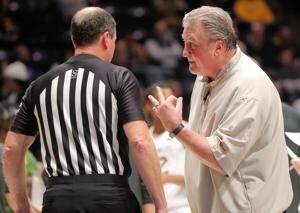
And so it was on Friday when walking in on Bob Huggins' pre-Kansas media session. His team had come out of two losses on a road trip to Kansas State and Oklahoma State, and one might say that the officiating played a key role in both games.
There were whistles blowing, free throws being shot, scrums on the floor, steps out of bounds. And so it was as we entered the West Virginia basketball facility that this one tweet was bouncing around the old cerebellum, a tweet that I felt had come from the former coach turned broadcaster, Fran Fraschilla.
I wasn't sure if he had originated it or what it said word for word, but the gist of it was that officiating today's basketball is more difficult than it's ever been, and with such a key game as WVU vs. Kansas little more than 24 hours away, it seemed like a topic worthy of discussion with Huggins.
It was breached sensitively to him, not meant to inflame him or put him in Big 12 officiating jail, but coaches have long memories, and he immediately took it in a direction not intended.
"Think about where the statement came from," Huggins said, thinking back to last year's New Year's Day game between WVU and Texas when the Mountaineers stole the ball in the first half and broke away for what seemed like a sure basket only to be hit savagely from behind by Brock Cunningham.
When the dust and blood cleared, Cunningham was hit with a technical and headed for the dressing room, flashing a "Horns Up" sign to an enraged WVU crowd.
Anyway, Fraschilla was on the air then, and Huggins remembered what he said.
"It came from a guy who said it was just a basketball play when a guy on Texas tried to take our guy's head off," Huggins said. "That just says to me, he's never played much. If a guy does that to me, they are going to take about three or four guys to stop me.
"That was totally uncalled for, not part of our game, not what's supposed to be and not what's supposed to happen," Huggins went on.
That, of course, was one instance in a game.
But there is something every time, up and down the court. Basketball has come to be played by bigger, stronger, faster players than ever. It is now a more physical game than ever ... so much so that where it once had two officials to call a game, it now has three.
That may make being in the right place at the right time easier, but there can be no doubt that with the fans on top of the court, with the unblinking eye of replay cameras coming from every angle and with officials flying all over the country to do games, at least a discussion of what the role of the official should be in the game is fair.
It's even difficult to figure out what the rules really are sometimes, I offered up to Huggins.
"Wait a minute," he said with a smile. "I was on the rules committee."
Indeed he was, and no one still knows what the hell the cylinder rule is or if it's a block or a charge.
Huggins feels no pity for the poor, overworked, on-the-spot officials of the game.
"They get paid more than they ever got paid," he noted. "I remember back when coaches weren't making $100,000 a year and they had the same pressure they had — well, maybe not quite as much because of television and that other stuff — that have now.
"If that's what you want to do, do it and do the best you can possibly do. It's just like coaches. We can't win, we're not going to last wrong."
The inference, of course, is that in officiating, as in every other profession, the best should survive, and those who can't handle it ought to be replaced.
Officials, of course, have always been part of the show ... some more than others. But since replay came in, some wind up with more air time than Sean Hannity and Joe Scarborough get combined on the news.
"It's harder, probably, yeah," Huggins said of the effect replay has on their performance, which is scrutinized in slow motion on big screens in the arena and on small screens across the nation. "It's hard on players, too. We're in a world now where you don't want to do something stupid because the world is going to see it.
"Should it be if you miss a call that the world shouldn't see it? I don't think so," Huggins said. "If I screw something up, I'm going to get vilified for it .... and I should. I've never bitched about or said a word. I take the blame."
There was a perfect example of the right way to handle it just a few minutes earlier when WVU player Erik Stevenson, who was caught making an obscene gesture to the home crowd at Oklahoma State and was assessed a technical, opened his press conference Friday with an apology.
"It's a huge thing when you get a 21-year-old to come in here and apologize because he's taking the blame for his actions," Huggins said. "It's real life."
Huggins remembers how it used to be, noting he coached in the days when there were only two officials on the floor.
"Now that's hard," he said. "I honestly think the majority of the officials do a great job. They work at their craft. You know, it's the same thing, players aren't any good unless they work at their craft. Coaches aren't any good unless they work their craft.
"Aren't officials part of the game? You can't put one foot in and take it back out. You have to put both feet in. They have decided to put both feet in. Deal with it."
So, now we've had our discussion. What's your over/under on the number of whistles blown in Saturday's Kansas-WVU game?