

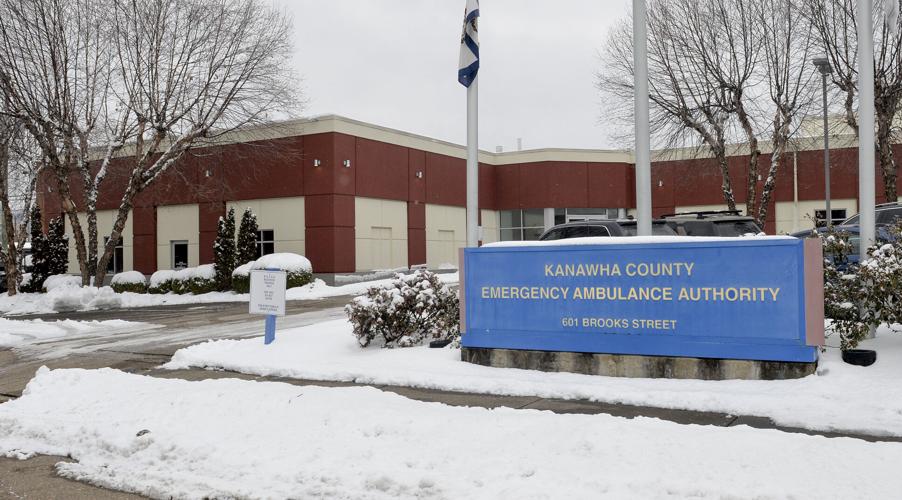


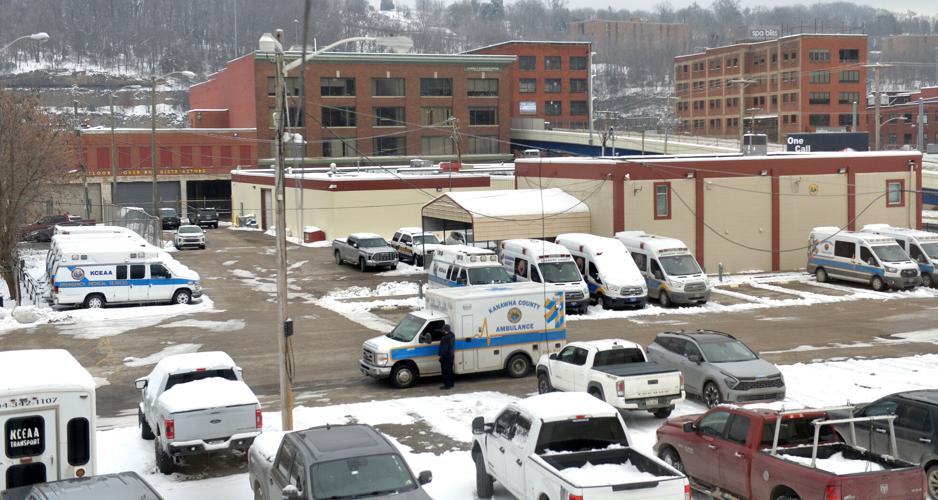


The Kanawha County Emergency Ambulance Authority has approved significant rate increases for its ambulance services to address a $4 million budget shortfall. The move comes as the agency faces rising operational costs and seeks to improve its services across Kanawha County.
For some services, costs could rise by more than 200%.
KCEAA operations
KCEAA is the primary EMS provider for Kanawha County, covering 910 square miles with 13 stations. It operates 42 ambulances and employs 319 personnel, including EMTs and other medical staff. During peak times, approximately 25 ambulances are on duty.
The agency provides a variety of services, including:
- Emergency services, such as 911 response and accident assistance
- Community paramedicine to prevent hospitalizations
- Nonemergency transportation
Addressing the deficit
During its Dec. 17 board meeting, KCEAA approved the rate increases as part of a broader effort to stabilize its finances.
The rate increases, recommended by the Page, Wolfberg and Wirth Advisory Group — a consulting group that was hired by the KCEAA to examine the agency’s finances and operations — aim to bring KCEAA’s fees in line with the market rate. Matt Zavadsky, a consultant with PWW, described KCEAA as one of the most cost-effective EMS systems in the state, noting its efficient expense management.
Still, according to the PWW report, the average ambulance transfer costs $688.59, which is $338 under the national average for the same service in 2021.
Spokesman Tom Susman said most of KCEAA’s $12.6 million in annual revenue comes from contracts with insurers such as Blue Cross Blue Shield, Aetna, Medicaid and Medicare. While contracted rates will remain unchanged until they are renegotiated, noncontracted insurance providers and auto insurers will see immediate rate increases.
KCEAA Executive Director Monica Mason emphasized that the rate hikes primarily affect commercial insurers, not Medicaid or Medicare recipients, who make up about 77% of agency transports. Those insurers pay a flat fee, and the insured patients are not billed after that.
“With the largest amount of the individuals being transported being on Medicare and Medicaid, they’re not going to see those changes at all,� she explained.
Financial assistance is available for those unable to pay, and can be found at bit.ly/KCEAA-Hardship.
The new rates are expected to generate an additional $4 million annually, helping KCEAA close its budget gap.
Commissioner Lance Wheeler, who has been on the KCEAA board since 2021, acknowledged the rates haven’t been updated recently, which is why the agency is examining every billable item, from administering medication to emergency transport, to see if insurance providers are paying their fair share. He also doesn’t feel as if the raised rates will be an issue.
“I can say that insurance [companies] will pay less if you ask for less,� he said. “[We have to] make sure that we are sending the bill to the insurance company and we’re collecting that money because if we don’t ...whatever we lose, the taxpayers are making up.�
Facing financial challenges
According to Zavadsky, the consultant, the KCEAA is doing well with managing its finances. He supported increasing the fees, saying, “They’re very efficient. The problem that the ambulance authority has is a revenue problem. It’s not a cost problem. They’re already so low cost it’s really difficult to do more to reduce costs.�
Currently, nearly one-third of KCEAA’s revenue comes from Kanawha County voters in the form of the safety levy, which Wheeler said is on the county ballot every six years. He said 40% of the levy money goes to the KCEAA, which adds up to about $5.7 million to the agency’s budget.
Despite its essential role in the community, the agency still struggles financially.
“Recently, due to the high costs of operation in anything, especially EMS, we’re seeing a lot more expenditures, and the levy is coming in at exactly the same,� Wheeler said. “We’re not seeing an increase.�
He said KCEAA is trying to provide the same services without raising taxes.
Zavadsky said the financial strain KCEAA is seeing mirrors challenges all EMS providers across the country face. The report from PWW Advisory Group specifically said that low fees, inflation, supply chain issues and post-pandemic workforce shortages have destabilized economic models for many ambulance services.
These conclusions are supported by an August 2023 study from the University of Southern Maine. It states, “The majority of rural ambulance agencies may not break even, particularly when agencies employ paid versus volunteer staff and/or serve in sparsely populated rural areas and/or in areas with a majority of publicly insured residents.�
KCEAA’s 2025 budget projected $12 million in ambulance service revenue and $5.7 million from the county levy, totaling, with other service revenue, $20.2 million. However, numerous costs — including $13 million for salaries — push total expenditures to $24.3 million.
In addition to low service fees, Susman pointed to three factors contributing to the deficit:
- Decreasing insurance reimbursements: Insurance providers are paying less than the actual cost of services
- Fewer nonemergency transport services: Transport to and from nursing home facilities, physician’s appointments and other services are provided to the community, but some facilities have created transport systems and have less need for this service from KCEAA
- Rising personnel costs: Increased wages are necessary to attract and retain EMS workers amid nationwide labor shortages
Transparency and what’s next
As of Friday, KCEAA’s list of board of directors, meeting agendas and minutes were not on the KCEAA website.
Wheeler said he noticed that this was the case for other boards, including the Airport Authority, KRT, and Parks and Recreation. But he said the board will consider adding that information to the KCEAA website. Susman and Mason confirmed that the matter would be addressed at the next board meeting on Wednesday.
In addition, Mason said the board created an implementation subcommittee to review the PWW Advisory Group report and that they will decide what recommendations will be feasible for the agency. The goal is to align operations with national best practices.
However, two cost-saving measures are planned, although the board may alter aspects of the plans as necessary.
One includes plans to build permanent ambulance stations in South ÂÒÂ×ÄÚÉä, Dunbar, St. Albans and Marmet. That $5 million project, funded through state and federal contributions, is expected to reduce long-term costs by eliminating lease expenses and cutting fuel usage.
Currently, KCEAA is in the process of procuring $2.8 million it was awarded in federal funds, already has $1 million in state funds and has taken out a loan for $1.5 million. The project won’t start until the funding is in hand, according to Mason and Susman.
Another upcoming measure is to either consolidate or co-locate communications with Metro 911, to eliminate issues with 911 call processing and response. The report suggests that combining dispatch centers into one unified center could benefit the community and system by:
- Improving call processing times
- Enhancing geographic coverage through better EMS unit positioning
- Reducing staff needs by streamlining processes
- Sharing resources to upgrade technology
- Using response prioritization more effectively, triaging calls
- Centralizing data for quality improvement tracking
As for the possibility of co-locating, instead of a full merger, the report suggests that Metro 911 employees could serve the call-taking role, with KCEAA personnel receiving the call information on the same computer-aided dispatch platform and assign units to responses. The KCEAA personnel also would be responsible for all pre-positioning of ambulances and other KCEAA response resources.
“[Metro 911] answers every 911 call that comes into Kanawha County,� Mason said. “So, Metro dispatches KCEAA units by the closest truck ... . Then it comes over, and our communication controller can see that call. From there, if a resource asset needs to be changed in any way, our controller can do that.�


