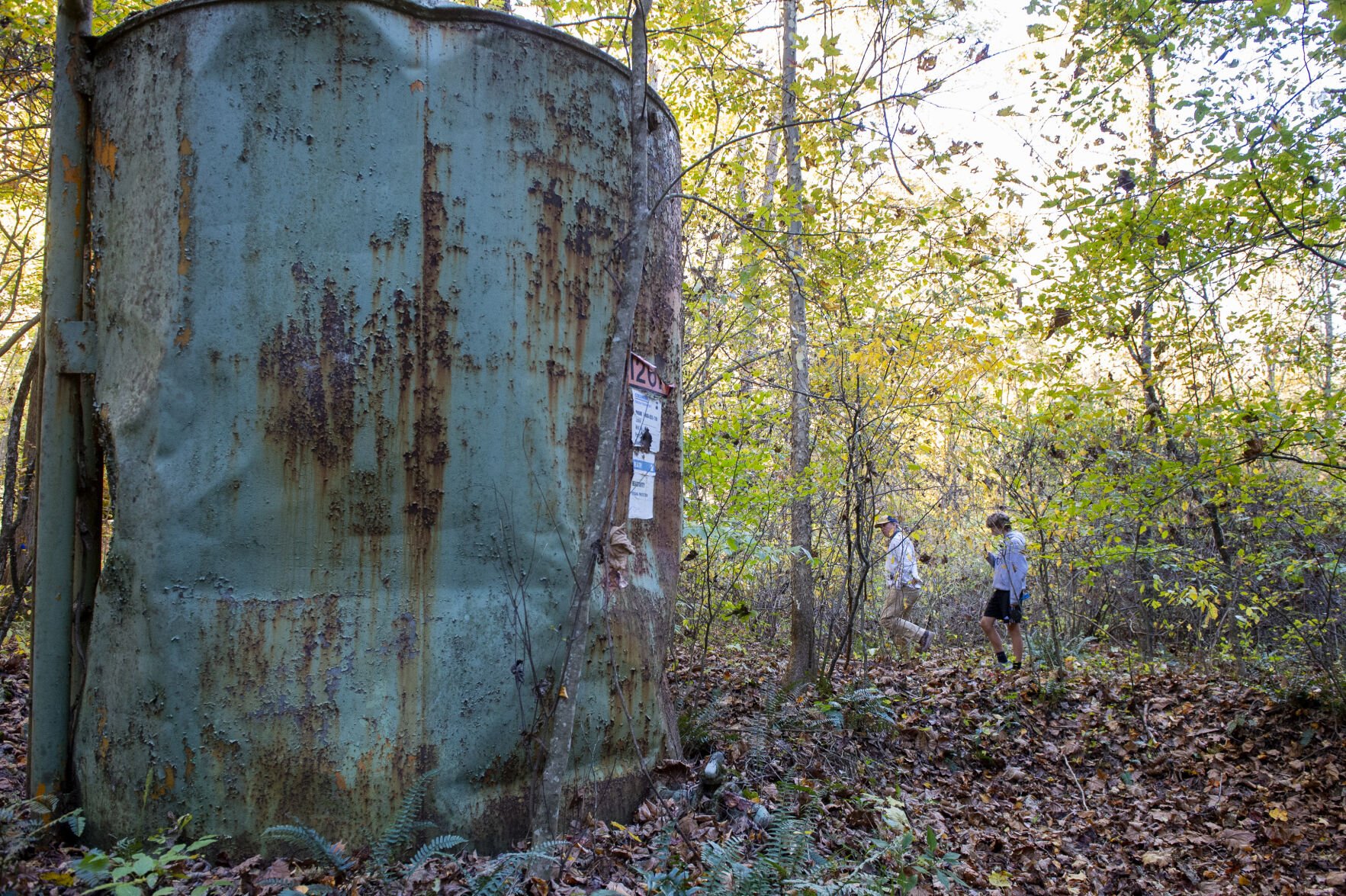
Ted Boettner and his son, Sid Boettner, walk past a gas storage tank listed as abandoned in Kanawha State Forest in ÂÒÂ×ÄÚÉä on Oct. 24, 2025.
LAURA BILSON | Gazette-Mail
Experts and advocates already were wary of a deal that Gov. Patrick Morrisey’s administration struck this month with the nation’s largest gas and oil well owner to seal, or plug, its wells throughout the state.
“[I]t’s not something I would be bragging about if I were West Virginia,� Peter Morgan, legal and policy director at the Center for Asset Retirement Accountability, a fossil fuel asset retirement-focused group, said in a phone interview.
Now that the Gazette-Mail has obtained the 481-page agreement via a Freedom of Information Act request, experts see even more reason to condemn the deal. They also see a missed opportunity to strengthen West Virginia’s protection against the threat of a future riddled with unplugged, abandoned wells that pollute groundwater, create sinkholes, hurt wildlife and emit climate-harming methane.
“[I[t is very disappointing and leaves West Virginia highly exposed,� Morgan said.
That exposure, Morgan says, is to billions of dollars in well-plugging liabilities carried by the well owner, Alabama-headquartered Diversified Energy Company, which reached the deal with the West Virginia Department of Environmental Protection to create a financial assistance fund for retiring gas and oil wells.
Called the Mountain State Plugging Fund, the arrangement is a $70 million commitment over 20 years from Diversified to West Virginia guaranteed by OneNexus, a Houston-based provider of financial assurance for gas and oil operators that launched in 2021.
States mandate that wells no longer producing gas or oil are plugged and abandoned, and that well owners secure a bond or other financial assurance that helps cover the expense of closing wells that aren’t productive anymore.
At an Oct. 16 news conference they held at the Bridgeport headquarters of Diversified subsidiary Next LVL Energy, Morrisey and Diversified CEO Rusty Hutson Jr. asserted the pact would go further in protecting taxpayers, which will lead asset retirement operations for Diversified wells under the new agreement.
But plugging advocates say the pact does the opposite, putting taxpayers further on the hook through well retirement math that doesn’t pass muster.
“[T]he dollars in this deal do not work, and we do not see the need for a middleman insurance company that will surely also get some part of the money,� West Virginia Surface Owners Rights Organization cofounder Dave McMahon said in an emailed statement after reviewing the agreement.
The Governor’s Office had declined to provide the agreement to the Gazette-Mail after it announced the deal on Oct. 16, advising submitting a Freedom of Information Act request to the DEP instead.
“[W]e can see why he did not initially talk to us before his announcement or hand out the consent agreement,� McMahon said.
An active gas well controlled by Diversified Energy Company sits in Kanawha State Forest on Oct. 24, 2025.
LAURA BILSON | Gazette-Mail
Diversified agreed to plug at least 75 nonproducing wells per year from 2026 through 2045, an annual target that represents less than 4% of the 1,927 wells Diversified owns that are considered abandoned per state code, according to the agreement. Diversified plugging 75 wells annually for 20 years would result in 1,500 wells plugged — just over 7% of the 20,694 overall gas and oil wells for which Diversified is responsible, per the agreement.
The agreement caps the amount the DEP can be paid by OneNexus if Diversified fails to comply with the plugging schedule at $32,000, regardless of the cost of plugging the well. The Governor’s Office did not note that provision in its Oct. 16 announcement of the deal.
The $32,000-per-well coverage appears skimpy given how much the DEP has estimated plugging wells costs.
West Virginia has previously indicated that the average state cost of plugging a well is roughly $157,000, doing so in a 2021 notice of intent to apply for formula grant funding to plug and restore orphaned wells — unplugged wells with no solvent operator — through that year’s Infrastructure Investment and Jobs Act.
Multiplying that estimated cost by Diversified’s number of unplugged wells in West Virginia — more than 20,000 — yields a total cost of more than $3.2 billion for reclamation of those wells, dwarfing the company’s new $70 million commitment.
Current DEP Office of Oil and Gas Acting Director Jason Harmon indicated at a meeting on federal methane emissions reduction funding last year that the DEP could plug as many as 400 wells with $38 million allotted through program grant funds, or about $95,000 per well.
At that lower cost accounting for low-producing wells that can be less expensive to decommission than orphaned wells, it would still take just under $2 billion to plug all 20,000-plus unplugged Diversified wells in West Virginia.
At just $32,000 per well, plugging Diversified’s 20,000-plus wells in West Virginia would cost over $662.2 million, which exceeds the $650 million into which company and state officials say they expect Diversified’s committed capital of $70 million to grow.
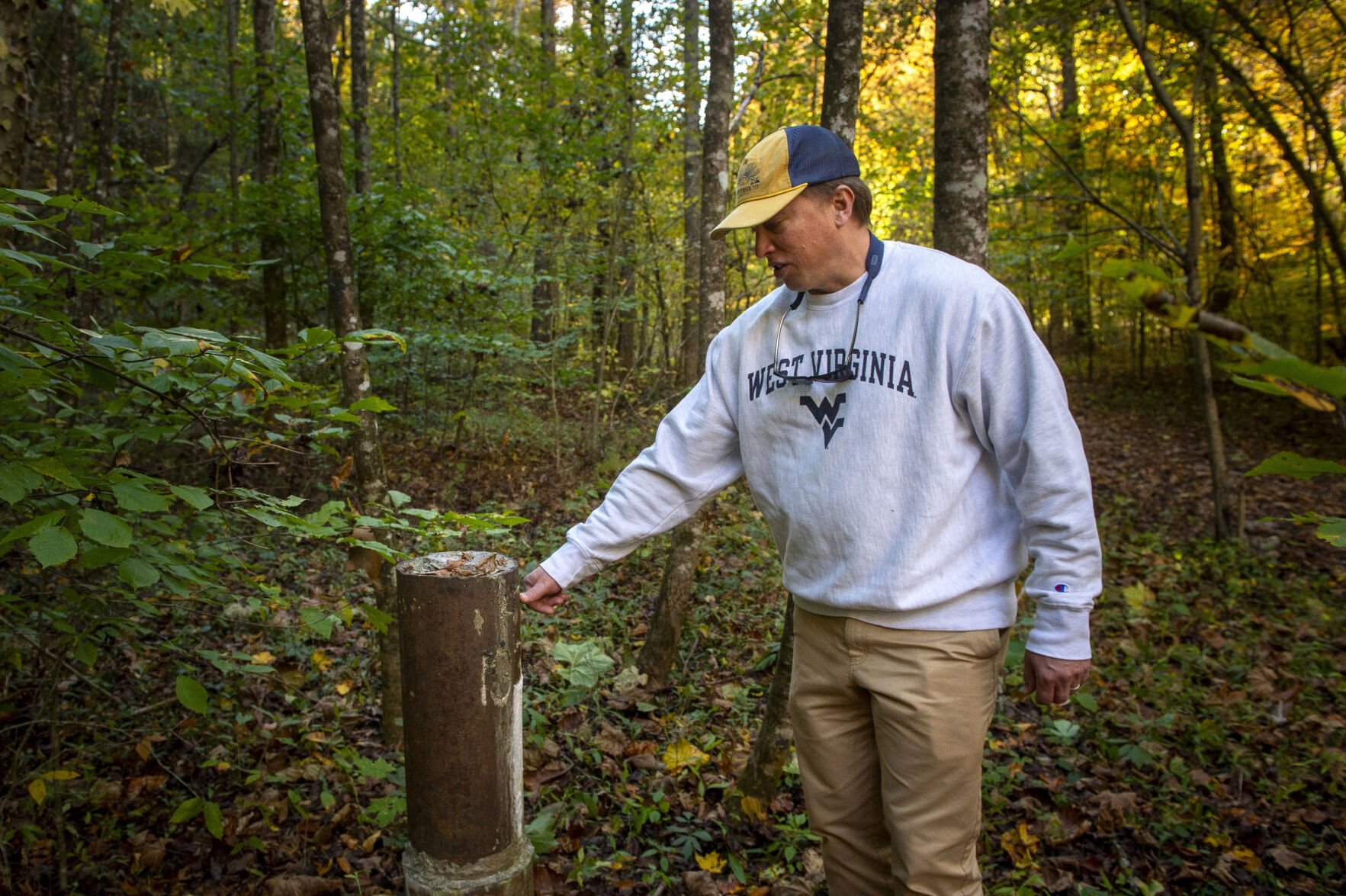
Ted Boettner, senior researcher at the Ohio River Valley Institute, examines a marked plugged gas well in Kanawha State Forest on Oct. 24, 2025.
LAURA BILSON | Gazette-Mail
That $32,000-per-well estimate also doesn’t account for inflation.
“[T]he $32,000 figure is artificially low,� said Ted Boettner, senior researcher at the Ohio River Valley Institute, a pro-clean energy think tank.
A study of the liability of decommissioning old wells in West Virginia, Ohio and Pennsylvania coauthored by Boettner and published in May by the Ohio River Valley Institute identified a 2.5-3.5% range for past, long-term industry service inflation.
At a 2.5% inflation rate, even at $32,000 per well, the combined cost of plugging the remaining 19,194 wells starting in 2046 if 75 wells were plugged annually for the next 20 years would exceed $9.2 billion.
The agreement also includes a penalty provision not noted by the Governor’s Office in its Oct. 16 announcement that plugging advocates find too weak to be effective.
Diversified agreed to pay a maximum cumulative penalty of $1,000 per day if it fails to plug nonproducing wells per the deal’s plugging schedule.
With the penalty set at that amount, Diversified would be on the hook to pay a maximum of $7.3 million if it was penalized every day for 20 years — a minute fraction of its plugging costs.
“[T]he stipulated penalties are very small at $1,000 per day, as counted against Diversified's current revenues,� Morgan said.
The company also reported a net loss of $87 million, and it has an uncommonly high number of low-producing wells, making well-plugging liability a more immediate concern.
An active gas well bore sits in Kanawha State Forest on Oct. 24, 2025.
LAURA BILSON | Gazette-Mail
Diversified’s nearly 75,000 total wells across eight states are higher than the next five highest operators in the country have combined, according to Center for Asset Retirement Accountability data. But Diversified’s 2023 well production was just 14th-highest nationally, per the center’s data.
Industry experts have said Diversified’s business model is based on acquiring a high number of low-producing wells that yield short-term dividends but present long-term liabilities mounting as the company puts off well decommissioning obligations.
In 2020, Greg Rogers, a senior advisor to Carbon Tracker, a London-based think tank researching climate change impacts on financial markets, called Diversified’s business model “a legal Ponzi scheme� in a conference call with the Capitol Forum, a corporate news analysis service.
OneNexus and a spokesperson for Diversified did not respond to requests for comment on financial details of the agreement.
“[T]he numbers in this deal do not add up,� McMahon said.
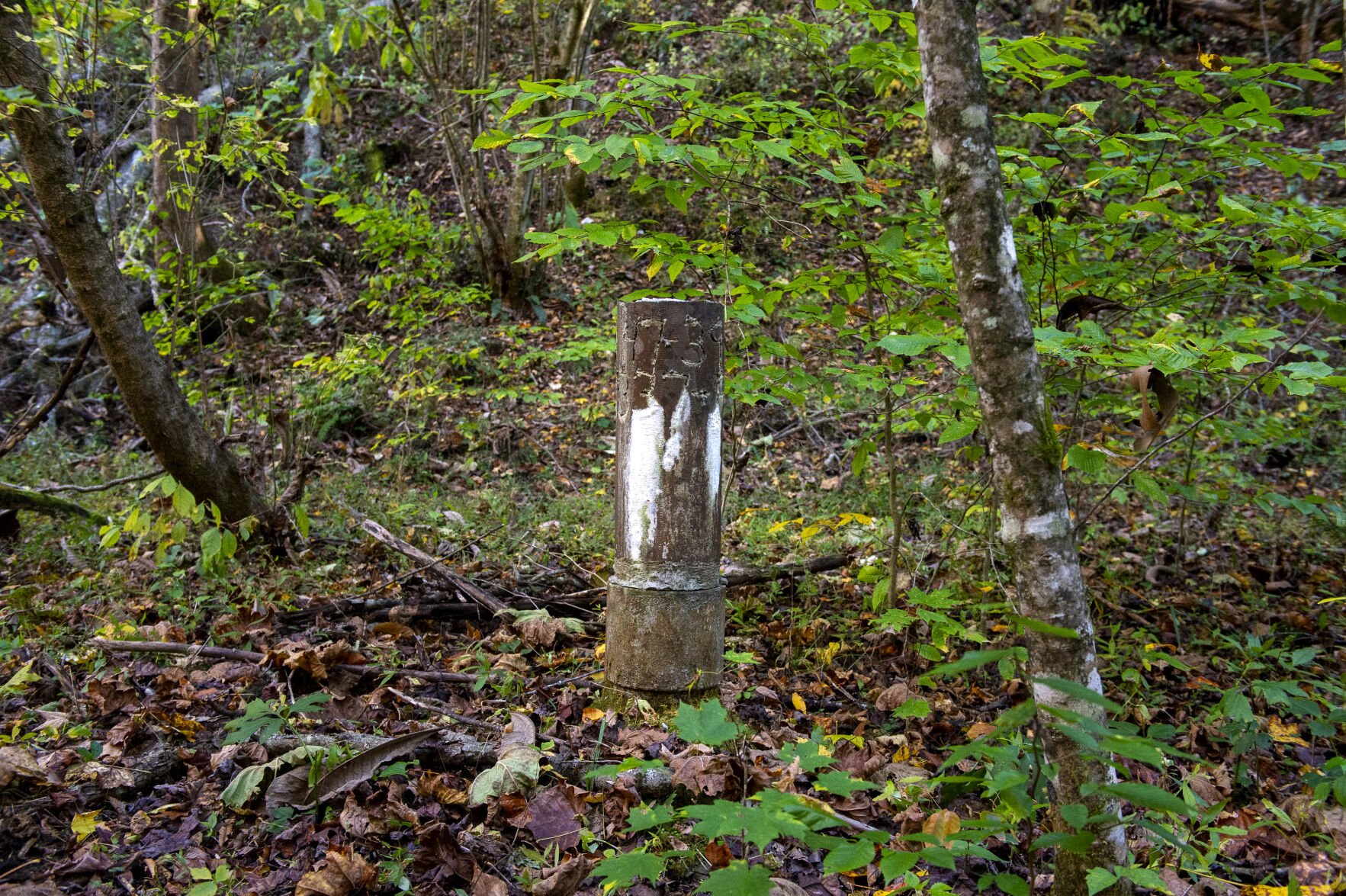
A marked plugged gas well sits in Kanawha State Forest on Oct. 24, 2025.
LAURA BILSON | Gazette-Mail
West Virginia code requires individual performance bonds of $5,000 per vertical, or conventional, well, or a blanket bond of $50,000 that can cover an unlimited number of conventional wells. State code calls for $50,000 bonds for each horizontal, or unconventional, well drilled or a $250,000 blanket bond.
Diversified already had been ordered by the DEP in 2018 to either place into production or plug at least 50 wells for which no production was reported in 2017 every year from 2020 through 2034, of which at least 20 had to be plugged each year.
With support from OneNexus, the new accord between Diversified and the DEP goes further.
“The State is in a far stronger position now than it was before, both financially and in terms of accountability,� DEP spokesperson Terry Fletcher said in an email, citing the new agreement.
But OneNexus enters the picture through a statutory gray area.
The agreement doesn’t address how much in fees OneNexus might receive or what basis points — a measure of changes in interest rates — might apply.
Fletcher acknowledged the new agreement doesn’t govern OneNexus’ investment fees and that there are no state regulations that govern the use of insurance products or other financial assurance providers for gas and oil companies in West Virginia beyond state code setting bonds for wells.
There are no West Virginia Offices of the Insurance Commissioner regulations regarding oil and gas well bonding, Offices of the Insurance Commissioner Deputy Commissioner and General Counsel Erin Hunter said.
Per the agreement, OneNexus doesn’t have to pay out more than what is provided by Diversified’s contract with the DEP plus any interest accrued if Diversified fails to comply with the assigned plugging schedule. The state also must provide a certificate showing state funds were used to plug a well within 60 days of the plugging to be eligible to receive payment from OneNexus.
“Is this really a scheme for Diversified to remove the enormous plugging liability on its books and turn it instead into an annual insurance payment liability and income tax deduction -- so it can convince investors to fund its purchase of more wells it will never be able to plug?� McMahon asked.
“This fund safeguards that Diversified and our wells will only bring economic benefits to West Virginians, never consequences,� Hutson wrote in an op-ed published by the Gazette-Mail Tuesday.
But Boettner questions what would happen if OneNexus can no longer step in to pay out, a scenario in which the state would be liable for potentially billions in cleanup costs — akin to the rampant risk of mine reclamation failure from the long-declining coal industry.
A 2021 audit report published by the West Virginia Office of the Legislative Auditor warned the DEP had failed to comply with state and federal law in its mine reclamation program oversight, resulting in missed opportunities to financially shore up its program that will need hundreds of millions of dollars to reclaim permit sites under federal regulations.
McMahon said surface owners weren’t consulted about the state’s Diversified deal.
When asked whether the DEP consulted surface owners or environmental groups leading up to the deal, Fletcher said consent orders like the one comprising the pact are “enforcement tools between the [DEP] and the regulated community,� and that in this case, the agreement “goes and beyond what the law requires.�
Advocates back escrow account approach for well-plugging Â
“What really needs done,� McMahon told the Gazette-Mail in an email, “is for drillers to be required to start setting aside money in escrow in banks paying interest just as soon as each well first starts producing, when the wells are producing the most, in order to pay themselves later to plug the wells.�
It has been common industry practice for larger companies better resourced to plug their wells to instead transfer the wells to smaller firms.
“Diversified’s original sin was to put that practice on steroids,� McMahon said.
McMahon supports state legislation in House Bill 3415 and Senate Bill 11 that stalled in the 2025 regular legislative session that would have required gas or oil well operators to establish a plugging money set-aside escrow account, out of which funds would be paid out only if the DEP certifies a well has been plugged.
Similarly to McMahon, Boettner says each new well that is completed should have a site-specific trust or escrow account backed by a surety bond and supports what had been HB 3415. The bipartisan legislation, which stalled in the House Energy and Public Works Committee, and SB 11 each would have required gas operators to pay a fee of 15 cents per thousand cubic feet of gas produced for plugging set-aside money.
West Virginia’s natural gas withdrawals totaled a record-high 3,417,995 million cubic feet in 2024, more than 18 times the state’s total in 2003 — the last year the state’s natural gas withdrawals didn’t increase, according to Energy Information Administration data. That long-term trend suggests hundreds of millions of dollars annually could be secured in plugging set-aside funding if a fee is enacted as was provided in HB 3415 or SB 11.
Morgan pointed to New Mexico, which is considering legislation that would implement tighter rules for inheriting wells, a frequent step toward well abandonment.
An orphaned natural gas well bubbles with methane gas in Kanawha State Forest on Oct. 24, 2025.
LAURA BILSON | Gazette-Mail
Meanwhile, Diversified’s production keeps declining. The company’s gas, oil and natural gas liquids production declined 47.6% in 2024 from 2023, a 74.8% drop from 2021, according to Center for Asset Retirement Accountability data. Diversified’s number of producing wells fell 54.9% from 2021 to 25,146 in 2024, per the data.
Boettner predicted that Diversified won’t have much money for well-plugging left when the time comes to plug most of its West Virginia wells at the end of the initial 20-year period set in its new agreement with the state.
Boettner cited a quote from 20th-century British economist John Maynard Keynes to warn against overreliance on long-term projections.
“In the long run,� Boettner said quoting Keynes, “we are all dead."
Unplugged wells, though, live on.
CLICK HERE to follow the ÂÒÂ×ÄÚÉä Gazette-Mail and receive