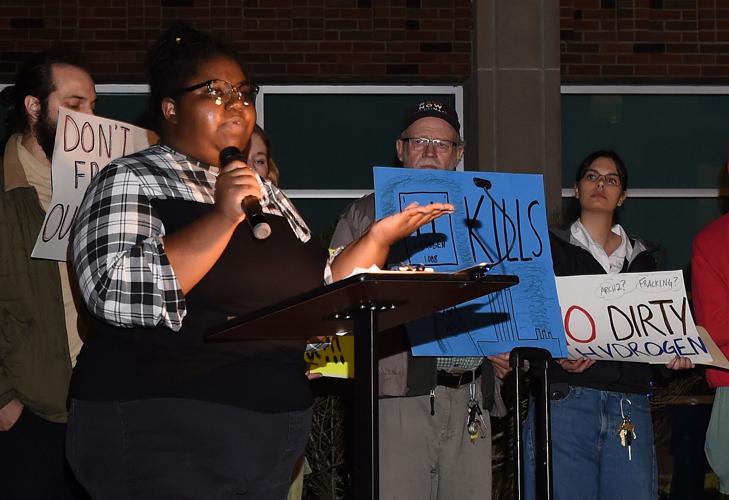
A-Nya Badger, an organizer for Fair Shake Environmental Legal Services, speaks against the ARCH2 regional hydrogen hub during a rally outside the James C. Wilson University Union building before the start of a community open house held by representatives of ARCH2 inside the building at West Virginia State University on Nov. 7, 2024.
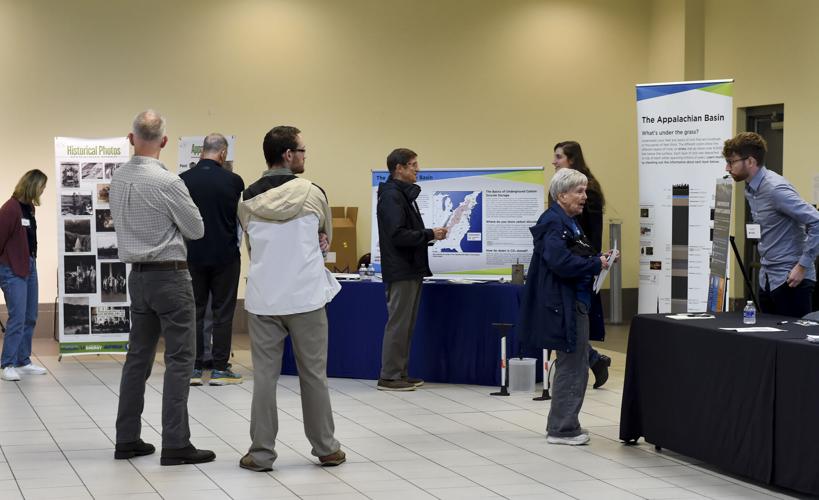
Visitors attend a community open house held by representatives of the ARCH2 regional hydrogen hub inside the James C. Wilson University Union building at West Virginia State University on Nov. 7, 2024.
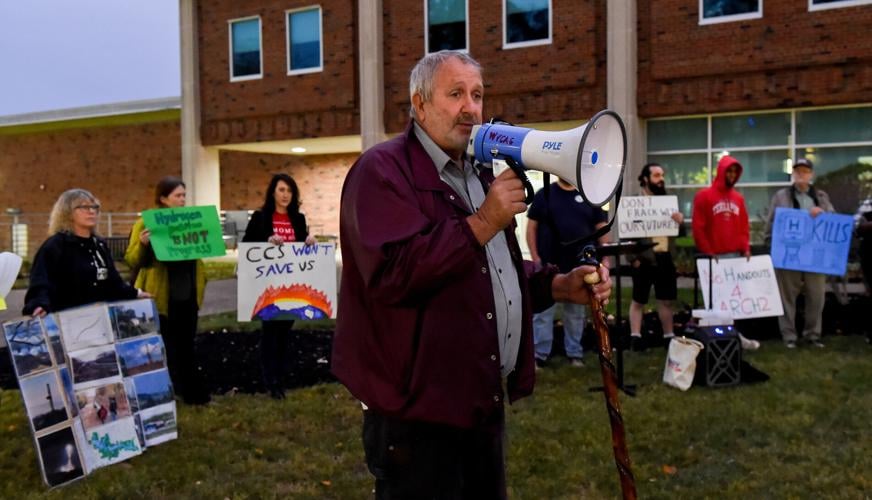
Maury Johnson of Monroe County speaks against the ARCH2 regional hydrogen hub during a rally outside the James C. Wilson University Union before the start of a community open house by representatives of ARCH2 inside the building at West Virginia State University on Nov. 7, 2024.
Before it had even begun, the open house had given way to a closed door.
“One, two, three, four, don’t let ARCH2 in the door!�
The chant rang out from about four-dozen concerned citizens just outside West Virginia State University’s James C. Wilson University Union building.
That’s where the team behind ARCH2, a planned hydrogen production and delivery network it has billed as the future of Appalachian energy, was about to hold an open house on Nov. 7. ARCH2, the Appalachian Regional Clean Hydrogen Hub, promised to give “the inside scoop� on their project that recently secured $30 million in federal funding — with more than 30 times that amount potentially still to come.
But the advocates gathered outside the open house didn’t want to let ARCH2 in the door because, after generations of enduring toxic air pollution in the heart of what’s accurately dubbed “Chemical Valley,� they feel they’ve been denied a seat at the table.
Lifelong Kanawha Valley resident Morgan King’s grandfather worked at Union Carbide in South ÂÒÂ×ÄÚÉä after serving in World War II. Speaking before the crowd at last week’s rally, King recalled her mother and her siblings watched both their parents die of liver cancer in the same year, suffering the same fate as many of her grandfather’s former colleagues.
“We cannot afford another chapter in this tragic and toxic narrative, one that perpetuates the cycle of extraction while ignoring the voices of those most affected,� said King, climate and energy program manager for the West Virginia Citizen Action Group, a progressive advocacy organization. “But that’s exactly what ARCH2 promises to bring. This project relies on blue hydrogen.�
Blue hydrogen and fossil fuel extraction
Blue hydrogen is a fossil fuel-enabled approach to hydrogen production in which the gas is derived mainly from breaking methane into hydrogen and carbon dioxide.
It’s also an approach that evidence shows has significant climate and health consequences.
Blue hydrogen production relies on technology unproven at commercial scale that captures and stores carbon emissions underground. The approach has drawn the ire of environmental and climate advocates noting its potential to leak methane and carbon dioxide and induce seismic disruptions.
Methane emissions linked to blue hydrogen can make hydrogen applications worse for the climate than fossil fuel technologies for several decades if emissions are high for both gases, according to a 2022 research paper published in Atmospheric Chemistry and Physics, a peer-reviewed journal.
Blue hydrogen relies on fossil fuel extraction, driving fears of increased well production that will trigger greater emissions of toxic chemicals like volatile organic compounds and fine particulate matter linked to cancer, liver damage, asthma and other respiratory illnesses.
West Virginia’s gas and oil industry-linked cancer risks are among the highest in the country, according to a 2022 analysis of EPA data by Clean Air Task Force, an environmental nonprofit.
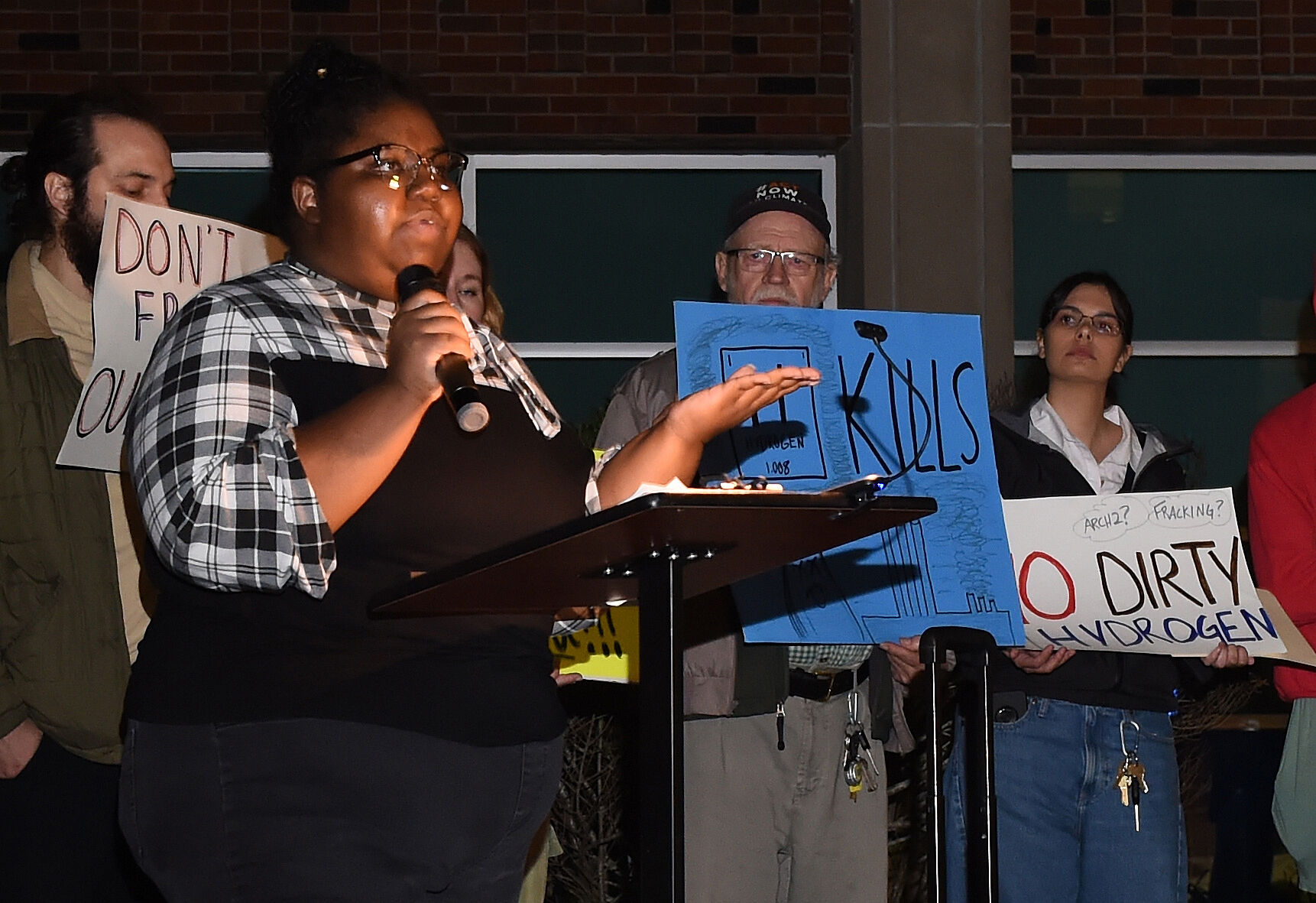
A-Nya Badger, an organizer for Fair Shake Environmental Legal Services, speaks against the ARCH2 regional hydrogen hub during a rally outside the James C. Wilson University Union building before the start of a community open house held by representatives of ARCH2 inside the building at West Virginia State University on Nov. 7, 2024.
CHRIS DORST | Gazette-Mail
A-Nya Badger’s asthma didn’t stop the lifelong resident of neighboring Dunbar from speaking out loud and clear against ARCH2 at the rally — even on a Code Orange state air quality alert day prompted by regional wildfire smoke.
“Not having a seat at the table means our voices are silent, and our loved ones are suffering,� Badger, 23, said. “And what do we have to show for it? Nothing. There’s absolutely no benefit to us.�
Badger, who is Black, accused ARCH2 of being “performatively set up� at West Virginia State, a historically Black university, in what she called a “Black neighborhood ravaged by the impacts of industry.�
“I would at least want them to have concrete details and a solid plan to at least educate us to be able to make a decision about how we feel about it,� Badger, community democracy program coordinator for Fair Shake Environmental Legal Services, an environmental law firm, said in an interview after her rally speech.
ARCH2 part of $7 billion hydrogen hubs program
ARCH2’s open house offered tables with posters explaining carbon capture technology and other project aspects. Representatives of ARCH2, few of its roughly dozen project development partners and members of the Department of Energy, had tables at which they fielded questions from attendees.
But ARCH2’s attempt at a good first impression led to more second guessing afterward from project skeptics who have predicted a looming boondoggle where state and federal leaders have promised a boon.
The ARCH2 network is planned to span parts of West Virginia, Pennsylvania and Ohio. The Department of Energy selected ARCH2 for an award of up to $925 million in October 2023 as part of its $7 billion program slated to support seven hydrogen hubs nationwide pending project negotiations.
The Biden administration has pushed the hydrogen hub program as an avenue toward reducing emissions from hard-to-decarbonize economic sectors like steel and cement manufacturing.
Shawn Bennett, energy and resilience division manager at ARCH2 leader Battelle, an Ohio-based nonprofit applied science and technology group, testified to Pennsylvania lawmakers in June that roughly 60% of the hydrogen produced through ARCH2 would be used for chemical manufacturing for agricultural use in the ARCH2 region and surrounding areas.
West Virginia officials teamed up with Battelle, Pittsburgh gas producer EQT Corp., Illinois energy research firm GTI Energy and Bridgeport energy technology consulting firm Allegheny Science & Technology in 2022 to create ARCH2.
Bennett pledged what he called a “primarily blue� hydrogen network to be based in Morgantown would boost local economies by creating 10,000 jobs in early siting and construction stages and nearly 3,200 jobs once in operation and would lower greenhouse gas emissions.
The Department of Energy has said the project will be subject to “go/no-go� decisions over a span of roughly eight to 12 years, including 12 to 18 months for the first, design-focused phase.
Open house attendees were offered a nine-page, Department of Energy-published community benefits summary touting “community advisory mechanisms� that include an advisory board and a community benefits steering committee composed of:
Visitors attend a community open house held by representatives of the ARCH2 regional hydrogen hub inside the James C. Wilson University Union building at West Virginia State University on Nov. 7, 2024.
CHRIS DORST | Gazette-Mail file photo
More questions than answers about ARCH2
Each project will establish a site-specific community advisory body.
The community benefits summary says that Air Liquide, a global industrial gas supplier, will work with gas producer EQT to “systematically gather community and labor feedback through focus group discussions and other engagement events.�
Air Liquide has planned to construct and operate a hydrogen liquefaction facility, onsite storage and loading facilities to serve offtakers in the mobility sector. Air Liquide operations would be co-located with a planned EQT facility to convert natural gas into hydrogen-rich synthesis gas, a mix of carbon monoxide and hydrogen, and then into low-carbon aviation fuel and other liquid fuels.
But the project location hasn’t been announced, and ARCH2 is determining possible siting and facility options for producing, storing and delivering hydrogen throughout the region. A fact sheet produced by the Department of Energy in late July listed 11 potential project sites, including five in West Virginia.
ARCH2 critics have condemned it for having a high concentration of locations still undetermined.
ARCH2 has said environmental and stakeholder perspectives will be considered during site planning. The enterprise’s website says that plans will be “communicated as soon as they are available, and that stakeholders will be able to comment on proposed locations. The locations of carbon storage facilities also are yet to be determined.
In a one-on-one conversation at the open house with King, who led the chant at the rally outside the Wilson Student Union, ARCH2 community benefits manager Melanie White suggested staunch community opposition wouldn’t necessarily stop a project from moving forward.
“If there is overwhelming [sentiment that] we don’t want this here, would you all consider doing [a project] elsewhere?� King asked White.
“That really comes down to their private capital and what they have the ability to do,� White replied, referring to individual projects within the ARCH2 network.
White noted that projects would be “on their own� financially if the DOE withholds support after progress assessments.
White also couldn’t say whether ARCH2 would move forward if the DOE’s Office of Clean Energy Demonstrations — the agency’s office overseeing the hydrogen hubs program — goes defunct in the upcoming Trump administration.
Project 2025, a proposed presidential transition project overseen by former Trump administration officials, included a collection of policy plans that recommends eliminating the Office of Clean Energy Demonstrations. The office was established in 2021 in line with that year’s bipartisan Infrastructure Investment and Jobs Act that provided more than $20 billion to create it.
White said projects within ARCH2 would have to assess whether to move forward based on their private investments if the office is eliminated.
The federal government required hydrogen hubs to provide a minimum of 50% of the total project cost, for a total expense of at least $800 million to $2.5 billion spanning eight to 12 years, when it announced the funding opportunity for the program in 2022.
Office of Clean Energy Demonstrations representatives at the open house declined to comment, deferring questions to office communications staff.
A Department of Energy spokesperson said in a statement when asked for comment on the office’s future that the office was established by Congress to oversee “large and complex projects that can span 10 years or more.�
Plans for ARCH2 hydrogen considered uneconomic
ARCH2 critics say the project’s economics are unsound because it aims to support end uses for hydrogen that experts say are among the least competitive applications of hydrogen when it comes to carbon reduction potential and cost.
Day-to-day power generation has “terrible� prospects as an end-use application for hydrogen, according to a report published earlier this year by Energy Innovation, a San Francisco-based climate policy firm. The report defined “terrible� uses for hydrogen as unlikely to be competitive with alternatives on cost and performance.
But despite skepticism over power generation as a goal for hydrogen projects, Hope Gas plans to use hydrogen-blended natural gas to power fuel cells installed at no cost to low-income consumers in their north central West Virginia-centered territory, according to a Hope Gas representative at the open house.
But a report published in August added to a long history of findings that using hydrogen in existing gas infrastructure is a risky option.
The report said a transition to pure hydrogen is not possible without significant retrofits and replacements and that “like-for-like gas substitution provides limited benefits for increased risks,� noting that harmful nitrogen oxide emissions would persist with hydrogen, which is more explosive than methane that comprises natural gas.
Energy Innovation found hydrogen is “terrible� or “poor� for not only day-to-day power generation, but also for buildings, industrial process heating, short-haul marine shipping and light-duty and heavy-duty vehicles.
But Clean Fuel Services LLC, a subsidiary of Hog Lick Aggregates, plans to develop what ARCH2 has called a “Clean Fuel Services Depot� near Fairmont featuring hydrogen vehicle fueling and maintenance facilities within the ARCH2 network. At full capacity, ARCH2 says the project would potentially use 1 metric ton per day of hydrogen to power medium- and heavy-duty trucks.
Despite expert skepticism about hydrogen blending, EQT plans to have a facility at a site to be determined to purify hydrogen for fuel cell vehicles or blending to gas distribution lines.
ARCH2 detractors say recent departures of industrial giants from the enterprise are signs that it doesn’t make economic sense. ARCH2 aims to add new projects after the Chemours Company and TC Energy stepped away from the project this summer.
Chemours cited concerns with the proposed implementation of a federal hydrogen production tax credit.
Nov. 8 marked the submission deadline for proposals to Battelle for hydrogen projects to add to ARCH2’s footprint. ARCH2 reported up to $110 million in federal assistance available for up to three projects.
Maury Johnson of Monroe County speaks against the ARCH2 regional hydrogen hub during a rally outside the James C. Wilson University Union before the start of a community open house by representatives of ARCH2 inside the building at West Virginia State University on Nov. 7, 2024.
CHRIS DORST | Gazette-Mail
‘No understanding of community consent’
ARCH2 should have used its request for information process soliciting new projects to address concerns about its operations, Tom Torres, hydrogen program director at the Ohio River Valley Institute, a pro-renewable energy, Pennsylvania-based nonprofit think tank, said.
“The hub has much work to do to show people that their concerns are being taken seriously,� Torres said after the open house.
King noted the Nov. 7 open house was the first on-the-ground engagement activity ARCH2 developers had held in the 25 months since it was selected to receive federal funding, after several webinars that didn’t let participants speak to project or Department of Energy representatives.
“They are using engagement activities to seek the path of least resistance to get the project completed and have no understanding of community consent,� King said after the open house.
White said she was pleased with the turnout. A project representative reported roughly 120 registrations for the event, which offered attendees comment cards to give feedback.
“I know we have individuals in the room that are not necessarily in favor of the hub, and I really appreciate the opportunity for us to be able to engage with them and talk with them and just open dialogue,� White said.
But the door to a seat at the table, Badger believes, has been closed for far too long.
“This isn’t just bad,� Badger said of the project during her rally speech. “It’s morally wrong.�
CLICK HERE to follow the ÂÒÂ×ÄÚÉä Gazette-Mail and receive