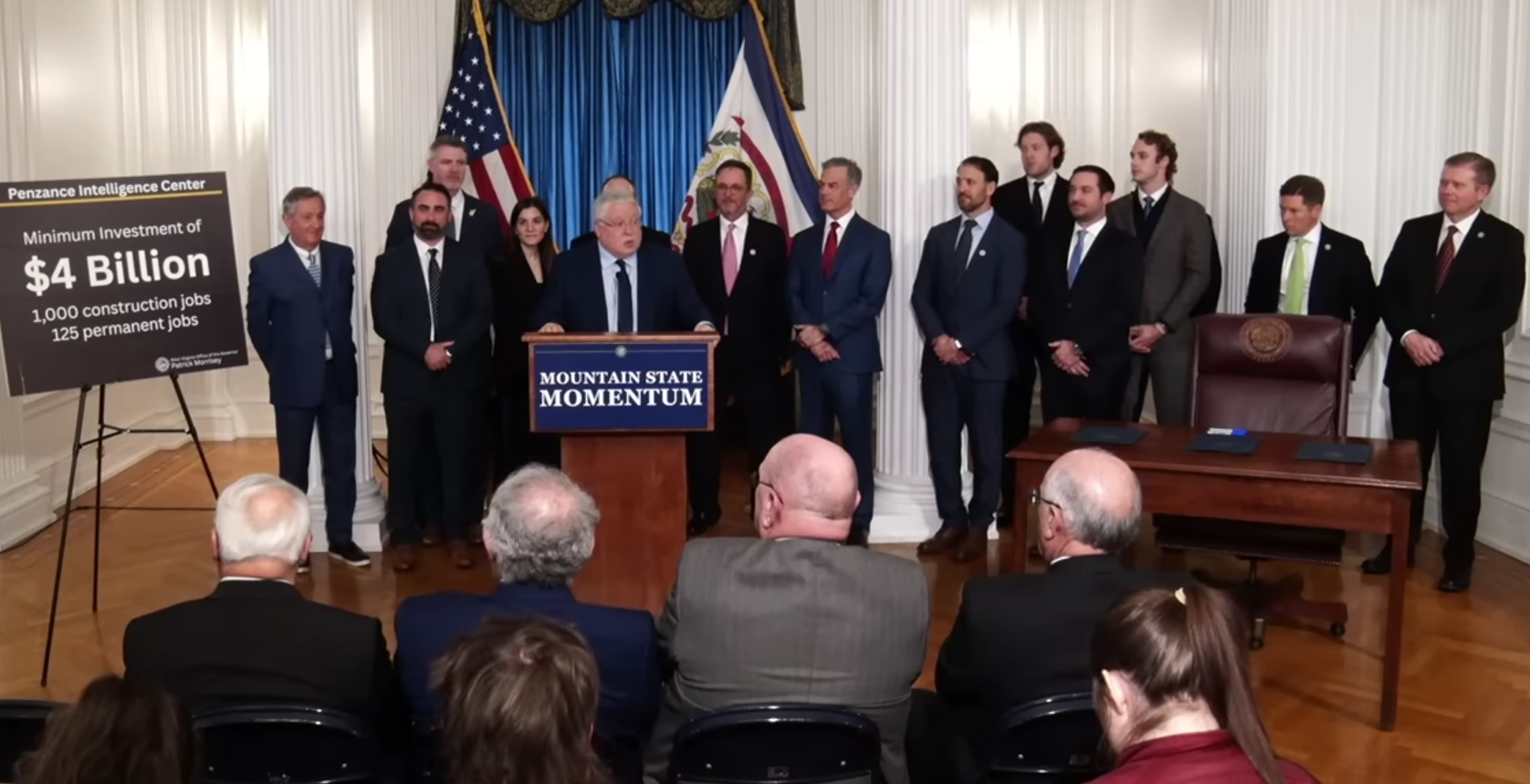
Gov. Patrick Morrisey (at lectern) stands with West Virginia government and Penzance officials at a Governor's Office news conference on Feb. 26, 2026, announcing the company's plans for a data center in Berkeley County.  Â
Energy Efficient West Virginia policy director Emmett Pepper speaks at a West Virginians for Energy Freedom news conference to promote ratepayer protections in the Governor’s Cabinet Conference Room of the West Virginia Capitol on Feb. 26, 2026.
The opposition couldn’t be clearer — and it was heeded.
The planning commission for Fredericksburg, Virginia, on Dec. 10 considered an effort to change the zoning from a medical center category to industrial for a data center project — after a nearly four-hour meeting in which residents of the city some 50 miles south of Washington, D.C., uniformly condemned the application.
None of the 14 speakers — or 35 comments submitted electronically and read into the record — supported the application, a resubmission from Penzance, a Washington-based real estate firm founded in 1996 that had broken ground the month before on a new, 240,000-foot Amazon data center in Chantilly, Virginia, roughly an hour from Fredericksburg.
“We are not only destroying our environment and the ambience of our city, but we are destroying people’s lives by taking their property value from them,� city resident Anne Little said, fearing a power line installation would send property values plummeting while producing unbearable noise levels, increased air pollution and requiring tree removal. “Please don’t approve this. This is just an aberration we shouldn’t even be thinking about.�
“Please consider what your neighbors are saying,� urged city resident Ed Santner of Fredericksburg.
The commission did, approving a motion to recommend denying applications to the city council for a zoning map amendment and special use permit.
“[T]he Planning Commission finds that the public necessity, convenience, general welfare, and good zoning practices do not favor the requested rezoning and special use permit,� the body concluded in its minutes of the meeting, which followed another commission disapproval recommendation of the applicant’s request to rezone 83.5 acres, permission for building height up to 90 feet and the use of a water-based cooling system and proposed substation on the site.
Gov. Patrick Morrisey (at lectern) stands with West Virginia government and Penzance officials at a Governor's Office news conference on Feb. 26, 2026, announcing the company's plans for a data center in Berkeley County.  Â
Penzance got a different reception in the West Virginia governor’s office Thursday.
“Can you guys feel the buzz going on?� Gov. Patrick Morrisey asked at a news conference that afternoon, backed at his lectern by more than a dozen officials from state government and Penzance.
Morrisey announced that Penzance planned a $4 billion investment for a campus in Bedington, Berkeley County, that had earned a designation as West Virginia’s first “high-impact� data center under House Bill 2014, a Morrisey-pushed 2025 state law that has drawn significant opposition for its design to entice in-state data center development — an area in which West Virginia has lagged compared with its neighbors.
The campus will be located on 548 acres in the Falling Waters district of Berkeley County, Morrisey announced, noting that at full buildout, the development will total some 1.9 million square feet and deliver 600 megawatts of information technology capacity.
The project qualified for the designation under HB 2014, Morrisey noted, because it is planned to exceed a critical information technology load of 90 megawatts.
“[HB 2014] helped make this investment possible and to help make West Virginia the most attractive place in the country to build an intelligence center,� Morrisey said, eschewing the phrase “data center� to describe the project.
“We’re thrilled to be here,� Penzance cofounder Victor Tolkan said moments later. “The governor and his team, as I said, have created along with you guys an extraordinarily pro-business environment specifically related to intelligence centers.�
Tolkan said Penzance “build[s] to suit for hyperscalers,� finding and titling land and then partnering with hyperscalers that effectively become its tenants.
Hyperscale data centers are massive, typically power-hungry and water-guzzling facilities that house cloud computing, large data applications and other network infrastructure.
Berkeley County Commission President Eddie Gochenour welcomed Penzance.
“There are some unanswered questions, but I feel very confident after meeting with your team over the last day — Monday actually — that they’re going to be a great partner with us,� Gochenour said.
The unanswered questions are many.
Tolkan at the news conference declined to give an outlook on securing a buyer of site capacity.
“I can’t,� Tolkan said. “I want to add to that there are times when we have actually signed leases and those people are in buildings, and I still can't.�
Morrisey said he believed the facility would be connected to the grid but that “there are other opportunities we won’t talk about.�
Asked to comment on Penzance’s footprint outside West Virginia, Tolkan replied, “I’d rather not at this time.�
“As you may know, sometimes there are sensitivities,� Morrisey added, citing a desire for hyperscalers “to break things when they are at the right time.�
Morrisey said the potential date for any “ribbon-cutting or the opening� is yet to be determined.
Morrisey said a prediction from his office the project would yield 125 full-time permanent positions — more than many comparable sites at what typically are low-employment facilities relative to other industrial operations — was based on “good-faith estimates� tied to the planned size and footprint of the facility.
The Governor’s Office after the meeting declined to provide energy resource and water use information, a projected permitting time frame, and any measures planned to limit noise or light pollution, referring comment to the company and county officials.
Berkeley County Development Authority executive director Jennifer Smith in an email referred comment to a public relations official, Sofia Royce at the Brand Guild, who has led the Washington and New York-based firm’s real estate team and crisis response services. Royce did not respond to an emailed list of questions.
Data center development strategy based on secrecyÂ
The announcement comes amid an outcry from residents and community and environmental advocates over HB 2014 stripping local control from officials throughout the state and shielding developers from having to share critical information about their planned projects publicly.
HB 2014 also required most of the property tax revenue the projects would generate from local taxing bodies, a move estimated to cost counties and school districts millions.
The Republican-supermajority House of Delegates last week passed a legislative rule via House Bill 4983 to provide the legal framework for HB 2014 that would keep basic information about proposed “High Impact� data center projects confidential and hidden from public view by the state Department of Commerce, fueling transparency concerns from West Virginians who fear they’ll have adverse financial and environmental effects.
The proposed rule would deem confidential all petitions seeking certification of a high-impact data center and all letters of intent seeking certification of a microgrid district.
HB 2014 is designed to ease in-state data center development in part by prohibiting counties and municipalities from enforcing or adopting regulations that limit creation, development or operation of any certified microgrid district or high-impact data center project. The law would split any property tax proceeds from high-impact data centers, with 50% going to a fund for reducing personal income tax.
The emphasis on confidentiality throughout the planned rule advanced by the committee is consistent with HB 2014’s requirement that to become a certified microgrid district, the operation’s representative must present the Department of Commerce secretary with a confidential letter of intent.
Delegate S. Chris Anders, R-Berkeley, criticized the Penzance announcement in a Facebook post Thursday, saying that “[a]ny project of this size, especially one that would possibly draw hundreds of megawatts of power and significant water resources, must be approached with caution, transparency, and strong protections for our citizens.�
Anders alluded to amendment efforts failed that would have required water use reporting requirements aimed at increasing transparency about potential impacts to local water supplies from prospective data centers proposed by developers to the Department of Commerce, which opposed the amendment efforts.
Large data centers can strain local water utilities, consuming up to 5 million gallons of water per day — roughly 5-8% of the total amount withdrawn for public water supply throughout West Virginia in 2023, according to West Virginia Department of Environmental Protection data.
“West Virginia deserves growth that respects its citizens, not growth imposed on them,� Anders’ post said.
Data center-linked projects planned for Mason, Mingo and Tucker counties securing DEP air quality pollution permits have drawn intense community opposition and quasi-legal appeals to the state Air Quality Board, with project critics objecting to feared impacts and DEP-approved developer claims of confidential business information about emission controls and other project details.
“The fact that the first certified data center under the law created last year is not one that we've been expecting is all the more telling that the entire program needs more transparency and public input,� West Virginia Environmental Council president Quenton King told the Gazette-Mail Friday.
Public comments to W.Va. overwhelmingly anti-data center
Morrisey has championed a data center-centric, fossil fuel-fired approach to energy and economic development in West Virginia, citing expected tax revenue gains.
But public comments on the Morrisey administration’s proposed comprehensive energy plan the Gazette-Mail obtained via the Freedom of Information Act from the Department of Commerce suggest that’s not what West Virginians want.
More than two-thirds of 80 comments reviewed by the Gazette-Mail indicated opposition to data centers or buildout of transmission power line infrastructure in general or specifically NextEra Energy Transmission MidAtlantic Inc.’s proposed $1.16 billion regional electric power line project planned to cross through Monongalia, Preston, Mineral and Hampshire counties and increase electric rates for customers of Mon Power, Potomac Edison, Appalachian Power and Wheeling Power.
Residents cited concerns over losing properties to eminent domain, seeing property values drop, deforestation and loss of treasured viewsheds and natural resources, many sending comments electronically on Christmas just ahead of a Dec. 26 state deadline for submissions.
“The long-term environmental and community costs [of large-scale data centers] far outweigh short-term revenue projections, and local residents are the ones left dealing with the consequences,� wrote Deborah Johnson, one of many residents from Jefferson County, which borders Berkeley County, who weighed in against data centers.
Morrisey’s energy agenda, features a coal and gas-led reach to more than triple West Virginia’s energy capacity to 50 gigawatts by 2050 and plan to develop plans to place natural gas pipelines and electricity transmission lines throughout the state. It drew a handful of comments from industry groups like the West Virginia Coal Association and Gas and Oil Association of West Virginia touting their own respective energy resources.
Energy Efficient West Virginia policy director Emmett Pepper speaks at a West Virginians for Energy Freedom news conference to promote ratepayer protections in the Governor’s Cabinet Conference Room of the West Virginia Capitol on Feb. 26, 2026.
But far more comments came from residents and advocacy groups like West Virginians for Energy Freedom urging a greater Morrisey administration embrace of renewable energy and energy efficiency measures to benefit ratepayers and the environment.
Mindy Messerly of Petroleum, a tiny community in gas well-heavy Ritchie County, wrote her home has a ground-mounted solar array with a Tesla battery that powers her home when the grid “goes down.�
West Virginians for Energy Freedom called for energy efficiency utility programs and legislation to institute virtual power plants, networks of small-scale, distributed energy resources like rooftop solar panels and home battery systems that can satisfy grid needs.
But House Bill 5381, pushed by Morrisey’s Office of Energy and slated for passage in the House of Delegates Monday, chiefly emphasizes coal and gas, requiring the office director to identify and designate sites suitable for coal and gas generation projects and “communicate� them as suitable to the Department of Environmental Protection’s Division of Air Quality and state Public Service Commission for construction and operation.
HB 5381 also would repeal state code requiring an energy savings program to designed to reduce energy usage for electricity, natural gas, fuel oil, and steam in all state buildings under the care, custody, and control of the state by 25% below 2018 levels by 2030 – a measure Office of Energy Director Nicholas Preservati told the House Energy and Public Works Committee this month wasn’t cost-effective.
At Thursday’s news conference, Morrisey emphasized what he called “speed to build.�
“That’s everything,� Morrisey said.
King doesn’t agree.
He noted public comments that asked for more opportunity for the public to weigh in on data center applications.
“[T]hose feelings from real West Virginians were cast aside,� King said.
CLICK HERE to follow the ÂÒÂ×ÄÚÉä Gazette-Mail and receive