
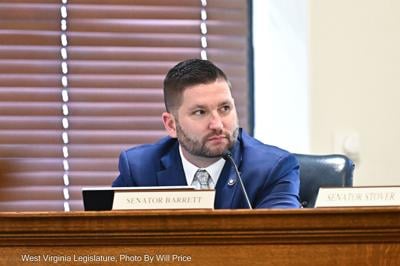

Measures poised to benefit the bail bond industry are on the verge of passing the West Virginia Senate after a senator whose wife is a registered lobbyist for the industry moved to add the measures to an unrelated bill.
House Bill 5257 was on its third and final reading before potential passage in the Senate after an amendment was offered by Government Organization Committee Vice Chairman Jason Barrett, R-Berkeley, at a committee meeting Tuesday afternoon.
Barrett’s move resurrected a proposed ban on magistrates releasing defendants charged with a felony on a personal recognizance bond, which allows a defendant to be released from jail without posting bail.
The ban, which is poised to create more potential customers for the bail bond industry, had been proposed in a measure Barrett sponsored, Senate Bill 725, that stalled in the House Judiciary Committee after the Senate passed it with a 29-2 vote on Feb. 26.
Barrett’s wife, Summer, is listed by the West Virginia Ethics Commission as a registered lobbyist for the West Virginia Surety Bail Bond Agents Association.
HB 5257 originally solely allowed the West Virginia Supreme Court to create pay scales for judicial support staff, a move aimed at aiding employee recruitment and retention efforts.
But with Barrett’s amendment, HB 5257’s reach extended to a separate chapter of state code to include the prohibition of magistrates releasing those charged with a felony on a personal recognizance bond, risking violating a state constitutional requirement that a bill embrace only “one object.�
Jason Barrett did not respond to requests for comment. But his wife did, saying she was not involved in crafting the legislation but has lobbied for it on behalf of two bail bond trade groups, including the American Bail Coalition, an association of national bail insurance companies.
Summer Barrett defended HB 5257 in a phone interview Wednesday, calling it “an attempt to establish some general guardrails for pretrial release to ensure some level of consistency between magistrate courtrooms.�
Supporters of HB 5257 and SB 725 have said uniformity is sorely lacking among magistrates in how they apportion personal recognizance bonds to those charged with a felony.
Barrett attributed her support for taking away magistrate discretion in part to what she said is an imbalance between some magistrates setting cash-only bail of thousands of dollars for those charged with petty misdemeanors while other magistrates release defendants charged with more serious crimes, such as sexual abuse and intent to deliver a Schedule I or II narcotic drug or methamphetamine on personal recognizance.
“I certainly think residents across the state should hope that [HB 5257] creates more business for the bail bond industry,� she said, “because, then, we have so much surety that these people who are charged with violent crimes actually show up for court.�
The Senate allowed HB 5257 to lie over one day on its third and final reading Thursday.
Options for bail
HB 5257 would allow a defendant to choose one of three options for making bail, which would be set at a monetary amount determined by a judicial officer:
- Cash deposit
- Agreement to forfeit property, including money, to assure the defendant’s appearance as required
- Use of a bail bondsman who posts a cash bond or execute a bail bond with a surety that sets an agreement to forfeit an amount needed to assure the defendant’s appearance as required.
The West Virginia Center for Budget & Policy, a progressive think tank that opposed SB 725, said an analysis it conducted of felony charges filed in Kanawha County revealed that magistrates set personal recognizance bonds in 1 of every 4 of those cases.
Critics of restricting magistrates’ authority to set felony case bonds say eliminating the personal recognizance option will increase the odds that people will await trial in jail, adding to long-lingering correctional overcrowding throughout West Virginia.
West Virginia Division of Corrections and Rehabilitation jails were 3.9% overcapacity, as of January, according to agency data.
The North Central Regional Jail and Correctional Facility in Doddridge County had 209, or 37%, more inmates than it has space to hold — and 48% were awaiting a felony trial.
The state faces a pending federal lawsuit from plaintiffs who have been inmates at state-run correctional facilities in Boone, Fayette and Logan counties who allege overcrowding, understaffing and inhumane treatment of inmates at facilities across the correctional system.
Putnam County Chief Magistrate Jean Anne Luikart told the Senate Judiciary Committee before its advancement of SB 725 last month that the bill would keep magistrates from considering important matters specific to each case.
“I’m a firm believer that you can’t blanket, especially something as flexible and should be, as many things as should be considered with bond,� Luikart. “There are so many things to consider when you set a bond.�
“You agree with that part of the bill, don’t you, that, if it’s a felony, we don’t just want you [to] O.R. [own recognizance] and out for public safety reasons?� Senate Minority Leader Mike Woelfel, D-Cabell, asked Luikart.
Luikart replied that it depends on the felony charge.
“[T]his is where you lose discretion,� Luikart said. “Is it a 5-year-old worthless-check felony warrant? Is that someone we want housed at the regional jail if they can’t make bond before their [preliminary hearing] in 10 to 20 days? Is it a 3-year-old driving-revoked charge that’s a felony?�
“OK. Fair enough,� replied Woelfel, who later voted for SB 725.


