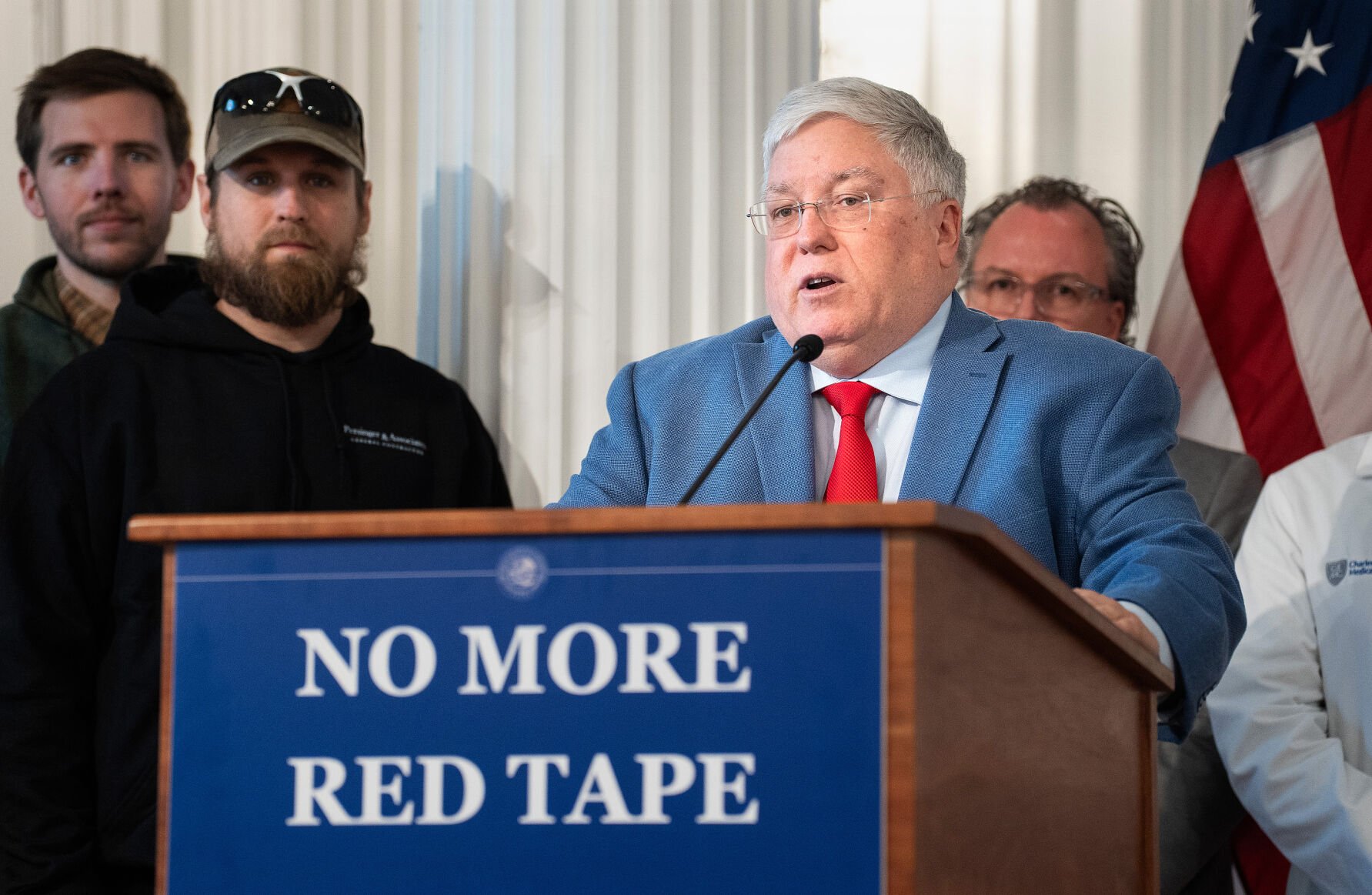
Gov. Patrick Morrisey speaks to reporters on April 7, 2025, at the Governor’s Office in the West Virginia Capitol before signing into law Senate Bill 458, the Universal Professional and Occupational Licensing Act. The law allows licensed and certified professionals to practice in West Virginia without taking additional examinations to attain local licensure or certification.
The West Virginia Legislature has passed bills stripping many state workers of civil service status and access to grievance procedures, moves feared to threaten job security and encourage partisan loyalty throughout the state workforce.
The Senate on Friday sent House Bills 2008 and 2009 to Gov. Patrick Morrisey by signing off on minor House of Delegates amendments to the bills Friday, the penultimate day of the state’s 2025 regular legislative session, after the House approved minor Senate changes to HB 2013 two days earlier.
Morrisey requested the bills and is expected to sign them. Morrisey has criticized the state’s civil service system, suggesting the legislation would make state government more meritocratic and dismissing concern it would result in state agencies hiring based on politics. He has asserted that, as West Virginia’s governor, it’s his job to choose who serves in state government.
Gov. Patrick Morrisey speaks to reporters on April 7, 2025, at the Governor’s Office in the West Virginia Capitol before signing into law Senate Bill 458, the Universal Professional and Occupational Licensing Act. The law allows licensed and certified professionals to practice in West Virginia without taking additional examinations to attain local licensure or certification.
Courtesy photo
Morrisey applauded the Legislature’s passage of the legislation in a statement Saturday night, saying they were among bills that would “grow our economy, streamline government, and uphold common sense.�
But opponents of the bills predicted they would usher in a political spoils system that rewards state employees based on who they know and support rather than the quality of the work they do.
HB 2008 would remove classified civil service status and grievance access from future Department of Economic Development employees.
HB 2009 would impose the same prohibitions on future Department of Tourism employees.
The Senate sent both to the governor via 24-8 votes on the penultimate day of state’s 2025 regular legislative session Friday.
The House green-lit Senate revisions to HB 2013 in a 70-27 vote Wednesday. HB 2013 would impose the same prohibitions on future employees of the Bureau of Senior Services, Department of Administration, Department of Environmental Protection, Department of Revenue and Department of Veterans Assistance.
Current employees of the agencies covered by the three bills who leave for another position within those agencies also would have their civil service status and access to grievance procedures stripped.
HB 2008 and HB 2009 also would reorganize the executive branch. HB 2008 would rebrand the Department of Economic Development as the Division of Economic Development and place it within the Department of Commerce. HB 2009 would abolish the Department of Arts, Culture and History and reorganize its sections and commissions under the Department of Tourism.
Spun off from the Department of Commerce in 2021, the Department of Economic Development houses the state’s Small Business Development Center, Office of Energy and other business, industrial and community advancement units.
All three pieces of legislation would take effect July 1.
‘Based on merit principles’
In a civil service system, government jobs are awarded based on merit rather than political affiliation. Chapter 29, Article 6, Section 1 of West Virginia code states the purpose of the state’s civil service system is to “attract … to the service of this state personnel of the highest ability and integrity by the establishment of a system of personnel administration based on merit principles.�
State grievance procedures, outlined in West Virginia code, allow claims by employees alleging a violation of state statutes and rules regarding compensation, hours, employment terms and conditions, employment status and discrimination. The procedures cover incidents of harassment and favoritism.
The Senate rejected amendments from Minority Leader Mike Woelfel, D-Cabell, and the chamber’s other Democrat, Assistant Minority Leader Joey Garcia, D-Marion, that would have preserved civil service and grievance procedure access to be stripped by HB 2008 and HB 2009, respectively.
State Library director requirements gutted
Per HB 2009, the Department of Arts, Culture and History would be abolished effective July 1. The Department of Tourism would be reconfigured to include Arts, State Library, Museums, Historic Preservation and other sections, as well as the National Coal Heritage Area Commission and Educational Broadcasting Commission.
HB 2009 would eliminate requirements for the director of the state’s Archives and History division to have a graduate degree in a social science or equivalent training and three years’ experience in administration in West Virginia or other history or in records, library or archives management.
Similarly, the bill would remove requirements that the State Library section director have a master’s degree from an American Library Association-accredited program in a library-related discipline and three years of management or administrative work experience in a library.
The Senate rejected an amendment proposed by Garcia that would have restored existing requirements for the State Library section director after Sen. Patricia Rucker, R-Jefferson, argued doing so would reduce state flexibility in how it fills the position.
Mike Tony covers energy and the environment. He can be reached at mtony@hdmediallc.com or 304-348-1236. Follow @Mike__Tony on X.