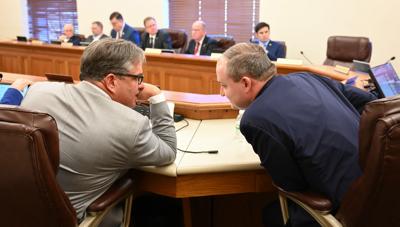
Sen. Rupie Phillips (at left) R-Logan, and Sen. Ben Queen (at right), R-Harrison, speak while the Senate Finance Committee discusses the Senate's proposed budget bill on Monday, Feb. 16, 2026 in at the West Virginia Capitol in ÂÒÂ×ÄÚÉä.
Sen. Rupie Phillips (at left) R-Logan, and Sen. Ben Queen (at right), R-Harrison, speak while the Senate Finance Committee discusses the Senate's proposed budget bill on Monday, Feb. 16, 2026 in at the West Virginia Capitol in ÂÒÂ×ÄÚÉä.
WILL PRICE | W.Va. Legislative Photography
The Senate Finance Committee rolled out their changes Monday to the governor’s proposed budget, making notable changes like a 10% tax cut instead of 5%, and a new plan for paying for the expensive education voucher program.Ìý
It’s much earlier than usual for the committee to reveal its proposed budget and send it to the Senate floor for a vote, which is likely to happen later this week.
“I didn’t think we’d get here to be honest with you,â€� said Sen. Ben Queen, R-Harrison, vice chair of the Senate Finance Committee.Ìý
The Senate sending a budget to the House this early could impact any bills still pending that cost money, like measures to fix the troubled public school finances.Ìý
Queen noted that Gov. Patrick Morrisey — who really wants a personal income tax cut — proposed a budget with a 5% tax cut, but asked the Legislature to get it to 10%. This would equate to $136 a year in return for the average West Virginia household, according to the West Virginia Center on Budget and Policy.
“It’s responsible to kick the football to the other side of this building. I’m not sure 10% makes it through,� Queen said, adding that he believes the Senate’s proposed budget rolled back government spending where appropriate. “I hope this might be the final product, but I’m not naive to think kicking the football off on Day 34, there’s going to be a lot of hands in the cookie jar trying to change this baby.�
The Senate’s budget bill, compared to the governor’s proposed version, would double funding for economic development. It would also increase funding for the state’s growing tourism industry, higher education, the School Building Authority and crisis pregnancy centers.Ìý
It includes Morrisey’s proposed 3% pay raise for state employees and teachers.Ìý
There are some proposed funding decreases, too, like $35 million less for state-owned psychiatric facilities, which are in need of millions of dollars in repairs.
Paying for the $230M school voucher program
The Senate Finance Committee also wants to change how the state would pay for the Hope Scholarship, the education voucher program that is estimated to cost $230 million next year — an increase of about $127 million from the current fiscal year.Ìý
The Hope Scholarship is one of the state’s biggest budget pressures, according to the governor’s office. The program, which gives students roughly $5,200 to use for private school tuition, homeschooling and more, opens up to all West Virginia students for the first time next school year.Ìý
The governor proposed paying for most of it — $230 million — through general revenue funds, then using lottery funds and other surplus funds — money left over from the current budget year — to cover the rest.
The Senate Finance Committee plans to fund it purely through surplus funds in the back of the budget, with $200 million coming from General Revenue Surplus funds.Ìý
This would fund it for a year and a half, eliminating the need for any future supplemental appropriations to pay for it.Ìý
Senate Finance Committee members also proposed changes to how the state would pay for Medicaid — used by nearly one-third of West Virginia residents. The Senate’s budget bill would use general revenue funds to pay for the majority of its $311.7 million price tag. Morrisey proposed paying for Medicaid through surplus funds as he proposed a tax cut.Ìý
“I want to thank the other work that’s been done on this budget, moving Medicaid to the front of the budget, indicating that that is a priority of ours, that we want to make sure that it’s properly funded,� said Sen. Mike Oliverio, R-Monongalia.
Senate will vote on 10% personal income tax cutÂ
The Senate Finance Committee also signed off on Senate Bill 392, which would put a 10% tax cut into motion should it pass the full Senate. The Senate’s proposed budget was built with a 10% tax cut in mind, which would equate to a $250 million decrease in revenue for the state.
The Senate’s personal income tax bill would make up for some of the lost revenue by taxing certain vape products in West Virginia. Their plan would raise the tax to $1.20 per closed vape cartridge and 25 cents per milliliter on open vaping systems.
The increase in the vape tax is anticipated to raise nearly $22 million.
Sen. Tom Takubo, R-Kanawha, who is a physician, said a tax on vape could act as a deterrent — particularly for young people — to vape.
“There will be a reduction in people using it because my patients for many, many years said the only thing that ever stopped them was increasing the tax so that helped them quit,â€� he said.Ìý
The state’s tax-cut trigger formula, passed by lawmakers in 2023, didn’t trigger a tax cut this year because West Virginia didn’t meet the revenue goal in this past fiscal year.Ìý
But Morrisey has been adamant that West Virginia can afford a tax cut due to streamlining government services. His administration also asked state agencies to cut their budgets by 2%.
Senate Minority Leader Mike Woelfel voted against the measure, saying he’d approved more than 30 tax cuts during his time in the Legislature, but couldn’t support this one.Ìý
“Public education is drowning. Every one of our counties can see what’s coming to them in terms of school closures,� said Woelfel, D-Cabell. “The Constitution guarantees every child in our state an efficient and thorough education. That’s a constitutional right every one of these children has.�
Sen. Jack Woodrum, R-Summers, had concerns about whether the tax cut was fiscally responsible given the state’s budget pressures.
“My concerns are things like PEIA. We’ve got pressure from our regional jail systems,� he said. “I’m a big proponent of tax relief, but I am concerned about our long-term stability.�
A six-year plan, used as a budget forecasting tool put together by the Morrisey administration, projects a $204 million gap in fiscal 2028.
Under previous Gov. Jim Justice, the Legislature cut personal income taxes by about 27% in recent years through bills and a trigger-based reduction plan.
West Virginia Watch is part of States Newsroom, the nation’s largest state-focused nonprofit news organization.