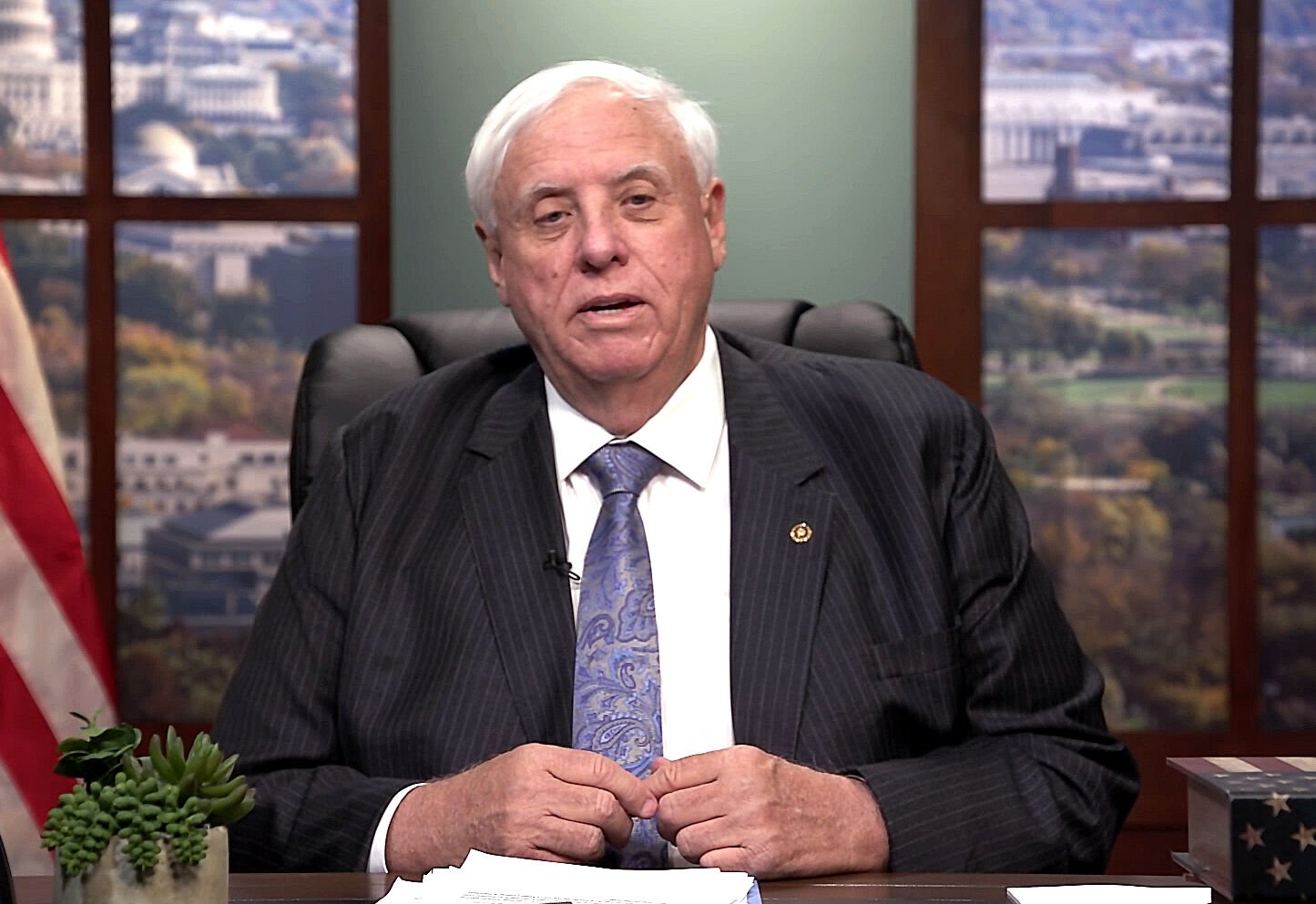
This is a video screenshot of U.S. Sen. Jim Justice during a virtual news conference from Washington on Oct. 23, 2025.
Courtesy photo
From Manhattan to southwest Virginia, Sen. Jim Justice, R-W.Va., and his family coal business empire are falling into deeper trouble.
A New York federal judge on Thursday ruled Justice and four of his family’s companies owe more than $8.2 million in debt after court findings that they violated an indemnity agreement.
In a separate federal court case in Virginia, environmental groups have presented evidence indicating a Justice coal firm that claimed it lacks income or cash to finance operations to fund mine reclamation obligations has assets of more than $9 million and operational revenue of more than triple that amount.
The filings come little more than two months after Justice and his wife Cathy agreed to pay $5.1 million in unpaid federal income tax assessments and a month after a federal court judge ordered eight companies in Justice’s family business portfolio to pay over $1 million to a workers’ insurance provider.
And on Dec. 30, a Louisiana-based bank told a West Virginia federal court a separate key company in Justice’s business empire owed a debt that had ballooned to over $47 million and was growing by more than $20,000 a day.
Ruling tied to multimillion-dollar debt found in other caseÂ
Thursday’s ruling from U.S. District Judge Mary Kay Vyskocil was a roughly $8.29 million judgment against Justice, Bluestone Resources, Inc., Bluestone Energy Sales Corp., Southern Coal Corp. and Beech Creek Coal Corp.
Vyskocil entered the judgment in favor of Indiana-based surety bond provider Federal Insurance Co., which had accused him and the firms of violating an indemnity agreement.
Federal Insurance’s lawsuit, filed in June 2023, is connected to another in which a Pennsylvania coal marketing company said Justice’s business empire failed to abide by a seven-figure court judgment against it.
The coal marketing company, Xcoal Energy & Resources, told another federal court in a filing this year that Justice and two of his family coal companies hadn’t indicated that $1.9 million was forthcoming following a 2021 court finding that a Justice coal company violated a coal supply agreement.
In March 2021, the District Court for the District of Delaware ruled Latrobe, Pennsylvania-based Xcoal was entitled to $6.8 million and later increased that amount to just over $10 million after accounting for interest and attorney’s fees and costs.
Xcoal later collected $8.1 million from a bond issued as Justice and Bluestone Energy Sales and Southern Coal unsuccessfully appealed the judgment.
Federal Insurance has said Justice and his companies are liable for the $8.1 million after Federal named them as principals and Xcoal the obligee in the May 2021 agreement. Federal Insurance that Justice and the coal companies agreed to indemnify Federal against all liability and expenses incurred by Federal due to having issued the bond, citing the indemnity agreement included as a court exhibit.
The agreement lists Bluestone Resources Inc. as an indemnifying party in addition to Bluestone Energy Sales and Southern Coal.
Justice and his coal firms had contested only Federal Insurance’s requested entry of a $170,595 judgment for attorney fees, costs and expenses.
The defendants had insufficiently claimed more backup information was needed to support Federal Insurance’s claim, Vyskocil ruled.
Auditor report: Justice coal firm had 2025 $27M net income
In a separate case, a federal court is probing evidence presented to contend that another Justice coal firm has hid assets in a case in which it has claimed a lack of income or cash to fulfill its mine reclamation obligations.
Environmental groups presented the evidence in a Feb. 11 Virginia federal court filing in their case against the Justice family’s Roanoke, Virginia-based A&G Coal Corp., filed in 2023 that prompted A&G Coal to agree to finish reclaiming three Virginia mine sites the groups said were years behind in complying with past reclamation agreements.
The evidence is an independent auditor’s report from Roanoke-based accounting firm Hamlet CPA Services PLLC finding A&G Coal had a net worth of at least $1 million, a $27.3 million net income for 2025 and, as of Dec. 31, 2025, assets of $61 million and additional paid-in capital of $95.4 million.
Additional paid-in capital is the difference between the nominal value of a stock and the price investors pay for it, reflecting what investors pay for shares above that value.
The auditor’s report is addressed to the shareholders and board of directors of A&G Coal and its subsidiaries.
The environmental groups — Southern Appalachian Mountain Stewards, Appalachian Voices and Sierra Club — said the reported income and asset figures in the statement obtained through a Freedom of Information Act request with the Virginia Department of Energy “flatly contradict� testimony and evidence A&G Coal presented to the court in November 2025.
The groups recalled that in a Nov. 13 evidentiary hearing, A&G executive vice president and general counsel Stephen Ball testified that in 2025, A&G’s net value was roughly negative $41 million and that A&G Coal had no significant assets or operations and no way, other than incurring debt, to generate any further funds or resources to allow the mine reclamation ordered by the court.
The groups said in their Feb. 11 filing that Ball’s testimony was “[i]n stark and apparently irreconcilable contrast� to the January 2026 auditor’s report.
“A&G is trying to have it both ways: telling this Court it is underwater and utterly destitute and therefore entitled to its impossibility defense, but telling Virginia Energy in the next breath that the company has vast resources nearly tenfold what Virginia law requires for self-bonded mining permittees,� the groups said in their filing.
The groups asked the court to conduct a status conference and potentially schedule an evidentiary hearing to give A&G Coal a chance to address the evidence.
At a Feb. 17 motion hearing, U.S. District Judge James Jones admitted the evidence, overruling an A&G Coal objection to doing so. Jones approved the groups’ request to take the deposition of the accountant who helped prepare the audit, and the groups said in a Wednesday court filing they intend to subpoena the accountant, Valerie Hamlet of Hamlet CPA Services.
“The integrity of the judicial process depends on honest testimony,� Matt Hepler, environmental scientist for Appalachian Voices, said in a statement. “When a company presents itself as deeply in debt in court, but submits audited records showing millions in assets to state regulators, the contradiction demands scrutiny.�
A&G Coal’s 2023 federal court reclamation deal set a reclamation schedule that the groups said was neglected for nearly a decade. The groups said A&G Coal regraded less than an acre over nine years ending in March 2022 on one permit and no land over more than a half-dozen years ending in the spring of 2022 on two other permits.
Justice’s Senate office did not respond to requests for comment. Justice legal counsel did not provide requested comment.
Other Justice financial liabilities accumulatingÂ
Justice and his wife in November agreed to pay the federal government what it said was over $5.1 million in unpaid federal income tax assessments.
At the request of the chief counsel of the IRS, the federal government had sued the couple over what it said was an outstanding balance of $5,164,739 in unpaid federal income tax assessments for the 2009 tax year.
That total covered federal income taxes, penalties and interest for the 2009 tax year as of Aug. 4, 2025, the federal government said, prompting the Justices to agree to pay the balance despite the senator previously claiming without evidence that legal proceedings looking to collect reported debts from his business interests were part of a political conspiracy to sabotage his Senate candidacy.
During a rare virtual news conference in October, Justice suggested his Senate candidacy played a role in his businesses not getting what he asserted were owed tax refunds in a dispute dating back to 2009, the year Justice sold Bluestone Coal Corp. to Russian coal producer Mechel for more than $400 million plus millions of shares of Mechel stock. Justice bought back Bluestone in 2015 for $5 million.
In an annual Senate financial disclosure report filed in July, Justice reported liabilities incurred in 2024 ranging from $80 million to $125 million, comprising most of the $85.8 million to $151.7 million in overall liabilities he reported. Members of Congress typically report financial figures in ranges.
Justice’s liabilities incurred in 2024 were reported as consisting of a $50 million-plus judgment owed to Martinsville, Virginia-based Carter Bank, a line of credit ranging from $25 million to $50 million owed to White Sulphur Springs-based Greenbrier Holdings LLC and a judgment of $5 million to $25 million owed to Chicago-headquartered Western Surety Company.
Carter Bankshares Inc., Carter Bank’s holding and parent company, indicated in a U.S. Securities and Exchange Commission filing in November that what had been a Justice-owed $301.9 million debt as of the second quarter of 2023 had been reduced to $228.6 million as of Sept. 30.
On Dec. 30, Louisiana-based First Guaranty Bank told a West Virginia federal court the Justice family’s Greenbrier Hotel Corp. owed over $47 million, a debt the bank said was growing by more than $20,000 per day.
First Guaranty said in the filing the White Sulphur Springs-based company has persisted in not paying what it owes in principal and accrued interest, late charges and other expenses that have accrued from a loan made from the bank to the company under a lending program established through the CARES Act.
The CARES (Coronavirus Aid, Relief, and Economic Security) Act is an economic stimulus law passed by Congress in 2020 to provide direct assistance to families, workers, small businesses and industries amid the pandemic.
The bank said it made a $35 million loan in December 2020 under the Federal Reserve-established Main Street Lending Program to support lending to small and medium-sized businesses and nonprofits through a bank branch in Denham Springs, Louisiana. The loan first became delinquent in December 2023, according to the bank.
First Guaranty sued the bank to open the unresolved case in July 2024. In its Dec. 30 filing, the bank said the Greenbrier Hotel Corp. owed about $35.3 million in principal debt, accrued interest of $12.2 million, attorney fees and costs of $122,507 and accrued late charges of $4,500, with interest accruing on unpaid principal debt at a default rate of 21% per year or $20,626 per day.
Last month, a federal judge ruled that eight Justice family companies owed roughly $1.02 million in unpaid premiums on workers’ compensation and employers’ liability insurance policies issued to Justice family-controlled coal and coke companies.
The Virginia federal court ruling was in favor of Boston-based Liberty Mutual affiliate, LM Insurance Corp.
LM Insurance on Dec. 5 had asked the Virginia federal court to award it that amount in damages following a May 2024 court-approved agreement under which the Justice companies admitted they owed premiums on such policies for two policy periods spanning June 2020 to June 2022.
Mike Tony covers energy and the environment. He can be reached at mtony@hdmediallc.com or 304-348-1236. Follow @Mike__Tony on X.Â