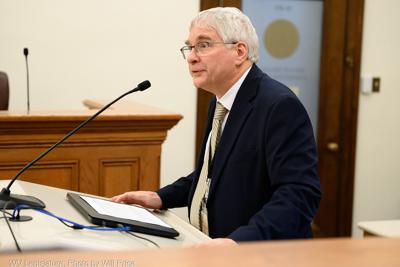
West Virginia Department of Revenue Deputy Secretary Mark Muchow addresses the Legislature's Joint Government and Finance Committee on Sept. 7, 2025, in ÂÒÂ×ÄÚÉä.
West Virginia Department of Revenue Deputy Secretary Mark Muchow addresses the Legislature's Joint Government and Finance Committee on Sept. 7, 2025, in ÂÒÂ×ÄÚÉä.
Two months after Congress passed a sprawling budget reconciliation law that has set up deep cuts to health care and food assistance for thousands of West Virginians, the law came up at a state legislative committee meeting.
At the Joint Government and Finance Committee’s Sept. 7 meeting in ÂÒÂ×ÄÚÉä, House of Delegates Speaker Roger Hanshaw, R-Clay, asked state Department of Revenue Deputy Secretary Mark Muchow whether his team had completed an analysis of anticipated implications for West Virginia from the law, the One Big Beautiful Bill Act.
Muchow answered in the affirmative.
“If that’s an analysis you’d be willing to share, we’d benefit from that,� Hanshaw told Muchow.
The next day, the Gazette-Mail filed a request with Gov. Patrick Morrisey’s office under the West Virginia Freedom of Information Act for that analysis of the West Virginia impacts of the law, which has been projected to increase power bills and add trillions to the national debt in addition to leading to health care and food assistance cuts.
After requesting an extension of time beyond the five-business-day window the law gives government agencies to respond to the request, Morrisey’s office on Dec. 19 denied the request. Governor’s Office Deputy General Counsel Katie Franklin argued in a letter the analysis falls under a state exemption for internal correspondence.
Morrisey has been a vocal supporter of the One Big Beautiful Bill Act, and the fellow Republican who signed it into law, President Donald Trump.
Franklin’s explanation doesn’t pass muster with Patrick McGinley, a government ethics expert and law professor emeritus at the West Virginia University College of Law.
“[The response] doesn’t explain why they have chosen to conceal this particular document that they say they may use, that the governor’s going to use in coming up with legislative strategy,� McGinley said in a phone interview. “What’s the explanation for that? Because they don’t have to [deny the request].�
Franklin said in the denial letter the analysis acknowledged by Muchow at the committee meeting was “prepared to aid the Governor in making upcoming decisions on state expenditures, the budget, and potential legislation.� Disclosure of the analysis, Franklin claimed, would discourage the kind of candid discussion a state exemption for “deliberative process� is meant to protect.
The stakes are high for that analysis going into the 2026 regular legislative session, which begins on Jan. 14. The Legislature will set the state’s budget for the coming year and is likely to consider effects from the One Big Beautiful Bill Act.
Supported by all four members of West Virginia's congressional delegation, the law was designed to extend tax cuts first created under Trump in 2017 that benefit the wealthy, aided by savings expected from proposals poised to sever access to Medicaid and the Supplemental Nutrition Assistance Program for millions of Americans.
Morrisey asserted in a news conference last month the results of the report would emerge when he submits his proposed state budget on Jan. 14 for the start of the legislative session.
“[T]he importance of it, considering the core concerns about the Big Beautiful Bill [and] really serious questions about where West Virginia is going and how this bill is going to affect people across West Virginia, the West Virginia government and so forth, it would seem that the analysis of this government body is well-positioned to inform not only the governor and the Legislature, but the people of West Virginia,� McGinley said.
Ann Ali, deputy chief of staff and communications director for the House of Delegates, told the Gazette-Mail Wednesday that Hanshaw did receive and view the report.
Ali, speaking for Hanshaw, said in an email she was “not sure who exactly from the executive branch shared it directly� and didn’t know if it came from Morrisey’s office.
Ali, Senate President Randy Smith, R-Preston, and two Senate communications staffers did not provide a copy of the report acknowledged by Muchow upon request.
Hanshaw couldn’t remember if he was emailed or delivered a paper copy of the report, so he didn’t know if he still had access to it, said Ali, who added she didn’t have a copy of the report and had not seen it.
Hanshaw’s “main takeaway was that [the report] was useful information – ‘good to know,’ but nothing critical or indispensable for his immediate purposes or from his perspective,� Ali said.
Drew Galang, Morrisey’s press secretary, did not respond to questions as to why the Governor’s Office wouldn’t release the report or with whom inside or outside West Virginia government the Governor’s Office has shared the report.
Galang contended in an email “[i]t is impossible to provide an accurate analysis of the impact of the One Big Beautiful Bill until the [state] budget is in its final form and the state determines how it will address potential implications from that law.�
Senate Minority Leader Mike Woelfel, D-Cabell, one of two Democratic members of the Senate and a member of the Joint Government and Finance Committee, told the Gazette-Mail Tuesday he hadn’t seen the report but had reached out to Smith to discuss it.
“I’d like to see it, but I do have some opinions on how that bill will affect our state, and my opinions aren’t positive in any way,� Woelfel said in a phone interview.
'Biggest roll back of health insurance ever'Â
The legislation is expected to impose requirements that result in cuts to Medicaid and SNAP that risk hospital and nursing home closures while dramatically reducing federal health care spending in rural areas.
The bill will result in about 17 million more people without health insurance, KFF, the nonpartisan health policy research group formerly called the Kaiser Family Foundation, projected last year.Ìý
“If all of this comes to pass, it would represent the biggest roll back of health insurance coverage ever due to federal policy changes,� the KFF said prior to the July 4 passage of the law, citing the legislation as well as the looming expiration of enhanced premium tax credits and the Trump administration recently finalizing a rule that would result in more people becoming uninsured.
Similar versions of the legislation would cut off coverage for at least 69,000 West Virginians and increase the state’s uninsured rate by 70%, according to an analysis released in June by Families USA, a nonpartisan health care consumer advocacy group.
The law sets up a new cost-sharing formula tied to payment error rates that would shift many SNAP costs to states while narrowing exceptions for work requirements for able-bodied adults.
There were more than 273,000 recipients of SNAP benefits in West Virginia in February — more than 15% of the state’s population.
Under a portion of bill text released in June, West Virginia could face a cost shift of up to $84 million in fiscal year 2028 if it has a SNAP payment error rate of 10% or higher — as it did in fiscal year 2023 — according to an analysis by the Center on Budget and Policy Priorities, a progressive think tank.
Cynthia Beane, commissioner of the West Virginia Bureau for Medical Services, previewed a path toward lower Medicaid enrollment and higher state administrative costs before the Joint Standing Finance Committee during the Legislature’s latest interim legislative session meeting on Oct. 6.
The One Big Beautiful Bill Act requires states to condition Medicaid eligibility for individuals ages 19-64 applying for coverage — or enrolled through expanded Affordable Care Act coverage — on working or participating in qualifying activities for at least 80 hours per month.
The law requires states to conduct eligibility redeterminations at least every six months for Medicaid expansion adults for renewals scheduled starting Dec. 31, 2026.
Beane indicated there are roughly 504,000 people in West Virginia’s Medicaid program — approximately 28% of the state’s population — including 160,000 participants covered by Medicaid expansion.
Beane predicted the law’s “community engagement� work-oriented requirements would decrease West Virginia Medicaid enrollment.
Roughly 60% of that group already draws earned income, Beane said before cautioning that her office doesn’t know if they’re meeting the new 80-hour requirement.
The new law restricts states from setting new health care-related taxes known as provider taxes or from increasing rates of existing taxes.
Beginning in 2028, revenue reductions will start at $35.6 million and grow to $71 million in 2029, $107 million in 2030, $142 million in 2031 and $178 million in 2032 — a combined loss of $533.6 million.
Beane noted the decreases apply to funds that are federally matched and directed to West Virginia hospitals.
“That’s money no longer going to West Virginia hospitals,� Beane told the Joint Standing Finance Committee, adding that “some of the rural hospitals that are on the margins are concerned.�
The West Virginia Hospital Association, which consists of 72 member hospitals, has sounded the alarm about the law, saying that larger, acute care hospitals like ÂÒÂ×ÄÚÉä Area Medical Center’s complex of hospitals and WVU Medicine’s J.W. Ruby Memorial Hospital and critical access hospitals often located in rural areas will be impacted the most.
Critical access hospitals are federally designated as such if they are located either more than 35 miles from the nearest hospital or more than 15 miles in areas with mountainous terrain or only secondary roads.
West Virginia Hospital Association president and CEO Jim Kaufman predicted in July more than $1 billion will be stripped from West Virginia hospitals by the One Big Beautiful Bill Act.
That cost would far exceed the $199 million for fiscal year 2026 that West Virginia was awarded through a federal rural health funding program established by the law, the Rural Health Transformation program. That $199 million award for the first year of a five-year award period, announced by the federal Centers for Medicare & Medicaid Services on Dec. 29, was 28th-highest among the 50 states.
Morrisey’s office has pledged that the funding will be used to support recruitment and retention of the health care workforce and expand telehealth services.
“[W]hat we’re going to see [is] no preventative care to people that don’t have health care. They’re just going to skip it,� Woelfel predicted. “We’re just going to really suffer long-term, I think, as a result of a lack of preventative care for folks that are not insured.�
'It just reeks'
Franklin’s letter denying the Gazette-Mail FOIA request for the One Big Beautiful Bill Act analysis report cited a 1996 West Virginia Supreme Court of Appeals decision, The Daily Gazette Company, Inc. v. The West Virginia Development Office, holding that government agencies have an “executive ‘deliberative process’ privilege.�
But the decision also holds that the disclosure provision of the West Virginia Freedom of Information Act is to be “liberally construed� and the exemptions to the act “are to be strictly construed.�
The Supreme Court also held in the decision that since it’s “generally accepted that the deliberative process privilege does not extend to materials which are factual in nature, even if such material may have been used by government decision makers in their deliberations,� factual data that can be extracted from government documents should be disclosed even if it may have been used by government decision-makers in their deliberations.
“Their response could be, these facts are so intertwined with advice and opinions that we can’t disclose them, they’re part of the deliberative process. But I’m not so sure of that,� McGinley said. “That’s kind of hard to believe, that there aren’t facts there that the public has a right to know.�
McGinley anticipates that the analysis cites congressional and administration reports that are facts — not deliberative and therefore not subject to exemption from public view.
“It just reeks of, there’s something wrong here,� McGinley said. “It’s something the public should be entitled to understand, the decisions that are being made based on this document.�
In the absence of the analysis cited by Muchow, shadows cast by projections of the One Big Beautiful Bill Act’s impacts in West Virginia linger.
“I don’t see anything really beautiful about it,� Woelfel said.
Mike Tony covers energy and the environment. He can be reached at mtony@hdmediallc.com or 304-348-1236. Follow @Mike__Tony on X.Ìý