
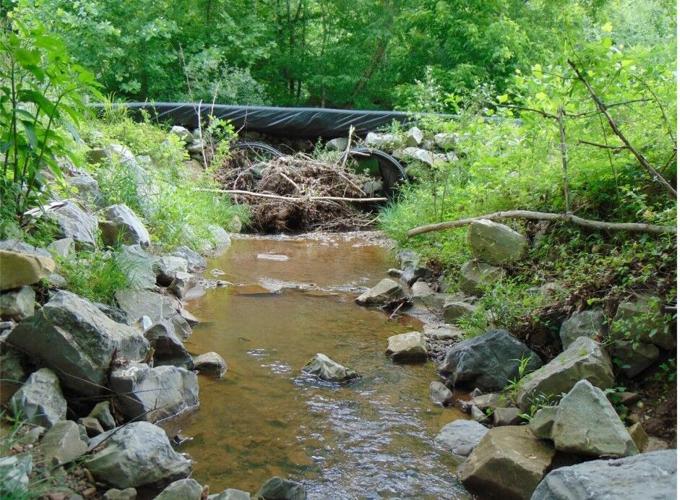
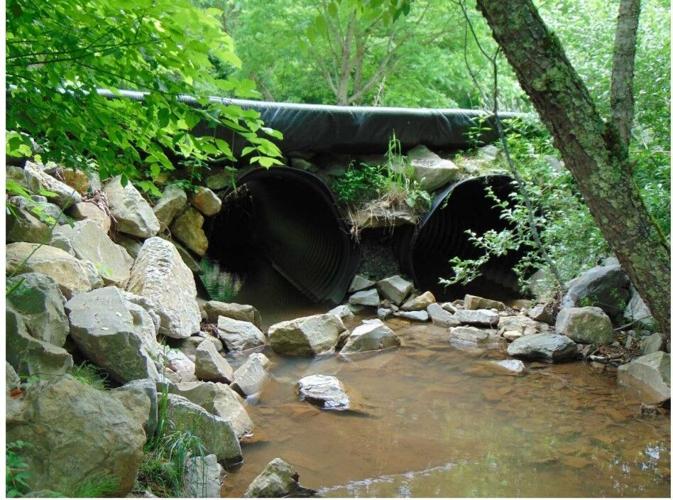

It was a peaceful, secluded place. Water tumbled over rocks. Fish could flourish.
But now Second Big Run is a sediment trap offering less chance for survival to the few minnows that remain with each new washout.
That’s the change in scenery that Lewis County farm owner Suzanne Vance underscored in comments filed with federal regulators urging them to reject Mountain Valley Pipeline developers’ request for more time to finish the project.
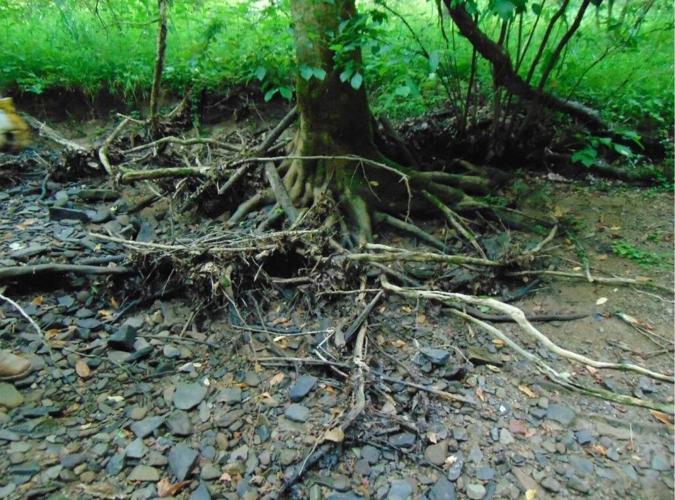
Vance documented for regulators what she said has been severe embankment erosion caused by a Mountain Valley Pipeline right-of-way increasing the amount and velocity of water rushing through the Little Kanawha River basin.
“This is what destruction of a mountain headwater creek looks like,� Vance wrote above one of many photos across some 100 pages she submitted to the Federal Energy Regulatory Commission.
Vance contends that deforestation and mountain removal along the right-of-way have condemned the basin to a future of ever-increasing creek and road washouts along the pipeline. She recounted three major floods in the past 14 months and cited a projection from the nonprofit First Street Foundation that precipitation will rise 5% to 10% in most of West Virginia in the next 15 years.
Throughout Vance’s FERC filings are photos showing flood-strewn debris and rocks washed into dried up creek crossings.
“[A]fter having them on our property almost 5 years, they don’t have a grip on the erosion and sedimentation issues,� Vance wrote. “From what I can see, the problem has become chronic and is quickly degrading to a worse situation. The only solution would be to get [Mountain Valley developers] out of the valley, reclaim the mountains with trees and pray it doesn’t wash out.�
Vance’s filings are among roughly 400 comments submitted separately to the FERC in a 30-day comment period ending July 29 to weigh in on Mountain Valley Pipeline developers’ request for another four years to finish the project long delayed by legal and regulatory roadblocks.
The Gazette-Mail reviewed all the comments and found an overwhelming majority asking the commission to deny the request for the 303-mile pipeline slated to carry natural gas across 11 counties in West Virginia before crossing into Virginia.
A 2-1 ratio of West Virginia commenters and a 4-1 ratio of Virginia commenters weighing in urged the agency to reject the request by Mountain Valley Pipeline LLC, the joint venture behind the project. Twice as many commenters from North Carolina, where an extension project is planned for the pipeline, weighed in against the request compared to those supporting it.
Those comments don’t include petitions against the requested extension from environmental groups such as Appalachian Voices, the Chesapeake Climate Action Network and Food & Water Watch that totaled thousands of signatures. Comments from outside West Virginia and Virginia against Mountain Valley’s request dwarfed supporting it.
“If this project had been economically and ecologically sound, it would have already been completed,� wrote Aileen Curfman of Jefferson County.
Commenters against extending the project argued it would result in continued water quality degradation, risk pipeline explosions and allow an unacceptable level of greenhouse gas emissions.
Equitrans Midstream Corp., the project’s Canonsburg, Pennsylvania-based lead developer, has estimated greenhouse gas emissions would total 48 million to 57 million metric tons per year, the equivalent of roughly 13 coal plants and 11 million passenger cars.
Other commenters urged the FERC to let Mountain Valley finish to boost property tax bases in financially challenged West Virginia counties on the pipeline route, increase domestic gas supply amid national energy security concerns and halt disturbances caused by project work.
Doddridge County farmer Earl Richards indicated that work on the 42-inch-diameter pipeline crossing his property has interrupted his cattle-raising.
“I am for progress. Progress is getting this pipeline finally completed,� Richards wrote. “I just want to get back to farming my land. Please let MVP build this pipeline and quit stalling.�
The pipeline’s future quickly has become a topic of national scrutiny now that the most prominent voice in the debate over the pipeline’s future has had his say.
U.S. Sen. Joe Manchin, D-W.Va., announced Monday that Democratic leaders had committed to unreleased legislation that would ensure completion of the pipeline as part of a deal to secure a long-sought clean energy spending package that backers say would be transformative in the fight against climate change.
“It’s going to be able to help energize the whole economy,� Manchin said Thursday in a press conference.
A White House spokesperson did not respond to a request for comment.
Mountain Valley has asked the FERC to rule on its request for more time by Monday, but there is no statutory deadline by which the agency must respond.
FERC spokeswoman Tamara Young-Allen said the agency considers all issues raised in comments in its decision-making.
The commission granted the project a two-year extension in October 2020, when the commission’s original 2017 order requiring the pipeline to be built and in service was set to expire. The two-year extension runs out Oct. 13.
A federal appeals judge asked a FERC attorney earlier this year why the agency didn’t more closely review the pipeline’s environmental effects following sedimentation issues that prompted fines from West Virginia and Virginia environmental regulators before granting the extension. The attorney cited a decline in state violations since 2020.
The judges haven’t yet issued a final ruling on the request by environmental groups to temporarily stop that extension order.
Announced in 2014, the pipeline originally was scheduled for completion by the end of 2018 at a cost of $3.5 billion.
Equitrans announced in May the estimated project cost had risen to $6.6 billion. The company pushed back the targeted in-service date to the second half of 2023.
“The longer you continue to delay this project, the more damage you are doing to the environment and to the land owner,� Harrison County landowner Mike Ford wrote in a comment to the FERC filed last month, lamenting that seven to 10 acres of pasture he agreed to let pipeline developers work on in 2015 are still unavailable to him.
What’s holding up the project now are federal court findings of endangered species threats and sedimentation impacts – concerns commonly cited in comments urging the FERC to let time run out on a pipeline that has become a national political lightning rod.
“There isn’t any ‘dry season’ in WV anymore,� Vance wrote. “Any projects started will end in washouts and more destruction.�
West Virginia feedbackA majority of the roughly three dozen comments separately submitted by West Virginia commenters opposing extending time for the project came from Monroe County, the last in the state on the pipeline route before it crosses into Virginia. The pipeline also crosses through Wetzel, Harrison, Doddridge, Lewis, Braxton, Webster, Nicholas, Greenbrier, Fayette and Summers counties.
Stories you might like
- WV frustration mounts amid evidence state is lagging in data center protection
- EPA plans to ax public participation mandate for data center, other industry permits
- Union Carbide, Covestro target testimony alleging raised South ÂÒÂ×ÄÚÉä cancer risk
- DEP questions Fundamental Data site control for Tucker Co. data center-linked project
Preserve Monroe, a coalition of county landowners and businesses, called the project “unneeded and dangerous� and accused Mountain Valley of downplaying impacts to landowners.
“The project has already caused harm — not only to stream water quality, but also small farmers and other landholders,� wrote Carey Jo Grace of Upshur County. “It benefits few, certainly not West Virginians.�
The state Department of Environmental Protection fined Mountain Valley $569,000 in 2019 and 2021 for erosion and sedimentation issues. The Virginia Department of Environmental Quality fined Mountain Valley $2.15 million in 2019, resolving a lawsuit the agency and former Virginia Attorney General Mark Herring filed alleging the company violated a previously issued water quality certification by not controlling sediment and stormwater runoff.
West Virginia proponents of the project submitting comments backing Mountain Valley’s extension request included the state Public Service Commission and Webster County Commission and Summersville Mayor Robert Shafer. Industry supporters such as the Gas and Oil Association of West Virginia and Kyle Mork, president and CEO of ÂÒÂ×ÄÚÉä-based natural gas driller and producer Greylock Energy, also filed comments supporting the pipeline.
West Virginia Gov. Jim Justice and Virginia Gov. Glenn Youngkin both submitted comments supporting Mountain Valley’s extension request. But Justice’s comment was filed five days after the comment period ended.
Justice alluded to a Mountain Valley estimate that the pipeline would generate $35 million annually in ad valorem taxes in West Virginia.
“The potential benefits to the customers, producers, and economies in West Virginia, and other states that will have access to the pipeline, as well as the economic benefits to the United States, are too great to simply stop this massive pipeline project which is so near to completion,� the state Public Service Commission commented.
Just how near the pipeline is to completion emerged as a point of contention in comments filed with the FERC.
Supporters cited Mountain Valley’s estimate that the project is 94% complete. Mountain Valley’s latest construction status report, filed July 27 with the commission, states final restoration is 55.8% complete, a fact opponents cited.
“If MVP needs four years to get only that far, it’s no wonder their application must be for ANOTHER four years,� Joshua Vana of Charlottesville, Virginia, wrote.
Equitrans spokewoman Natalie Cox defined final restoration as installation of permanent erosion control devices, return of topsoil and seeding and mulching along the pipeline right-of-way. Cox noted that portions of the right-of-way might have a fully installed pipeline without being fully restored.
Pipeline fears and hopesOpponents said they fear the pipeline’s route through steep mountains could result in ruptures and explosions. Vana recalled two Appalachian pipelines that exploded in 2018.
Columbia Gas Transmission said a landslide was the apparent cause of an explosion of its Leach Xpress Pipeline near Moundsville in June 2018.
A landslide led to a September 2018 explosion of ETC Northeast Pipeline LLC’s Revolution Pipeline in Beaver County, Pennsylvania, that the state Attorney General’s Office said forced residents to evacuate their homes as their barns, vehicles and homes burned. The office charged ETC Northeast Pipeline in February with nine environmental crimes for allegedly ignoring environmental protocols that contributed to the explosion.
“Since this is an extensive area of unstable sink holes, a pipeline leak or explosion can affect my well-water supply or destroy my home from forest fire,� Judith Bevans of Blacksburg, Virginia, wrote.
The agency received more than four times as many individually submitted comments from Virginia as it did from West Virginia.
The Mountain Valley Pipeline is slated to provide up to 2 billion cubic feet per day of natural gas from the Marcellus and Utica shale formations to markets in the Mid-Atlantic and Southeastern regions of the country.
The mayors of four North Carolina towns signed a joint letter asking the FERC to approve Mountain Valley’s request, saying their towns — Black Creek, Lucama, Sharpsburg and Stantonsburg — need economically priced natural gas that the pipeline could provide.
Dominion Energy North Carolina, Dominion Energy South Carolina, Washington-based utility WGL Holdings and Pittsburgh-based natural gas marketer EQT Corp. noted they had entered into agreements with Mountain Valley to obtain a combined 1.7 million dekatherms per day of the project’s capacity. WGL Holdings’ subsidiary WGL Midstream acquired a 7% ownership interest in Mountain Valley in 2015.
“Mountain Valley is critical infrastructure that will provide access from Appalachia to critical markets,� Patrick K. Craine, chief legal and administrative officer at Oklahoma City-based natural gas producer Gulfport Energy Company, said in a comment to the FERC.
Manchin’s office said in a document it released Monday that the pipeline would lower energy prices at home and “backfill our allies around the world currently relying on Vladimir Putin and other dictators.�
From pipe dream to nightmareThe last environmental impact statement for the project issued by FERC staff came in June 2017 – before Marjorie Lewter of Giles County, Virginia, told the agency she began observing muddy waters pouring from the pipeline right-of-way near her home with every rain.
“They have tried and failed to deliver on their pipe dream,� Lewter wrote. “It won’t work here.�
More than 200 miles away in Lewis County, Vance concluded it’s not working in her neck of the woods either.
When Vance takes stock of her farm property, she sees what she calls a wasteland of Jersey barriers and orange fencing.
Vance no longer trusts Mountain Valley to collect piles of stones and rotten flood debris from the creek or fields unless she’s around.
Mountain Valley aims for the pipeline to be in service in the second half of 2023 — nearly a decade after it was first announced. Equitrans said earlier this year it took a $1.9 billion impairment charge in the fourth quarter of fiscal year 2021 because of its investment in the project.
RGC Resources Inc., the parent company of Roanoke Gas Company, reported a $29.6 million impairment charge for one of its subsidiaries, RGC Midstream, related to its investment in the project earlier this year.
An impairment charge describes a significant loss in the value of an asset that can be recovered.
Vance sees losses that can’t be replaced when she eyes the damaged creek embankments at Second Big Run. One is so washed out that the hillside above will collapse, Vance predicted to the FERC.
She says the valley didn’t have that problem before Mountain Valley arrived.
The pipeline is at a crossroads. But Vance is one of many landowners along its route who want federal regulators to know they see no path forward.
“[Mountain Valley’s] corporate backers should just admit that this pipeline is a bad idea for the steep mountains of West Virginia and Virginia,� Vance wrote. “No matter how rich these corporations are, they can’t run from the problems that they are creating for everyone.�
CLICK HERE to follow the ÂÒÂ×ÄÚÉä Gazette-Mail and receive


