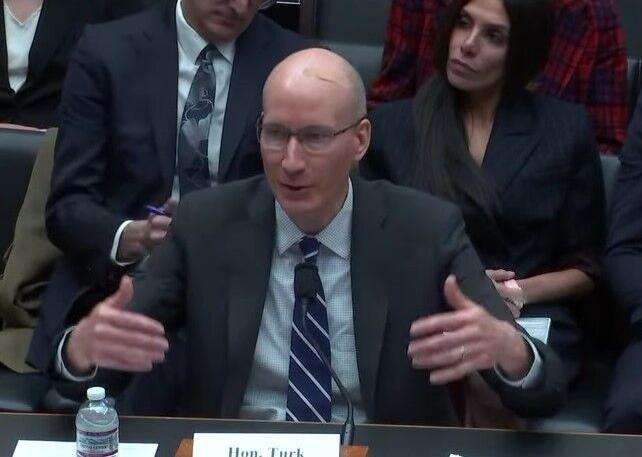
David Turk, distinguished visiting fellow at Columbia University’s Center on Global Energy Policy and former U.S. Department of Energy deputy secretary, testifies at an April 9, 2025 U.S. House of Representatives Energy and Commerce Committee hearing on the future of artificial intelligence technology.
“We still have a lot of coal left in the ground.�
Gov. Patrick Morrisey speaks to reporters on April 23, 2025, at West Virginia Independence Hall, in Wheeling.
Courtesy photo
That’s how Gov. Patrick Morrisey, speaking at a news conference in Wheeling on Wednesday, set up his endorsement of a bill he indicated he would sign designed to usher a wave of data centers into West Virginia and favoring coal- and gas-fired electric generation.
House Bill 2014 would prohibit local jurisdiction over state-certified “high-impact� data centers and divert most of the property tax revenue they generate away from local taxing bodies, a move estimated to cost counties and school districts millions that has drawn the ire of local government leaders.
HB 2014 is also designed to empower the fossil fuel industry, requiring public electric utilities to keep a minimum 30-day coal supply at each coal-fired power plant and run their generating units to achieve at least a 69% capacity factor — a measure of how often a plant runs at full capacity and a measure geared toward getting utilities’ plants to double down on self-generated, coal-fired power.
HB 2014 also would divert 5% of all property tax revenue collected from data centers to a fund the legislation would create to help maintain utility-owned coal and gas electric generation.
The legislation, Morrisey said Wednesday, would “take advantage of the God-given resources that are in the ground.�
“We have a lot of opportunities with respect to natural gas and coal,� Morrisey said.
But renewable energy is the fastest-growing source of electricity for data centers, according to an International Energy Agency analysis released this month.
The IEA, an intergovernmental organization that provides data on the global energy sector, projected that growth is mainly driven by rising deployment of wind and solar in power systems throughout the world.
Renewables — primarily wind, solar and hydro — already supply roughly 27% of electricity consumed by data centers globally, per the IEA, outpacing gas’ 26% share and just behind coal’s 30%.
David Turk, distinguished visiting fellow at Columbia University’s Center on Global Energy Policy and former U.S. Department of Energy deputy secretary, testifies at an April 9, 2025 U.S. House of Representatives Energy and Commerce Committee hearing on the future of artificial intelligence technology.
“For a variety of market dynamics, the quickest way to power new AI data centers over the near term will be by using solar, wind and storage,� David Turk, distinguished visiting fellow at Columbia University’s Center on Global Energy Policy and former U.S. Department of Energy deputy secretary, testified at an April 9 House of Representatives Energy and Commerce Committee hearing on the future of artificial intelligence technology.
Turk testified that “there are real and immediate constraints� on abundant U.S. gas resources, with the supply chain for gas turbines chief among them.
But amid a global trend toward renewables-powered data centers, data center development in West Virginia is trending the other way with HB 2014 poised to become law.
Gas-driven data center for Mingo County
The West Virginia Department of Environmental Protection’s Division of Air Quality has three pending applications from entities proposing to construct or operate data centers in West Virginia.
Data storage servers fill a room at an Alpha Technologies data center in the West Virginia Regional Technology Park in South ÂÒÂ×ÄÚÉä.
ALPHA TECHNOLOGIES | Courtesy file photo
Two are for neighboring gas-powered facilities for data center campus operations proposed for rural Mingo County by New York City-based TransGas Development Systems LLC. The other is for a planned project in Tucker County by Purcellville, Virginia-based Fundamental Data LLC. This project has drawn heavy opposition from local residents and leaders fearing its environmental impacts and lamenting missing out on potential property tax revenue under HB 2014.
The DEP identified the facilities in response to a Gazette-Mail request under the Freedom of Information Act for all permit applications the DEP received since the start of last year from entities proposing to construct or operate data centers in West Virginia.
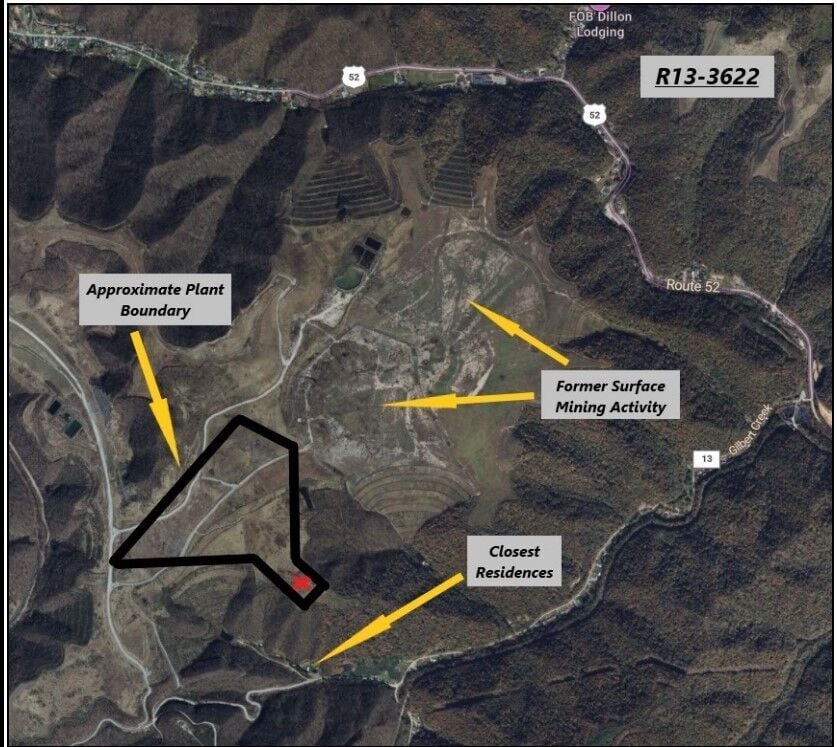
The TransGas facilities are off-grid power-generating facilities that DEP spokesman Terry Fletcher said were more than 14 miles apart.
The construction permits would be for data center energy campus operations in Mingo County on 22 Mine Road near Holden and on Twisted Gun Road near Wharncliffe, respectively, according to the applications received by the Division of Air Quality on March 26.
Construction is planned to begin after receipt of the Division of Air Quality permit and other regulatory approvals around Jan. 1, 2026, with operations to start roughly 12 months after construction begins, per the permit applications.
Ultra-low-sulfur diesel would be stored in 40 tanks on the property near the facilities, per the applications. Powerhouses would have one set of emission control fluid tanks for hydrous ammonia, caustic soda, sulfuric acid, sodium chlorite and sodium hydrosulfide. A natural gas pipeline would feed facility engines.
Those substances carry significant safety and health risks, according to data sheets included in the applications.
Sodium hydrosulfide contains hydrogen sulfide, a highly toxic gas with a rotten egg odor. Sodium chlorite is very toxic to aquatic life with long-lasting effects. Sulfuric acid is carcinogenic to humans.
The facilities would have haul road activities and equipment leaks, according to the applications.
Facilities could emit hundreds of tons of air toxics
Each facility would have the potential to emit:
206 tons per year of carbon monoxide, which can cause nausea, fatigue and other flu-like symptoms at very low levels
194 tons per year of nitrogen oxides, which can harm the human respiratory system and contribute to acid rain
118 tons per year of volatile organic compounds, which can contribute to ozone and may cause cancer
The facilities would have the potential to emit 187 and 188 tons per year, respectively, of fine particulate matter, or soot, which can pierce the lungs and lead to asthma attacks, heart attacks and premature death.
TransGas’ applications follow the DEP Division of Air Quality’s March 2024 approval of an air quality permit for an ammonia production site near Wharncliffe planned by the company, which applied for approval to build up to six 6,000-metric ton-per day ammonia plants on a reclaimed surface mine land.
The process, according to DEP records, would be to “crack� natural gas into hydrogen and carbon components using proprietary autothermal reforming technology and to chill ammonia vapor to make liquid ammonia for storage and transport.
TransGas has announced plans to capture and store carbon dioxide underground as part of the production process in what it has called its “Adams Fork� project — a label also used for its proposed data center operations.
The DEP has said that because the proposed facility is defined as a “minor source� under state legislative rule and greenhouse gases like carbon dioxide aren’t regulated pollutants under the rule, no review of TransGas’ carbon capture and sequestration “claim� was conducted.
TransGas officials did not respond to a request for comment.
‘There’s going to be a blitz’
Fundamental Data’s planned Tucker County facility would be powered by gas-fueled turbines equipped with heat recovery steam generators, but the turbines may need to use diesel as a backup fuel source during gas pipeline failures.
The facility, planned for location off U.S. 48 near the city of Thomas, would have three diesel storage tanks holding 10 million gallons each. The application indicates there would be haul road activities and equipment leaks.
Operation startup is planned for 2027 or 2028 but subject to change depending on availability of equipment from manufacturers, according to the application filed last month.
The facility would have the potential to annually emit:
99 tons of nitrogen oxides, gases which contribute to smog
56 tons of carbon monoxide
44 tons of volatile organic compounds
A meeting hosted by Davis Mayor Al Tomson at the Davis Volunteer Fire Hall in Tucker County on April 13 to discuss the Fundamental Data application drew more than 200 people in person and another 100 virtually. Attendees voiced concerns about the proposed development having adverse environmental impacts while getting reduced property tax revenue benefits due to HB 2014.
Neither Fundamental Data nor a company representative listed on the air quality application responded to requests for comment.
“Now that we have this bill passed, it’s clear that there’s going to be a blitz,� West Virginia Highlands Conservancy board member Tyler Cannon said at the meeting. “There’s going to be a rapid pursuit of this sort of development here, anywhere that’s willing to take it, anywhere that’s willing to sell out the longevity of their communities for the sake of short-term gain and menial job prospects.�
Data center energy trend toward renewables for U.S., China
The IEA’s data center energy supply analysis noted that new demand from data centers is a significant near-term driver of growth for gas-fired and coal-fired generation and that gas and coal together are expected to meet over 40% of additional electricity demand from data centers until 2030.
But coupled with growth of renewable electricity generation, an increase in nuclear electricity generation will lead to a decline in coal-fired generation for data center operations by 2035, the IEA projects.
Most of the electricity consumed by data centers in the U.S. and China — by far the largest data center markets — is produced from fossil fuels, the IEA noted. But rising deployment of renewables and, later, nuclear is expected to slow fossil fuel power generation growth after 2030.
The IEA predicts that an increase in U.S. renewable electricity generation and expansion of small modular nuclear reactors will reduce need for additional gas-fired power so that, by 2035, low-emissions sources will account for over half of U.S. data center electricity supply.
In Wheeling Wednesday, Morrisey pointed to China’s continued embrace of coal-fired power.
“West Virginia can provide the energy resources that America needs to be strategically out in front of our greatest geopolitical rival,� Morrisey said.
But renewables are expected to grow substantially in China’s data center energy mix in coming years. By 2035, renewables and nuclear will comprise nearly 60% of China’s data center energy supply, according to the IEA.
China has been leading the world in buildout of renewable energy, commissioning as much solar energy in 2023 as the entire world did in 2022, per the IEA.
The IEA noted upon publishing a global renewables analysis last year that while increases in renewable capacity in the U.S., Europe and Brazil hit all-time highs in 2023, “China’s acceleration was extraordinary.�
Renewable energy’s technology has proven simpler, cheaper and easier to install, cutting costs that utilities and other providers pass to consumers.
A different view of competing with China
But the potential for the Trump administration hostile to renewable energy and a Republican-controlled Congress to repeal technology-neutral tax credits for producing clean electricity threatens to halt the rise of renewables-driven data center growth in the U.S. relative to the rest of the globe.
The 45Y and 48E tax credits enacted by the Inflation Reduction Act — signed into law in 2022 by then-President Joe Biden — named after sections of tax code, allow direct payments from the IRS for the value of the tax credits for political subdivisions, states and tax-exempt organizations — with a bonus of up to 10% for use in energy communities like those throughout West Virginia.
Turk, who served as Energy department deputy secretary under Biden, predicted rolling back tax credits like 45Y and 48E would delay AI development and raise consumer costs — and that Trump administration tariffs were standing in the way of U.S. data center development.
“I can’t think, honestly, of a worse policy right now if you want to bring on AI power quickly in our country,� Turk told House lawmakers.
In formal comments last month to the U.S. Office of Science and Technology Policy as it considers an AI action plan, OpenAI, a San Francisco-based AI research and deployment group that has considered West Virginia as a potential site for its $500 billion Stargate infrastructure project, touted the importance of federal tax credits and loans in encouraging sufficient capital flow to build AI infrastructure.
Trump’s subsequent exemption of computers and semiconductors from his tariffs didn’t extend to key data center components like building materials and cooling equipment.
Eric Schmidt, chair of the Special Competitive Studies Project, an initiative making recommendations to strengthen America’s long-term AI competitiveness, testified that “baseload� power production could be achieved by combining renewable energy and batteries.
Like Morrisey, Schmidt urged guarding against falling behind in a “strategic competition� with China in harnessing the power of AI and energy — but not with a focus on coal.
“They are pouring resources into AI [research and development],� Schmidt said of China, “while simultaneously building the world’s leading renewable energy capacity and modern grid infrastructure. Our response must be equally ambitious, coordinated and decisive. We are in a race, and we must win.�
CLICK HERE to follow the ÂÒÂ×ÄÚÉä Gazette-Mail and receive