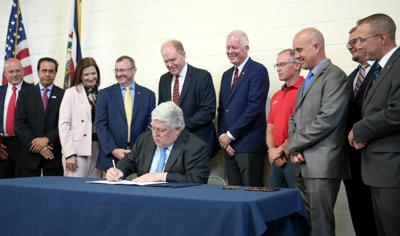
Gov. Patrick Morrisey (seated) signs House Bills 2014 and 2002 at a bill-signing ceremony near the planned site of a 2,000-plus-acre data center campus in Mason County on Wednesday, April 30, 2025.
Gov. Patrick Morrisey (seated) signs House Bills 2014 and 2002 at a bill-signing ceremony near the planned site of a 2,000-plus-acre data center campus in Mason County on Wednesday, April 30, 2025.
Courtesy photo
They’re power-hungry water guzzlers that have drawn heavy opposition in other states for their impacts on the environment and energy bills.
They’re also the focal point of Gov. Patrick Morrisey’s vision of West Virginia’s economic future.
Morrisey made that clear Wednesday at a bill-signing ceremony held near what’s planned to be the future site of a 2,000-plus-acre data center campus in Mason County.
Morrisey signed into law House Bill 2014, controversially far-reaching legislation aimed at attracting data center development in West Virginia, joined by state lawmakers and an executive at the Houston-based company planning the data center campus in the Point Pleasant area.
“This is how we rise,� Morrisey said, reporting data center development interest in West Virginia among unnamed “big companies� with many investors. “This is how we fuel our comeback story.�
HB 2014, which takes effect 90 days from passage on July 11, wipes away local jurisdiction to fast-track data center buildouts and is expected to keep millions in property tax revenue from counties through a distribution formula that will divert 60% of that revenue to state-controlled funds.
In addition to those provisions upsetting local government leaders, HB 2014 also has fossil fuel-favoring provisions that renewable energy and consumer advocates say will swell power bills while deepening the state’s anachronistic dependence on coal for its electricity.
“I hope that someday our elected state leaders will act to help address utility cost and reliability,� Emmett Pepper, policy director of Energy Efficient West Virginia and critic of HB 2014, told the Gazette-Mail Thursday.
But Morrisey and other backers of HB 2014 say it will drive job creation and be a tax revenue coup while extending the state’s status as one of America’s most prolific fossil fuel energy producers.
“We want to make sure those industries are taken care of,� Senate Economic Development Committee Chair Glenn Jeffries, R-Putnam, said of coal and gas at Wednesday’s ceremony, “because that’s been the backbone of West Virginia.�
“It will be, I feel, the most impactful piece of legislation that will come out of this last legislative session,� said House of Delegates Energy and Manufacturing Subcommittee Chair Bob Fehrenbacher, R-Wood, a HB 2014 sponsor.
Fidelis executive hails HB 2014 becoming law
HB 2014 drew high praise at Wednesday’s ceremony from Bengt Jarlsjo, cofounder of Fidelis New Energy LLC, the Houston-headquartered energy transition company behind a planned 2,300-acre Monarch AI Compute Campus in Mason County.
HB 2014 “a major milestone� and “a transformative bill,� Jarlsjo said. “It will change things dramatically. West Virginia is open for business.�
In 2023, the West Virginia Economic Development Authority approved a forgivable $62.5 million loan for Mountaineer GigaSystem LLC, a Fidelis subsidiary.
Per a memorandum of agreement between Mountaineer GigaSystem and state economic development officials, the project is to consist of:
A hydrogen production facility that yields 640 metric tons per day of hydrogen
A 75-megawatt-electric biomass power plant
Carbon capture equipment
A supporting carbon sequestration pipeline and wells
Supporting infrastructure for barge and train offloading and warehousing
Mountaineer is to deliver hydrogen power to industrial and business users such as chemical producers, transportation companies, power providers and data center operators interested in decarbonizing and co-locating on the facility site, according to the agreement.
Fidelis was founded in 2019 and had 39 employees as of May 2023, according to an informational sheet prepared for the Economic Development Authority. Fidelis also has offices in Baton Rouge, Louisiana, and Copenhagen, Denmark, according to the sheet and the company’s website.
Carbon capture, use and sequestration is an umbrella term for technology that removes carbon dioxide from the atmosphere and uses it to create products or stores it permanently underground. It’s unproven at commercial scale.
Jarlsjo asserted carbon capture is a key way for large data centers to decarbonize.
“But they want power first, and with [carbon capture and sequestration] now available in the state of West Virginia, because of all the effort, they can say, yeah, we can build now [with] real fast power time to market, and then we can reduce our emissions over time. So it’s absolutely critical to have that in the state, and that’s why we came.�
Citing an estimate from Morrisey, Jarlsjo predicted data center operations could yield hundreds of billions of dollars of investment in West Virginia.
“We hope to do about $100 billion of that here in Mason County,� Jarlsjo said.
But that would take five to eight years or longer, if it happens at all, Jarlsjo added. “We may not get there.�
“No, no, you’re going to get there,� Morrisey interjected.
Morrisey signs ‘one-stop shop’ for permitting
Morrisey and Jarlsjo also heralded HB 2002, another bill Morrisey signed into law aimed at easing development of data centers, plus other projects.
Effective from passage, HB 2002 creates a “One-Stop Shop Permitting Program� that requires the Department of Administration secretary to, by Jan. 1, 2027, make available for public use an online permitting dashboard that allows applicants to view, research, apply for and renew permits in the state.
The dashboard will allow individuals and businesses to create private accounts, through which they can view, save and submit applications, electronically pay all required fees, receive updates on the status of applications; send and receive communications directly to and from state regulatory agencies, and receive electronic copies of approved permits.
HB 2002 also requires that the dashboard provide applicants a “fast-track� option by which an applicant can pay an additional fee to expedite the processing of a permit application.
The new law authorizes the Department of Administration secretary to issue rules to implement the permitting program, including:
Deadlines for making completion determinations and for the processing of a permit application
Expedited deadlines for the processing of a “fast-track� permit application
As needed, an applicant or user fee to fund the permitting program
A fee to be paid by an applicant to expedite a permit application
Agencies and other entities to be governed by HB 2002 include:
Department of Commerce
Department of Environmental Protection
Office of Environmental Health Services
Department of Revenue, exempting the Lottery Commission
Department of Tourism
Department of Transportation, exempting the Division of Motor Vehicles
Secretary of State
Both HB 2014 and HB 2002 were requested by Morrisey.
“[P]ermitting was already pretty good in West Virginia, much better than just about every other place we’ve been,� Jarlsjo said. “But this streamlining on the permitting too is really extremely helpful.�
Fear HB 2014 favors helping utilities over ratepayers
HB 2014 is designed to empower the fossil fuel industry.
The law eliminates a requirement that electrical service to business development districts be generated from renewable sources and removes a limit on such districts from a 2022 law designed to facilitate development of microgrids — localized power grids that can operate independently.
HB 2014 requires public electric utilities to keep a minimum 30-day coal supply at each coal-fired power plant and run their generating units to achieve at least a 69% capacity factor — a measure of how often a plant runs at full capacity and a measure geared toward getting utilities’ plants to double down on self-generated, coal-fired power.
HB 2014 would divert 5% of all property tax revenue collected from data centers to a fund the legislation would create to help maintain utility-owned coal and gas electric generation.
State lawmakers chose to keep that provision in the tax proceed distribution formula, but not a 10% allotment for the Department of Human Services-administered Low Income Energy Assistance Program axed from the legislation as it advanced in the Senate.
That program, known as LIEAP, assists eligible households with the cost of home heating through direct cash payments or payments to utility companies on their behalf.
Pepper lamented that HB 2014 as signed into law is designed to benefit electric utilities to which West Virginia consumers have paid sharply increasing power bills in recent years rather than those on a fixed income who struggle to pay those bills.
“[T]he bill did nothing to help them,� Pepper said.
West Virginia has had the nation’s highest percentage of electricity powered by coal by far in recent years, a period in which power bills in the state have climbed faster than in most states.
State ratepayers faced a 90% climb in average residential electricity retail price from 2005 to 2020, per U.S. Energy Information Administration data. Only Michigan had a greater increase by percentage.
‘We want to do this the right way’
HB 2014 has drawn the ire of local leaders and residents in Tucker County wary of a Virginia-based developer’s plans to build what they fear will be an environmentally damaging facility there.
The DEP’s Division of Air Quality told the Gazette-Mail it has three pending applications from entities proposing to construct or operate data centers in West Virginia.
Two are for neighboring gas-powered facilities for data center campus operations proposed for rural Mingo County by New York City-based TransGas Development Systems LLC. The other is for the project planned for Tucker County by Purcellville, Virginia-based Fundamental Data LLC. The planned facility would be powered by gas-fueled turbines equipped with heat recovery steam generators.
The facilities would have the potential to emit hundreds of tons of air pollutants.
Large data centers can consume 3-5 million gallons of water per day — roughly 5-8% of the total amount withdrawn for public water supply throughout West Virginia in 2023, according to DEP data.
A Virginia legislative staff report to Virginia Gov. Glenn Youngkin and the state’s General Assembly in December found data centers’ increased energy demand there would likely increase system costs for all customers, including non-data center customers.
The report noted that residents near data centers complained about noise they generated and that most of the economic benefits from the state’s world-leading data center industry come from the construction phase rather than ongoing operations.
In Indiana, the ratepayer advocacy group Citizens Action Coalition recently called for state lawmakers to place a moratorium on new “hyperscaler� large data centers that power artificial intelligence, calling them a threat to affordability, reliability and environmental sustainability.
Morrisey, a prominent opponent of federal environmental safeguards issued by the Obama and Biden administrations, insisted at Wednesday’s ceremony that the state knows the importance of addressing issues like noise pollution, having proper setbacks and protecting the environment.
“We want to do this the right way, I can promise you. We want to preserve the beauty of West Virginia in the process,� Morrisey said. “But by God, we’re going to grow wealthier, and we’re going to be stronger as a state because of this law.�
Mike Tony covers energy and the environment. He can be reached at mtony@hdmediallc.com or 304-348-1236. Follow @Mike__Tony on X.