Editor’s note: This report contains references to a suicide attempt. If you need help, call the national suicide and crisis hotline by dialing 988.
A federal district judge has ordered that a mentally ill inmate in solitary confinement at West Virginia's Mount Olive Correctional Complex be transported to a state mental health facility.
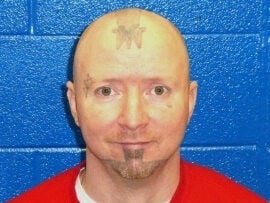
Keith Lowe is serving a life sentence following a 2005 conviction for the murder of Roy Loyd in Kanawha County.
Courtesy photo
Keith Lowe, 51, is serving a life sentence at Mount Olive after being convicted of the first-degree murder of Roy Loyd in 2005. He has been in solitary confinement for more than 12 years.
Lowe has suffered from illnesses such as bipolar disorder, PTSD, anxiety and paranoid schizophrenia, according to court testimony and documents.
In early April, Lowe attempted suicide. Fearful of another attempt, his attorneys sued the West Virginia Division of Corrections and Rehabilitation and Mount Olive Superintendent John Frame. They asked that a court order Mount Olive to transport Lowe to a mental health facility, such as William R. Sharpe Jr. Hospital in Weston, Lewis County.
At a May 16 hearing, Lowe's attorney, Lydia Milnes, told Judge Thomas Johnston of the Southern District of West Virginia, that this treatment violated Lowe's constitutional right to be free from cruel and unusual punishment.
On Friday, Johnston granted Lowe's request to be transported to Sharpe Hospital. A request to have Lowe removed from solitary confinement was set aside for the time being. On Tuesday, Milnes said Lowe was still at Mount Olive, as far as she knew.
Escape attempts
At the May 16 hearing, Johnston heard from Lowe, Frame and psychiatrist Dr. Stuart Grassian.Â
Frame, who did not dispute Lowe’s description of his solitary confinement conditions, testified that Lowe was in solitary because of multiple escape attempts.
In his order, Johnston acknowledged three “significant" escape attempts made by Lowe, in addition to more than 50 disciplinary violations Lowe had accumulated since 2007.
“Plaintiff has been less than a model inmate while at Mount Olive, to say the least,� Johnston wrote.
However, Johnston wrote, Lowe’s last “serious escape attempt� was in 2020 and that the escape attempts were “not very promising ones.�
He wrote that it was "troubling" that while Frame said a gap in disciplinary violations would help Lowe move out of solitary confinement, Lowe was still in solitary confinement despite no write-ups since 2022. Johnston wrote that he was not considering a write-up related to the suicide attempt.
Risk of suicide
Johnston found that Lowe is at a substantial risk of suicide, as he told his mental health providers that he wouldn’t tell them if he were planning to attempt suicide. He also testified that therapists from PsiMed, which provides mental health services at Mount Olive, were no longer helpful to him.
Mount Olive can’t “shirk responsibility for providing adequate medical care by outsourcing such care to PsiMed,� Johnston wrote.
PsiMed was initially sued by Lowe, as well, but was dismissed from the case last week.
Lowe testified that he had asked for mental health care many times. These requests were often denied or rescheduled. Documents showed that this was because of staffing shortages, which Johnston wrote was “understandable.�
“However, if Plaintiff cannot have access to critical mental health services at a time in which he is vulnerable to committing suicide, then that indicates WVDCR is not capable, even if it is willing, of treating Plaintiff for his suicidal risk. Defendants’ efforts are simply inadequate to meet the moment in this particular case,� Johnston wrote.
The threat of a future lethal suicide attempt is real, Johnston wrote, citing testimony from psychologist Grassian and statements from Lowe to PsiMed therapists. PsiMed claims that Lowe's denials of suicidal ideation are credible, but Johnston wrote that those claims seemed "debatable, at best."
At the end of a hearing in the case, Johnston asked the parties to come to a resolution that would not require a ruling from him.
“That time has passed. What is apparent now is the fact that the Defendants — having heard uncontested expert testimony about the dangers of keeping Plaintiff in solitary confinement given his present state of mind — ignored such warnings and persisted in keeping him in his condition of confinement,� Johnston wrote. “Thus, it is apparent to the Court that the Defendants will continue with their inaction unless the Court instructs them otherwise.�
Ruling
Johnston wrote that, while a court shouldn’t ordinarily override the judgement of jail officials, this scenario is an “extraordinary circumstance.� Efforts from officials haven’t adequately addressed the “underlying factors associated with the increased risk of suicide — i.e. unending solitary confinement combined with serious mental illness.�
While Johnston’s order expires in 90 days, he wrote that he could address other relief, such as Lowe’s request to be removed from solitary confinement, if the parties in the lawsuit don’t find a solution.
Johnston closed by writing that Lowe is convicted of a “heinous crime� and that he is a “thorn in the side� of Mount Olive officials.
“Even so, this is the United States of America, and we have a Constitution that sets certain minimum standards for the treatment of inmates, even disagreeable or dangerous ones,� he wrote.
CLICK HERE to follow the ÂÒÂ×ÄÚÉä Gazette-Mail and receive