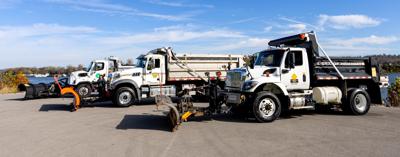
Snowplow teams from Ohio, Kentucky, and West Virginia conduct a winter readiness meeting on Wednesday, Nov. 5, 2025, in Catlettsburg, Ky.
RYAN FISCHER | HD Media
CATLETTSBURG, Ky. — The first flakes of the season have already fallen in some parts of West Virginia, and more snow could be looming in the coming weeks.
Whenever snow arrives in the region, road crews from West Virginia, Ohio and Kentucky say they’re prepared for whatever this winter may bring.
During a joint information session Wednesday between the Ohio Department of Transportation, West Virginia Department of Transportation and the Kentucky Transportation Cabinet, Rusty Marks — a public information specialist with the WVDOT — said the cities in the different states that make up the region often are dealt a similar hand when it comes to weather conditions.
With a large portion of the area’s drivers commuting across the three states on a daily basis, Marks said that means the state road departments have to work together.
According to Marks, the region has been mostly spared from particularly hazardous conditions for prolonged periods, but WVDOT has already begun its preparations for the worst winter roadways, starting with transitioning over 1,000 pieces of its equipment into snowplows, snow blowers and road graders.
As of last month, Marks said, the state Division of Highways has stockpiled over 186,000 tons of salt and nearly 150,000 tons of a salt brine mixture and WVDOT drivers have already began conducting “dry runs� of their various routes across the state to familiarize themselves with terrain and hazards they may encounter once roadways are ice- or snow-covered.
To the northwest, Matt Bruning, ODOT’s press security, said its department is equipped to dispatch roughly 3,000 full-time drivers for snow fighting on over 43,000 miles of interstates, state and federal routes across Ohio.
According to Bruning, crews drove over 9 million miles last winter, using just shy of 800,000 tons of salt and pre-treating roadways with more than 16 million gallons of deicers.
In preparation for the 2025-26 winter season, Bruning said ODOT already has 800,000 tons of salt in storage, about 1,700 plow trucks on deck and thousands of full-time and seasonal drivers ready to roll.
LeAnn Norton with KYTC said the state departments are similar not only in their preparations, but also in their treatment response by listing roadways based by priority and traffic flow.
For example, in West Virginia, Marks said roads are categorized into four different priorities, starting with interstates, expressways, highways and high-traffic county roads before shifting focus to secondary school bus routes before reaching rural routes.
In Ohio, Bruning said the department’s goal is to have primary roadways back open within two hours and secondary routes in operation within four hours of the last snowfall.
Safety tips when driving near snowplow trucks
Although the Tri-State road departments are prepared supply-wise, both Bruning and Marks urge drivers to do their part in ensuring a safe commute for everyone.
The departments advise winter drivers to:
Be patient: Snowplows travel 25-45 mph in order to clear roads effectively. Drivers should leave extra time for their commute during winter conditions.
Follow snowplows at a safe distance. Maintain at least 200 feet — or 10 car lengths — behind a snowplow to avoid flying debris and allow for ample stopping time.
Avoid the “snow cloud.� Never drive into the large cloud of snow created by an active plow as it can reduce visibility to zero, and avoid passing if possible. The surface immediately ahead of a plow is often the worst part of the road.
Turn on headlights to ensure visibility for snowplow drivers, even during daylight.
Turn off cruise control and avoid sudden braking, acceleration or maneuvers during icy conditions.
Never drive between or around multiple plows working in a staggered formation across multiple lanes.
CLICK HERE to follow the ÂÒÂ×ÄÚÉä Gazette-Mail and receive