

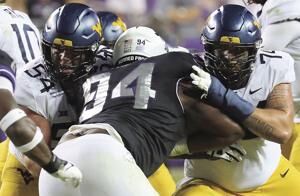
West Virginia’s offensive line performed well in the Mountaineers’ win over Iowa State, and deserves credit for the more consistent play it has shown since the open date week.
“We’re playing the way it should be played. We are much more physical at the point of contact, and we are straining at the point of blocks,� head coach Neal Brown detailed. “We’re consistently doing a better job at the details.�
“I think having five guys across the board that trust each other was a big part of that,� guard James Gmiter said of himself and teammates Brandon Yates, Zach Frazier, Doug Nester and Wyatt Milum, who all played every snap against TCU and Iowa State. “We are holding each other to higher standards, and once all five of us were together for the TCU game, that was a big part of it. We come off the field, start communicating, and we know what has happened on the other side of the ball. Being able to play together has been a huge step for the line.�
Now comes, though, perhaps a tougher challenge. While the Cyclone are statistically the better defense, Oklahoma State might have the best defensive line in the Big 12. The four-man front pressures the quarterback well, and much more heavily, than ISU’s three-man alignment, and quality depth exists throughout. The Pokes have produced 55 tackles for loss and 22 sacks in 2021, and will put much more initial stress on West Virginia’s offensive line than it experienced in the past two games.
WVU has admittedly given its tackles more help in both pass protection and in the run game over the past two weeks, both formationally and with its play-calling. Will it be able to execute the same against OSU’s Tyler Lacy, Brock Martin and company? This figures to be one of the defining matchups of the afternoon.
* * * * * *
Fourth downs are generally short-yardage situations, and as such produce short yardage gains. WVU has bucked that trend somewhat, averaging 7.4 yards per attempt on its 14 fourth down snaps. WVU is 15th nationally in fourth-down conversions, getting a new set of downs on 10 of its attempts.
* * * * * *
The season-ending injuries to West Virginia tight end Mike O’Laughlin and cornerback Nicktroy Fortune cannot be overlooked. While TJ Banks had the best game of his career against Iowa State, the absence of O’Laughlin will make it more difficult to use two tight-end sets, although some workarounds are in place. Charles Finley, who is coming back from an off-season injury, will be Banks’ backup, and perhaps playing partner. Offensive lineman Nick Malone can play in a blocking role, as he has done in some short yardage situations this year. Treylan Davis could also be used, as he has two more games to go before he reaches the four-game redshirt limit.
That last factor is also in play for WVU’s defensive secondary, where Charles Woods has become a starter at corner and Jackie Matthews sees time as the third corner. That leaves holes at safety, where Caleb Coleman, Saint McLeod and Davis Mallinger have all played in three games this season (in addition to special teams duty). This week, McLeod will be in the rotation, but that will be it for him unless his redshirt is to be burned. The same will be true for Coleman and Mallinger in the coming weeks.
From an immediate standpoint, that leaves a tough decision. If one is playing better than the others, does the coaching staff go ahead and play him in more than one more game? It’s a difficult call, with no way to know the right answer, but keeping an eye on that trio is something to track over the final four games of the regular season, and hopefully, a bowl game.
“Getting off the field� is the battle cry on third down for defenses, and few are going it better than the Cowboys. Oklahoma State is allowing a third-down conversion rate of just 27% in 2021, which is third nationally. Match that up against West Virginia’s improving ability to put together long-ish drives (14 of six plays or more over the past two games) and another highlighted conflict area is in the spotlight. Will the Pokes continue to send their opponents to the sideline early, or can the Mountaineers fashion five or six sustained possessions that result in points?
* * * * * *
With the firing of TCU head coach Gary Patterson, State’s Mike Gundy now laps the Big 12 field in terms of tenure. In his 17th season at the head of the Pokes he is 144-68, and has since 2010 has finished worst than third in the league only twice. Iowa State’s Matt Campbell is now second on the tenure list, working in his sixth year as the head of the Cyclone program.
* * * * * *
When Oklahoma State targets a wide receiver in the red zone this year, it meets with top-level success. Cowboy wideouts have caught eight balls in the red zone this year, and every one has resulted in a touchdown.
The Pokes also aren’t afraid to go deep on third down – they have 13 pass completions of 20 or more yards on third down this season, which is tied for second most among in the FBS.
* * * * * *
WVU has reverted to pooch and squib kickoffs in its last two games after early kicks and coverages went awry, and that remains an option to watch for against Oklahoma State. Short of being able to kick the ball into the end zone (WVU has eight touchbacks on 33 deep attempts this year), the Mountaineers have to be efficient in several areas to keep from having to revert to some of the tactical changes it has shown in the TCU and Iowa State games.
“It’s the location,� Brown noted of the first of those. “Evan (Staley’s) location was fine (against Iowa State) but one of the kicks was low, and then we missed a tackle on another one. We’d love for kickoffs to be around the goal line with around 3.5-3.8 seconds of hang time. But the location (which also includes placement on the field) is really important depending on what the coverage is. We have confidence in Evan.�
Brown admitted that it’s often a feel factor as to when to go to Casey Legg and the tactical kicks. After its touchdown return on the opening kick of the game, TCU only had one drive off a kickoff begin outside its own 28-yard line, and that was at the 31. Iowa State did better, with five beginning between its 30- and 40-yard lines.


