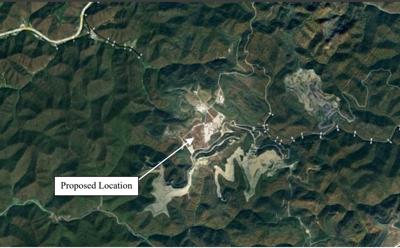
TransGas Development Systems LLC wants to put a data center operation on this tract of land near Holden, in Mingo County. The image is part of a company air quality application approved by the West Virginia Department of Environmental Protection on Oct. 2, 2025.Â
TransGas Development Systems LLC wants to put a data center operation on this tract of land near Holden, in Mingo County. The image is part of a company air quality application approved by the West Virginia Department of Environmental Protection on Oct. 2, 2025.Â
For nearly an hour before they invited questions from community members at their meeting in Mingo County to take input on controversial air quality permit applications for facilities aimed at powering data centers there, West Virginia Department of Environmental Protection officials led residents through a litany of reasons they couldn’t provide the environmental protection the residents were looking for.
“I know it can be tough to follow, but this is just the way that it works,� Joe Kessler, senior engineer for the DEP’s Division of Air Quality, told a dissatisfied crowd at the Larry Joe Harless Community Center in Gilbert at the DEP’s Sept. 18 meeting before breaking down the history of federal air quality regulations dating back to the Clean Air Act of 1970, the state’s compliance with national outdoor air quality standards and how standards are determined at the federal level.
At the meeting, the DEP scheduled under pressure from community and environmental advocates who said a virtual meeting it held last month wasn’t sufficient to address their concerns, agency officials said they couldn’t evaluate anything other than air quality implications in their review of the applications.
That meant no consideration of feared adverse water, light and noise pollution impacts or what the facilities planned by New York City-based TransGas Development Systems LLC could do to nearby property values if its air quality permit applications are approved.
That also meant, agency officials asserted, no consideration of cumulative air quality impacts that factor in other emission sources and health disparities in Mingo County and nearby Logan County, which rank in the 80th to 100th percentiles nationally for asthma, according to an unofficial version of the federal Environmental Justice Screening and Mapping Tool developed by the Biden administration and erased by the Trump administration.
“We're not the scientists,� Kessler said. “We're not the epidemiologists. We're not the toxicologists. We're not creating these standards.�
The DEP had already announced a preliminary determination to issue the permits sought by TransGas for its proposed off-grid generating facilities designed to power planned adjacent data centers.
The proposed facilities are the Adams Fork Harless Data Center Energy Campus to be located off of 22 Mine Road near Holden and Adams Fork Data Energy Center to be located at 2002 Twisted Gun Road in Wharncliffe. The anticipated startup date for the facilities is Jan. 1, 2027.
TransGas’ plans come amid a push from Gov. Patrick Morrisey and other state leaders to keep local governments from providing checks on data center projects, just as data center growth is prompting other states to ramp up oversight of such projects due to their heavy toll on nearby water and energy resources.
“If it’s not illegal, we can’t deny [an application],� Kessler said.
Water quality, quantity concernsÂ
Tonya Mounts, an attorney and Gilbert resident, asked DEP officials about whether data center water withdrawals tied to the TransGas projects would affect water quality or quantity in nearby domestic water wells and whether predevelopment water quality surveys would be offered.
Cooling for the proposed facilities would be provided by mine pool water as needed, according to TransGas’ applications, prompting water supply and pollution concerns among local residents.
“Are there other demands on this supply of water? We need to know how large the mine pool is,� Mounts said. “How is the public to understand water impacts when we have no information about volume of withdrawal?�
DEP Chief Communications Officer Terry Fletcher said the agency has received “no official plan� about water use from TransGas for the facilities and indicated the Division of Water and Waste Management may get involved depending on TransGas’ plans.
Fletcher noted that if more than an acre of ground is to be disturbed by TransGas development, the company would have to get a stormwater construction permit after providing information on stormwater runoff management planned for the project. The company also would need a water pollution control permit for any proposed water discharges, Fletcher noted.
Large data centers can consume 3-5 million gallons of water per day — roughly 5-8% of the total amount withdrawn for public water supply throughout West Virginia in 2023, according to DEP data.
In 2015, the DEP lowered its minimum reporting threshold to 300,000 gallons withdrawn from surface or groundwater sources in any 30-day period. Large-quantity users have been required to submit their annual water use to the DEP through an electronic reporting system.
Morrisey and other proponents have presented data center development as necessary to put the U.S. on the cutting edge of innovation in artificial intelligence and cloud computing.
But residents near TransGas’ planned power facilities have been struggling just to secure clean water.
In April 2024, 17 complaints were filed with the state Public Service Commission against the Mingo County Public Service District, including one by the Town of Gilbert Water Works alleging negligence in addressing water leaks, patching deteriorating service lines instead of replacing them, allowing leaks at a booster station and not accepting responsibility for water problems.
Residents from the Justice area of Mingo County and the Town of Gilbert filed complaints against the Mingo County PSD alleging frequent water outages, low pressure, water leaks, inadequate water system maintenance, muddy water, lack of boil water notices, fire hydrants not working properly and inadequate customer service.
In January 2025, the PSC received another six complaints about water outages in a 12-day span and ordered a general investigation into the PSD’s service and practices in an unresolved case.
In July, the Mingo County PSD told the PSC it had been issuing boil water advisories and that the PSC and state health officials had been notified of the issuances.
Data center worries beyond W.Va.
Data center development is straining water resources elsewhere.
Amid increasing water demand in the Great Lakes region, “tremendous growthâ€� in the data center industry is contributing to increased pressure on regional water resources, with states lacking the legal authority to curb groundwater use before impacts occur, according to a report last month from the Alliance for the Great Lakes, a regional water protection nonprofit.Â
The report found that local governments weren’t “holistically considering� water resources when offering incentives to large water users.
Legislationproposed in Morrisey’s home state of New Jersey would require data center owners or operators to submit water and energy use reports to the state Board of Public Utilities and to notify the board of an substantial change in operations that would require a use report update at least 60 days before implementing the change.
Legislation introduced in Georgia in February would require facilities there with a peak load of 30 megawatts or more to submit annual disclosure reports to providing detailed information about their energy and water usage, as well as community impact.
Community advocates have pushed back against data center development in Northern Virginia, Ohio, Indiana and other states, viewing data centers as threats to environmental and economic sustainability.
In Indiana, the ratepayer advocacy group Citizens Action Coalition last year called for state lawmakers to place a moratorium on new “hyperscaler� large data centers that power artificial intelligence.
“Hyperscaler data centers are the single biggest threat to affordability, reliability, and environmental sustainability in Indiana this decade,� Citizens Action Coalition program director Ben Inskeep said in an October 2024 statement. “We need to press pause on new data centers that pose enormous risks and develop policies that protect Hoosiers instead of throwing away billions in subsidies to Big Tech companies already worth trillions of dollars.�
A Virginia state legislative staff report to Virginia Gov. Glenn Youngkin and the state’s General Assembly in December 2024 found data centers’ increased energy demand there would likely increase system costs for all customers, including non-data center customers.
The report noted that residents near data centers complained about noise they generated and that most of the economic benefits from the state’s world-leading data center industry come from the construction phase rather than ongoing operations.
How HB 2014 cuts local jurisdictionÂ
The West Virginia Legislature drew the ire of local governments and their advocates by approving the Morrisey-requested House Bill 2014Â because it removes local jurisdiction over data center projects.
HB 2014 prohibits counties and municipalities from enforcing or adopting regulations that limit creation, development or operation of any certified microgrid district or high-impact data center project.
HB 2014 also would divert most of the property tax proceeds for any high-impact data center project away from local governments, a move expected to take millions of dollars away from counties and school districts.
The law splits property tax proceeds from such projects as follows:
50% in a fund for reducing personal income tax
30% to the county or counties where a data center is located
10% to all counties on a per capita basis
5% to the Water Development Authority-administered Economic Enhancement Grant Fund
5% to an Electric Grid Stabilization Fund HB 2014 creates to help maintain utility-owned coal and gas electric generation
“House Bill 2014 doesn’t affect our process at all,� Fletcher told the Mingo County crowd.
DEP: 'We don't have any authority' on health impacts
But area residents fear that process isn’t doing enough to protect them from what they predict will be adverse air quality effects from TransGas’ plans.
Per TransGas’ two nearly identical air quality permit applications, each of the two planned facilities would consist of 117 engines able to operate on natural gas or diesel fuel. Each engine would have a maximum output of 21 megawatts, resulting in aggregate power outputs of 2,457 megawatts for each facility. Of those 117 engines per facility, 114 would operate full-time, with three in reserve.
Those figures would make TransGas’ facilities among West Virginia’s most power-intensive industrial sites.
In cases when no gas is available, the engines could be operated in an emergency mode in which the power would come from diesel. In that mode, a single engine could consume 798 gallons an hour with hourly emissions of 10.35 pounds of nitrogen oxides, 1.29 pounds of particulate matter and 17,896 pounds of carbon dioxide.
But the DEP has signaled it will approve categorizing the facilities as “minor sources� after finding all individual pollutant emissions would be below the federal major-source threshold of 250 tons per year of a regulated pollutant. Minor sources are subject to less stringent regulations than major sources.
The DEP drew the ire of Tucker County residents by making the same minor-source categorization for an air quality permit application it approved last month for an expected data center operation proposed for the county by Purcellville, Virginia-based Fundamental Data LLC.
Tyler Cannon, climate alliance coordinator for West Virginia Citizen Action Group, a progressive advocacy organization, asked DEP officials at the Mingo County meeting if the DEP would consider that areas around the TransGas’ planned facilities had a high asthma prevalence and were contending with increased black lung disease incidence.
“[W]e don't have any authority to review and make considerations on those metrics,� Fletcher said.
Route released for heavily opposed transmission line
Another major data center-linked project drew attention Friday when NextEra Energy Transmission LLC announced the proposed route for the 107½-mile, 500-kilovolt MidAtlantic Resiliency Link transmission line planned to cross four West Virginia counties.
The company-preferred route transmission line would cross through Monongalia, Preston, Mineral and Hampshire counties on its way from a Greene County, Pennsylvania substation to a connection point in Frederick County, Virginia.
The project has been anticipated to support electricity demand growth expected from data centers and already has drawn significant opposition in an open case with the West Virginia Public Service Commission. PSC records showed 880 comments in opposition and none in support for the case initiated by NextEra Energy Transmission’s Aug. 28 notice of intent to apply for PSC project certification.
Monongalia County Commission President Jeffrey Arnett submitted a letter dated Sept. 17 to the PSC on behalf of the commission opposing the proposed project, contending the project “seeks to turn Monongalia County into a transmission corridor primarily serving out-of-state interests, particularly data centers in Northern Virginia.�
Planned routes would “irreparably affect family-owned lands, farms, forests, and environmentally sensitive areas,� Arnett predicted, echoing similar opposition from Morgantown City Council and the Preston County Commission.
In May, the Institute for Energy Economics and Financial Analysis, a Valley City, Ohio-based energy market analysis firm, published a study projecting West Virginia electricity customers would have to pay over $440 million for the MidAtlantic Resiliency Link project and another proposed transmission line expected to support data centers.
The data center wave is crashing too close to home via TransGas, which did not respond to a request for comment, for many Mingo County residents.
Residents jeered the absence of TransGas CEO Adam Victor at the meeting. Then they went home in what is poised to become new data center territory against their wishes.
“We don’t know anything [about this project],� longtime Gilbert resident Pam Surber told DEP officials, saying she didn’t want the project to affect her six-year-old granddaughter. "We don’t know what’s it's going to cause down the road when it comes to cancer."
CLICK HERE to follow the ÂÒÂ×ÄÚÉä Gazette-Mail and receive