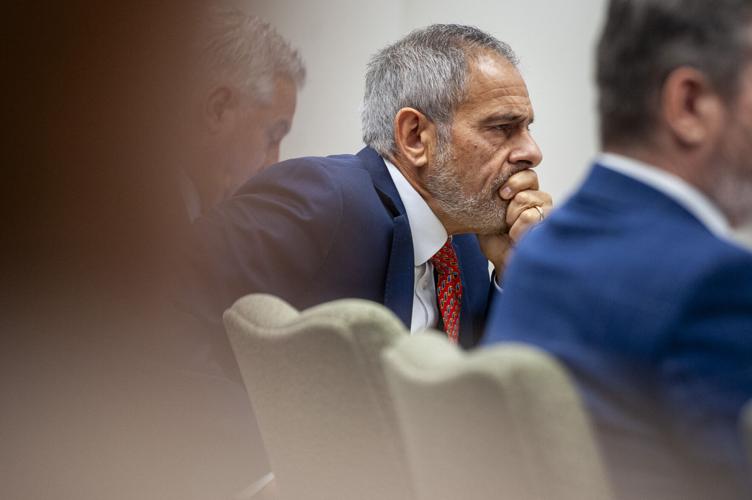
David Yaussy, an attorney representing Fundamental Data, listens during a Wednesday, Nov. 5, 2025, West Virginia Air Quality Board hearing at the state Department of Environmental Protection's ÂÒÂ×ÄÚÉä headquarters. The hearing was in response to community and environmental advocates' appeal of DEP approval of an air quality permit application for an expected data center in Tucker County.
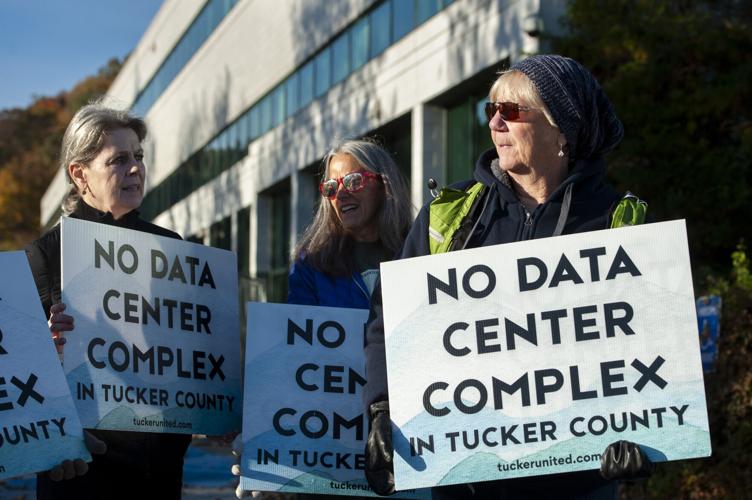
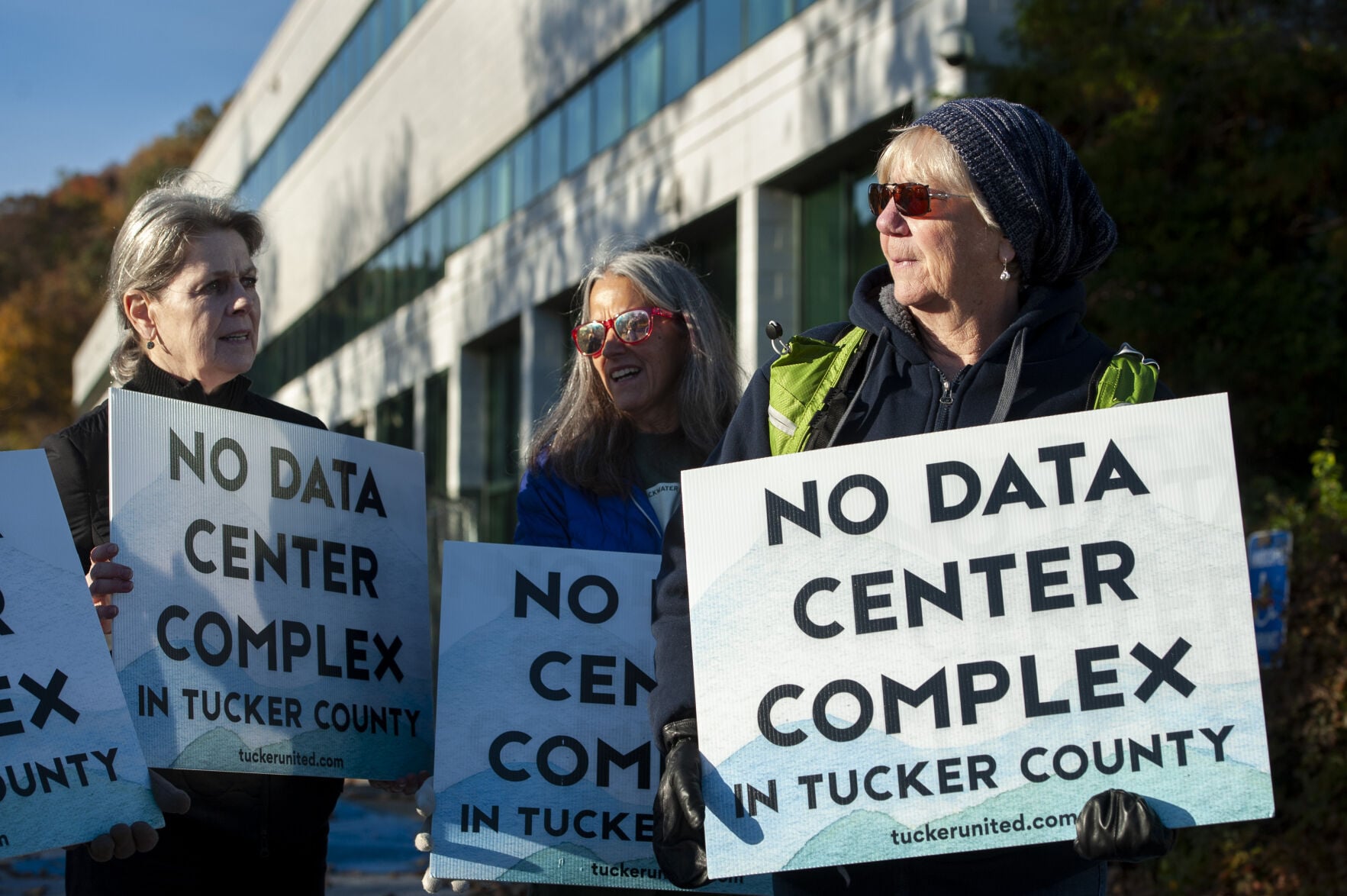
Jill Wilson (from left), Deb Mattingly and Kathy Hackney demonstrate on Nov. 5, 2025, outside a West Virginia Air Quality Board hearing at the state Department of Environmental Protection's ÂÒÂ×ÄÚÉä headquarters. The hearing was in response to community and environmental advocates' appeal of DEP approval of an air quality permit application for an expected data center-linked facility in Tucker County proposed by Fundamental Data LLC.
Peyton Levi listens during a Wednesday, Nov. 5, 2025, West Virginia Air Quality Board hearing at the state Department of Environmental Protection's ÂÒÂ×ÄÚÉä headquarters. The hearing was in response to community and environmental advocates' appeal of DEP approval of an air quality permit application for an expected data center in Tucker County. Levi drove from Barboursville to attend the hearing. “We wanted to see this hearing, learn about the companies who want to put this data center in Tucker County, and the ecological implications of the plant,â€� Levi said.
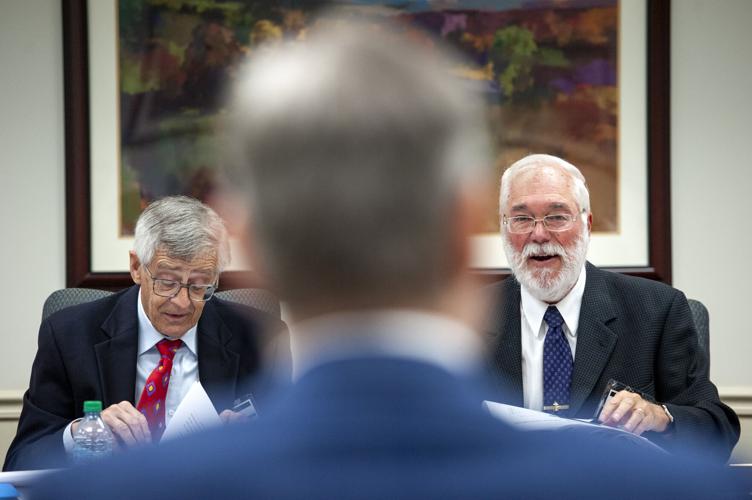
West Virginia Air Quality Board members R. Thomas Hansen (left) and J. Michael Koon ask DEP counsel C. Scott Driver why many headings and tables are redacted from submitted documents at the West Virginia Department of Environmental Protection office in ÂÒÂ×ÄÚÉä on Wednesday, Nov. 5, 2025.
Morgan King felt she had to acknowledge something during a meeting her advocacy organization, West Virginia Citizen Action Group, held Wednesday evening that focused chiefly on anticipated data center growth in West Virginia.
“If you asked me a year ago what I would be working on this year primarily, or what ... Citizen Action Group or communities would be concerned about, I would not have guessed data centers,� said King, the group’s climate and energy program manager, during the group’s virtual Climate Committee meeting.
But a fight against momentum toward buildout of data centers in West Virginia has intensified in recent days, with division growing between residents and community advocacy organizations like West Virginia Citizen Action Group who fear environmental health impacts from planned data centers and West Virginia political leaders wanting to boost the state’s power capacity profile through them.
That power play, led by Gov. Patrick Morrisey, comes despite evidence data centers — warehouses that can store thousands of servers and other digital infrastructure to support large-scale data processing — are poised to further increase electricity bills already rising at an uncommonly sharp rate in West Virginia.
“Nowhere in the mission or charter of the [West Virginia Department of Environmental Protection] does it state that you will ... enforce the agenda of the sitting governor,� Candice Grigsby of Point Pleasant said at an Oct. 7 meeting the West Virginia Department of Environmental Protection held at the Mason County Courthouse on a still-pending air quality permit application proposal for a planned organic material-fueled industrial facility in Mason County linked to plans for nearby data center operations.
MGS CNP 1 LLC, an affiliate of Houston-based Fidelis New Energy LLC, has filed an air quality permit application for construction of a biomass-fired boiler near Point Pleasant to generate electricity not for sale, near fellow Fidelis affiliate MGS H2 1 LLC’s proposed hydrogen production facility.
In 2023, the West Virginia Economic Development Authority approved a forgivable $62.5 million loan with a three-year term for Fidelis subsidiary Mountaineer GigaSystem LLC, which was formed to develop a hydrogen production facility in the Point Pleasant area.
Then-Gov. Jim Justice's office said Fidelis planned for data centers to be powered by net-zero carbon hydrogen as part of its Mason County hydrogen production plan, with data center capacity potentially reaching 1,000 megawatts when fully built out.
Grigsby, who lives within a mile where the industrial buildout is expected, is one of many West Virginians who fear a loss of control of their communities following the Legislature’s April passage of the Morrisey-requested House Bill 2014, which the governor framed as the economic development centerpiece of the Legislature’s 2025 regular legislative session.
HB 2014 is designed to ease in-state data center development in part by prohibiting counties and municipalities from enforcing or adopting regulations that limit creation, development or operation of any certified microgrid district or high-impact data center project.
It would divert most of the property tax revenue they generate away from local taxing bodies, a move estimated to cost counties and school districts millions.
“It says the county has no say-so in any of this,� Grigbsy said in a phone interview, “which means that the people of the county that live in the county have no say-so.�
HB 2014 has proven deeply unpopular among Tucker County residents who have opposed an expected data center operation there whose permittee not only has been quiet about its plans for the gas turbine-powered facility but omitted site air emissions-related information from a DEP-approved air quality permit application.
The permittee, Purcellville, Virginia-based Fundamental Data, has claimed the materials it redacted from its application comprise confidential business information — a claim flagged by the DEP as potentially problematic in April before the agency backed down and approved the application in August.
The facility, planned for a location off U.S. 48 near the city of Thomas, would have three diesel storage tanks holding 10 million gallons each. The application indicates there would be haul road activities and equipment leaks, fueling area resident concerns.
The DEP has claimed it has narrow discretion in its consideration of air quality permits and can’t consider residents’ worries about potential water, light and noise pollution impacts from planned data centers.
The agency defended its categorization of the proposed facility as a “minor source,� a designation for sources that emit below a certain threshold, drawing less stringent state oversight.
Jill Wilson (from left), Deb Mattingly and Kathy Hackney demonstrate on Nov. 5, 2025, outside a West Virginia Air Quality Board hearing at the state Department of Environmental Protection's ÂÒÂ×ÄÚÉä headquarters. The hearing was in response to community and environmental advocates' appeal of DEP approval of an air quality permit application for an expected data center-linked facility in Tucker County proposed by Fundamental Data LLC.
LAURA BILSON | Gazette-Mail file photo
Wednesday brought what community and environmental groups welcomed as a step forward in their appeal to the state Air Quality Board of the DEP’s Fundamental Data permit approval – the board’s direction at an evidentiary hearing for the company and groups to attempt to come up with a protective order that would let redacted information be used for hearing purposes.
Mike Becher, attorney for the permit approval challengers — Tucker United, a coalition of Tucker County residents and allies that has opposed the project, the West Virginia Highlands Conservancy and the Sierra Club — argued at the hearing at DEP headquarters that the information would allow those groups to be “on an equal footing� as “a basic element of fairness.�
“Today’s hearing and rally show a united front of concerned West Virginians who are willing to fight any developments of power plants and data centers that will harm our people and communities,� Nikki Forrester, spokesperson for Tucker United, said in a statement Wednesday.
Data centers driving higher W.Va. power cost projections
West Virginia Air Quality Board members R. Thomas Hansen (left) and J. Michael Koon ask DEP counsel C. Scott Driver why many headings and tables are redacted from submitted documents at the West Virginia Department of Environmental Protection office in ÂÒÂ×ÄÚÉä on Wednesday, Nov. 5, 2025.
LAURA BILSON | Gazette-Mail
Data center concerns throughout West Virginia have centered on affordability in addition to air quality.
Electricity demand from proposed data centers is a key driver of recent electricity bill spikes for residents living in PJM states like West Virginia, according to the independent market monitor for PJM Interconnection LLC, the regional grid operator for 12 states and the District of Columbia.
Citing PJM forecasts, the Natural Resources Defense Council, a global environmental advocacy group, estimated in September that PJM consumers will pay $163 billion through 2033 as new data centers exceed available power supplies. By 2028, an average family in the region will be paying around $70 a month extra on their electricity bills because of forecasted data center growth, the NRDC projected.
In May, the Institute for Energy Economics and Financial Analysis, a Valley City, Ohio-based energy market analysis firm, published a study projecting West Virginia electricity customers would have to pay over $440 million for two proposed transmission lines expected to support data centers.Â
Consumers for a Better Grid, a project of Chicago-based utility customer watchdog Citizens Utility Board, has called for requiring data centers to cover their own costs and bring their own capacity, use energy efficiency and demand flexibility, and improve demand forecasting to prevent overpaying.
HB 2014 doesn’t include energy efficiency, demand flexibility or demand forecasting requirements. Although HB 2014 prohibits utility customers from bearing costs stemming from electric service to a microgrid district, Appalachian Power regulatory and finance vice president John Scalzo testified to state lawmakers during the legislative session the legislation wouldn’t ensure against increased rates as intended.
Clara Summers, campaign manager for Consumers for a Better Grid at the Citizens Utility Board of Illinois, warns that if data centers are allowed to contract with existing generation to serve their specific demands, there will be less available capacity for other consumers, and prices will climb further.
“Unless something is done, everyday people will be left holding the check for some of the wealthiest companies in the world, and that's unacceptable,� Summers said in a statement.
Morrisey eyes 'technological supremacy' in data center push
Morrisey, though, has taken a data center developer-friendly approach before and since HB 2014’s passage.
At a Tuesday news conference in ÂÒÂ×ÄÚÉä, Morrisey claimed his administration was “very much on top of all the PJM issuesâ€� and touted his goal of more than tripling West Virginia’s power generation capacity by 2050, claiming doing so will protect consumers.
Morrisey has said West Virginia would work with the federal government to pursue new coal-fired generation, which is a rarity in West Virginia and the U.S. this millennium as market forces have made renewable energy, whose technology has proven simpler, cheaper and easier to install.
But West Virginia’s investor-owned electric utilities doubled down on fossil fuel use in long-term power resource plans they filed with the state Public Service Commission as required on Oct. 1, indicating reliance on coal-fired electricity is the optimal scenario through the lifespans of their coal-fired plants in West Virginia, which depends on coal-fired power more than any other state and has experienced among the most sharply rising electricity prices in the U.S. this century amid coal’s decline elsewhere.
FirstEnergy on Thursday highlighted its plan to build a 1,200-megawatt combined-cycle natural gas plant at an undetermined site in West Virginia at an event at the Harrison Power Station in Harrison County attended by Morrisey and other elected officials, business representatives and employees.
Morrisey and FirstEnergy board chair, president and CEO Brian Tierney cited data center growth as an argument for building the gas plant, with Morrisey declaring a “major contest with China for technological supremacy to fuel� data centers and artificial intelligence.
FirstEnergy’s plan to embrace gas-fired power in West Virginia comes at a time of rising gas plant costs.
A report published in September by GridLab, a Berkeley, California-based clean energy policy firm, found that gas-fired power plant construction costs are being driven by price increases for nearly all key components of projects, including turbines. The report found that elevated costs are likely to persist instead of decline.Â
Sean O’Leary, senior researcher at the Ohio River Valley Institute, a pro-renewable energy think tank, says elevated costs from building gas plants are likely to find their way into monthly electric bills.
“Morrisey’s [plan] to expand power generation in West Virginia is ill-conceived, economically counterproductive, and unlikely to be realized,� O’Leary said.
Attorney cites turbine competition in redaction defense
David Yaussy, an attorney representing Fundamental Data, listens during a Wednesday, Nov. 5, 2025, West Virginia Air Quality Board hearing at the state Department of Environmental Protection's ÂÒÂ×ÄÚÉä headquarters. The hearing was in response to community and environmental advocates' appeal of DEP approval of an air quality permit application for an expected data center in Tucker County.
LAURA BILSON | Gazette-Mail
David Yaussy, counsel for Fundamental Data, cited difficulty in securing turbines in his defense of the company’s position that it shouldn’t have to disclose the information sought by community and environmental groups.
“[W]e have a real concern about handing out the redacted data, because it's extremely competitive in the industry getting these turbines,â€� said Yaussy, an attorney at Spilman Thomas & Battle PLLC in ÂÒÂ×ÄÚÉä.
“The [DEP] and Fundamental Data say their priority is to protect trade secrets, but the result is that basic information is hidden from the public,� Amy Margolies, a witness for Tucker United who lives in Canaan Valley, said in a statement.
Fundamental Data representative Casey Chapman did not respond to a request for comment. DEP Chief Communications Officer Terry Fletcher declined to comment.
W.Va. senator dismisses environmental fears at DEP meeting
Facility-wide emissions in tons per year at MGS CNP 1's proposed Mason County biomass site would include:
90.9 tons of nitrogen oxides, which can harm the human respiratory system and contribute to acid rain
75.7 tons of fine particulate matter, or soot, which can pierce the lungs and lead to asthma attacks, heart attacks and premature death
46.5 tons of carbon monoxide
The turn off to MGS CNP 1’s proposed biomass-fired facility would be approximately 3 miles north of Point Pleasant High School, according to a DEP engineering evaluation.
State Sen. Eric Tarr, R-Putnam, whose district includes Mason County, spoke in favor of MGS CNP’s planned biomass facility at the DEP’s Oct. 7 meeting, asserting it as a chance to realize economic potential at the site and concluding Mason County has “some of the best industrial property in West Virginia.�
At the meeting, Tarr dismissed community air quality and other environmental health concerns residents expressed before and after he spoke.
“[E]very time you hear any kind of industry [is coming], you can break all that down and the fearmongering goes wild,â€� Tarr said. “It does it in committee [meetings] up in ÂÒÂ×ÄÚÉä. It does it when you have the Sierra Club groups come in, any kind of community [that] tries to stop businesses from opening in West Virginia.â€�
Grigsby didn’t hide her fear.
“It is on your shoulders to ensure that the emissions from this plant is not going to cause our children [to have] cancer,� Grigsby told DEP officials at the meeting.
Peyton Levi listens during a Wednesday, Nov. 5, 2025, West Virginia Air Quality Board hearing at the state Department of Environmental Protection's ÂÒÂ×ÄÚÉä headquarters. The hearing was in response to community and environmental advocates' appeal of DEP approval of an air quality permit application for an expected data center in Tucker County. Levi drove from Barboursville to attend the hearing. “We wanted to see this hearing, learn about the companies who want to put this data center in Tucker County, and the ecological implications of the plant,â€� Levi said.
LAURA BILSON | Gazette-Mail
But the DEP’s Division of Air Quality had already determined through a preliminary evaluation MGS CNP’s proposed facility would meet all state and federal air quality requirements, a sign the agency will approve the permit application.
The DEP has claimed it has narrow discretion in its consideration of air quality permits and can’t consider residents’ worries about potential water, light and noise pollution impacts from planned data centers. The DEP last month set aside Mingo County resident objections in that vein in approving air quality permits for two facilities designed to power data centers there.
Data center opponents will have to dig in deeper in their fight against what they view as a welcome mat being laid across their communities by state leaders.
Another Air Quality Board hearing to focus on the appeal is scheduled for Dec. 3 at a location to be determined.
“We are not going anywhere,� Forrester said. “Our allies are growing across the state as we join forces to fight against selling our futures to big data.�
CLICK HERE to follow the ÂÒÂ×ÄÚÉä Gazette-Mail and receive